Expressing a Fairy Tale Inner World with Perspective and Motion [Lee Hyunhee's 'Art Talk']
- Input
- 2025-08-04 19:15:35
- Updated
- 2025-08-04 19:15:35
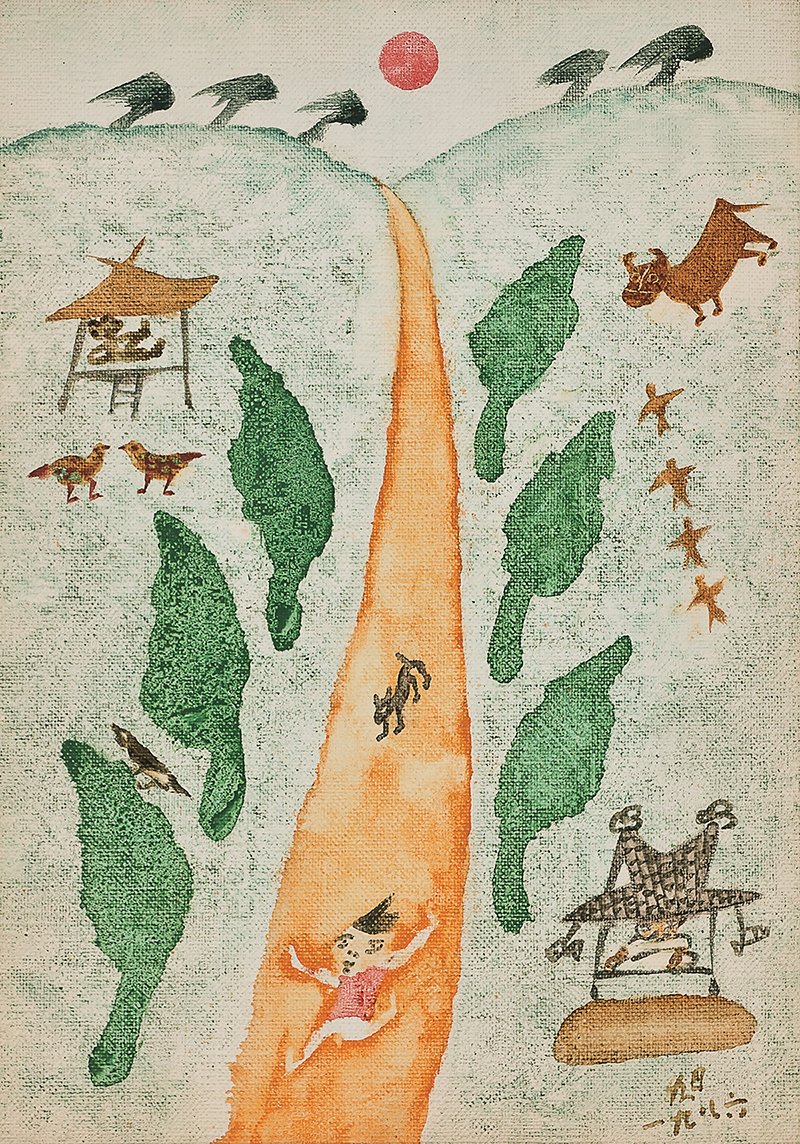
"An artist must have their own language while not forgetting it is also the common language of contemporaries," said Jang Wookjin, who limited the size of his works to maintain the power to dominate the canvas as an artist.
He drew images that were affectionate and everyday, understandable by anyone. His style, showing omission and compression, transcendence of time and space, is sometimes mistaken as childish, but he adhered to the philosophy that one must empty the mind to see things purely, expressing a fairy tale-like and ideal inner world.
A significant number of his works were drawn during the last 15 years of his life. 'Gil', painted in 1986, is also from that period. The village landscape with a road is a composition the artist frequently used, but the road usually played a subsidiary role. However, in this work, the road takes the center of the canvas, incorporating various elements like the sun, trees, cows, and figures, providing relief to what could be a complex scene. In the foreground, the road gradually widens, drawing attention to the child playing at the bottom, achieving perspective, motion, and optical illusion simultaneously, even in a flat work.
Jang Wookjin had a small pavilion called 'Gwaneodang' (Hall of Fish Viewing), about the size of one pyeong. The name was given by Korean literature scholar Lee Heeseung, meaning to feel with all senses, not just see with the eyes when watching fish. It is said that sitting in this pavilion, built with four pillars and a thatched roof on the slope behind the main house of Jang Wookjin's home in Yongin, offered a beautiful view of the harmony between the hanok roof and the greenery of the front hill. The untroubled and ideal appearance of the work seems to tell the story of the view seen from the pavilion.
Lee Hyunhee, Seoul Auction Archive Team Leader