"I will pay directly to the driver".. New consumption behavior triggered by consumption coupons
- Input
- 2025-08-04 17:18:28
- Updated
- 2025-08-04 17:18:28
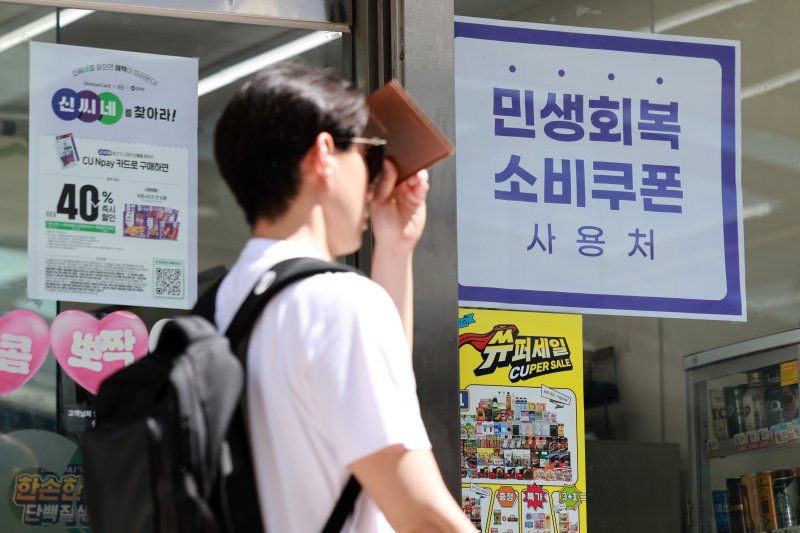
[Financial News] #. A housewife in her 40s, Ms. A, recently visited a local grocery market to use consumption coupons received as livelihood recovery support funds, but was embarrassed by the staff's statement that they could only be used as local currency. As it was difficult to use not only in large supermarkets but also in local markets and cumbersome to check the places of use one by one, Ms. A is using the consumption coupons by buying daily necessities and food at a nearby convenience store. Ms. A said, "It was difficult to use them in supermarkets, so I bought bean sprouts, tofu, instant rice on sale, and even pork at the convenience store," adding, "I used to think convenience stores were expensive, but there are many promotional products like 2+1, so the price difference with supermarkets is not that big."
The government's livelihood recovery support fund payment to stimulate consumption has been two weeks, and a 'new consumption behavior' surrounding the use of consumption coupons is emerging. As delivery apps are excluded from the places where consumption coupons can be used, 'face-to-face payment' before COVID-19 is being revived, and convenience stores with franchise systems are rapidly emerging as a shopping channel for fresh food.
Will convenience stores solidify as a 'shopping' channel?
According to the industry on the 4th, convenience stores have emerged as the most convenient place to use consumption coupons among large distribution channels, and the sales increase effect continued in the second week of coupon issuance. The overwhelmingly high franchise rate of stores where consumption coupons can be used is the biggest reason. While Daiso and Olive Young have franchise rates of 30% and 16%, respectively, convenience stores have a 99% franchise rate.
In particular, for the convenience store industry, which was seeking changes as a 'nearby shopping channel' by diversifying fresh food, the consumption coupon usage period is expected to be an important turning point. The convenience store industry is strengthening fresh food categories such as vegetables, fruits, and meat by promoting 'quick commerce' that delivers immediately upon order, enhancing competitiveness with not only supermarkets but also e-commerce.
In fact, after the issuance of consumption coupons, the growth rate of the fresh food category in convenience stores has accelerated. The fresh food sales of the three major convenience stores, CU, GS25, and 7-Eleven, in July grew by more than double digits compared to the same period last year. By category, sales of fruits increased by 25%, vegetables by 32.5%, and meat by 69.1%. Especially, after the start of consumption coupon use on July 22, the sales growth rate increased further, with fruits by 39%, vegetables by 60.3%, and meat by 79.8%, all exceeding the overall growth rate for July.
As demand increased, fresh food orders also increased. A GS25 representative explained, "The order volume for eggs has noticeably increased, and orders for domestic and foreign fruits such as bananas, kiwis, apples, and peaches are also on the rise."
An industry representative said, "With the consumption coupons as an opportunity, convenience stores are seeing the potential to attract more new demand for fresh food beyond existing processed foods."
Delivery also returns to face-to-face payment
The restaurant industry is also experiencing fluctuations due to the effect of consumption coupons. Among delivery apps, the public delivery app 'Ttaenggyeoyo' operated by Shinhan Bank saw a surge in customers through collaboration with the chicken industry. Ttaenggyeoyo supports local currency payments, making it the only delivery app where consumption coupons can be used within the app. According to Mobile Index, the weekly number of users of Ttaenggyeoyo was 1.47 million in the fourth week of July (21st-27th), when the use of consumption coupons became full-fledged, a 45.5% increase compared to 1.01 million the previous week.
In particular, as consumption coupons cannot be used for delivery app payments, face-to-face payment before COVID-19 is becoming popular again. A bhc representative said, "Based on the weekend of July 26-27, when consumption coupons were used, 'meet and pay' sales increased by 260% compared to the previous month."
Private delivery apps such as Baedal Minjok and Yogiyo also allow the use of consumption coupons if 'meet and pay' is used. When consumers apply for 'meet and pay' through the app, they pay with a card payment terminal or consumption coupons at the franchise or rider.
A delivery app representative said, "In the last week of July, when the use of consumption coupons began, the proportion of 'meet and pay' increased more than three times compared to the previous week."
wonder@fnnews.com Jeong Sang-hee, Lee Hwan-joo Reporter