Foreseen Tragedy, Repeated Victims... 'Effective Measures Against Relationship Crimes Needed'
- Input
- 2025-08-05 15:20:12
- Updated
- 2025-08-05 15:20:12
Uijeongbu, Daejeon, Guro and other areas nationwide see a series of relationship crimes
Last year, 181 women were killed due to relationship crimes
Victims continue to occur but substantial protective measures are lacking
"Comprehensive measures needed to prevent repeated killings of women"
Last year, 181 women were killed due to relationship crimes
Victims continue to occur but substantial protective measures are lacking
"Comprehensive measures needed to prevent repeated killings of women"
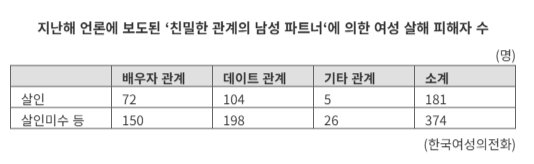
[Financial News] Recently, 'relationship crimes' such as stalking and dating murders occurring in intimate relationships have been on the rise nationwide. Every year, at least hundreds of female victims occur, but there is not even proper statistics. Women's groups are urging the government to come up with effective measures, calling the repeated killings of women a clear failure of the state and system.
According to the Korea Women's Hotline on the 5th, last year, at least 181 women were killed by men in intimate relationships such as husbands or boyfriends, and 374 women survived attempted murder, totaling 555 female victims of relationship crimes in one year. However, these figures are based on media reports compiled by the Korea Women's Hotline due to the absence of official statistics, and the actual number of victims is expected to be much higher when including unreported cases.
Relationship crimes refer to crimes that repeatedly occur in a state where a certain relationship is formed between the perpetrator and the victim. Stalking between lovers, dating violence, and domestic violence are typical examples. As they occur in close relationships, the risk of recidivism is high, and there is a high possibility of leading to serious crimes. Particularly, if the victim does not disclose the fact of the damage to the outside, the crime can persist for a long time, which is a characteristic of high risk.
According to the '2024 Major Police Activities for the Protection of Socially Vulnerable' report published by the National Police Agency last month, among the 333 female victims of murder and attempted murder cases last year, 108 (32.4%) had a history of female violence such as domestic violence, dating violence, or stalking. This shows that a considerable number of women had already experienced violence before being killed by someone in an intimate relationship.
Recent incidents nationwide prove this. On the 26th of last month, a woman in her 50s working at a senior protection center in Uijeongbu City was stabbed to death. It was found that the victim had reported the perpetrator for stalking to the police three times. Then on the 29th in Daejeon, a woman in her 30s was killed by her ex-boyfriend, and on the 31st, a woman in her 50s living with a man was stabbed to death in Guro-gu, Garibong-dong, Seoul. All of them had a history of reporting the suspect to the police before the crime.
Despite such repeated warning signals, institutional measures to substantially protect victims are insufficient. When a stalking report is received, the police can issue an emergency measure (prohibition of access within 100 meters of residence and use of telecommunications) ex officio, and apply to the court for provisional measures 1-4 (written warning, prohibition of access within 100 meters, use of telecommunications, detention, etc.). However, there has been constant criticism that these measures are ineffective. It takes a long time for the court to decide, and the measures themselves are only temporary responses rather than criminal punishments.
Heo Min-sook, a legislative investigator at the National Assembly Research Service (Ph.D. in Women's Studies), pointed out, "The current provisional measures require going through both the police and prosecution stages, but there are no clear criteria for 'continuity' and 'repetition', and decisions are made based on the arbitrary judgment of investigative agencies, so their effectiveness is low." She added, "The bigger problem is that even if provisional measures are issued, the actual implementation depends entirely on the 'goodwill' of the perpetrator, and if the perpetrator does not comply, there is no way to enforce it."
Accordingly, women's groups emphasize the need for comprehensive government-level measures to prevent repeated killings of women. Women's organizations such as the Korea Women's Hotline and the Korea Women's Workers Association stated, "Investigative agencies do not take protective measures or punish perpetrators because 'the victim did not want it', and are too lukewarm in measures to separate the victim and perpetrator," adding, "The paradigm of current victim protection measures, which shifts responsibility to the victim and is not properly monitored, must be changed."
The police also plan to strengthen their response to relationship crimes. Park Sung-joo, head of the National Investigation Headquarters of the National Police Agency, said at a regular press conference the previous day, "We will take the failure to protect precious lives during the prohibition period as a painful reflection and focus police capabilities on high-risk relationship crimes," adding, "Regardless of the victim's intention to punish, if the risk of recidivism is high, we will implement stricter criteria for separating the victim and actively apply for arrest warrants."
[email protected] Jang Yu-ha Reporter