106 Members of Parliament from Both Parties Propose 'K-Steel Act'... 50% Tariff Bomb 'Steel Support'
- Input
- 2025-08-04 14:02:44
- Updated
- 2025-08-04 14:02:44
Although the Korea-US tariff negotiations have been concluded, steel tariffs remain at 50%
106 members of the Democratic Party and the People Power Party propose the 'K-Steel Act' for steel support
In a confrontational situation, both parties unusually speak with one voice "Steel industry crisis"
106 members of the Democratic Party and the People Power Party propose the 'K-Steel Act' for steel support
In a confrontational situation, both parties unusually speak with one voice "Steel industry crisis"
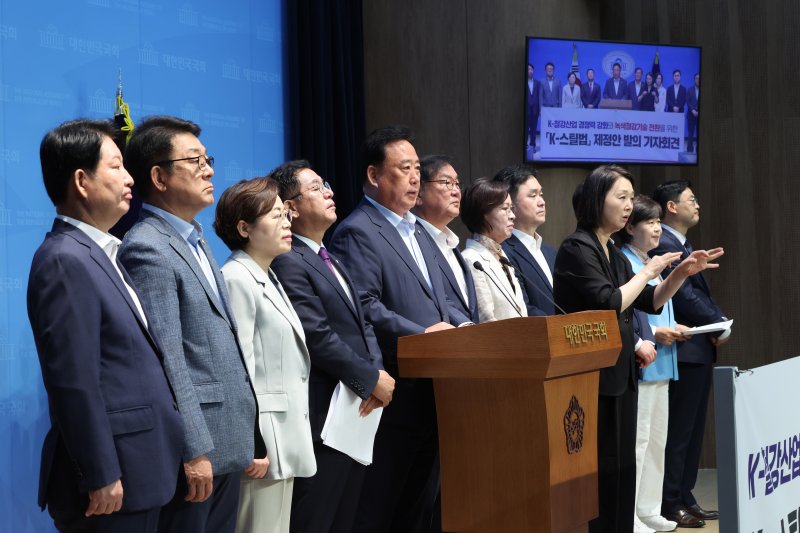
[Financial News] On the 4th, 106 members of the National Assembly from both parties proposed the 'K-Steel Act' (Special Act for Strengthening Steel Industry Competitiveness and Transitioning to Green Steel Technology) to support the steel industry hit directly by the tariff bomb from the United States. Although the Korea-US tariff negotiations were dramatically concluded, the 50% high tariff on the steel sector remains, increasing the difficulties of domestic companies, prompting the National Assembly to step in with legislative support. The unusual consensus reached by the ruling and opposition parties, who have been experiencing extreme conflicts over contentious bills, is due to the shared understanding that the situation in the steel industry is serious. As they have transcended political factions to jointly propose the bill, both parties aim to pass the bill quickly.
Eo Gi-gu of the Democratic Party and Lee Sang-hwi of the People Power Party, who are leading the National Assembly Steel Forum, held a press conference at the National Assembly Communication Hall on this day to announce the plan to promote such a bill. Eo stated, "The United States imposed a 25% tariff on steel products imported from around the world, and in June, doubled it to 50%, dropping a tariff bomb. This measure was maintained even in the tariff negotiations concluded on July 31," adding, "As a result, major companies like POSCO and Hyundai Steel, as well as small and medium-sized steel processing companies, are facing export hits and management uncertainties."
He continued, "With the implementation of the European Union's (EU) Carbon Border Adjustment Mechanism (CBAM), the flood of cheap imports from China, and the enormous investment pressure due to carbon neutrality implementation, our steel industry is experiencing an all-out crisis," emphasizing, "With this awareness of the problem, the National Assembly Steel Forum has been actively communicating with the government, industry, and academia to reflect the opinions from the field and has been closely cooperating with related institutions to prepare the steel industry support bill." In response to reporters' questions about the timing of the bill's processing, Eo mentioned the participation of 106 members of the ruling and opposition parties, stating, "The steel industry is quite in crisis," and "We aim to pass it as soon as possible."
The proposed K-Steel Act establishes a 'Special Committee for Strengthening Steel Industry Competitiveness' chaired by the President, with the main point being the establishment of a basic plan every five years and an annual implementation plan. Additionally, it designates decarbonization steel technologies like hydrogen reduction steelmaking as 'green steel technology' and specifies subsidies, loans, tax reductions, and production cost support for technology development and investment.
Furthermore, it allows for the creation of green steel special zones to simplify licensing procedures, exempt preliminary feasibility studies, provide tax support, and support infrastructure installation, along with regulatory-related special cases and financial support. It also strengthens the rules of origin and restricts the import and distribution of non-compliant steel materials, granting the government direct authority to respond to unfair trade practices. A systematic nurturing plan for related industries is also prepared to secure competitiveness in eco-friendly steel raw materials.
Moreover, if voluntary industrial restructuring by steel companies and supply-demand adjustment of steel are not possible, the government is to actively induce business restructuring and supply-demand adjustment through tax and financial support, and secure new demand through support.
This bill was proposed as the voices of concern grew with the Korea-US tariff negotiations concluded, but the 50% tariff in the steel sector remained unchanged, prompting the National Assembly to step in with legislative support. In the Korea-US tariff negotiations concluded on July 31 (local time), the 50% tariff rates on steel, copper, and aluminum remained unchanged. The steel industry, which was subject to a 50% high tariff, is bewildered as the tariffs are confirmed unchanged. The steel industry is anxious, saying that if the duty-free quota for exports to the US is abolished, tariffs will soar from 0% to 50%, effectively blocking the export route to the US.
cjk@fnnews.com Jong-geun Choi, Ji-won Song Reporter