[fn Editorial] Without cooperation, the giant ruling party's hardline leader cannot ensure the success of the Lee government
- Input
- 2025-08-03 19:11:30
- Updated
- 2025-08-03 19:11:30
Extreme confrontation between ruling and opposition parties over legislative push in August and September
Need to restore democracy beyond political disgust
Need to restore democracy beyond political disgust
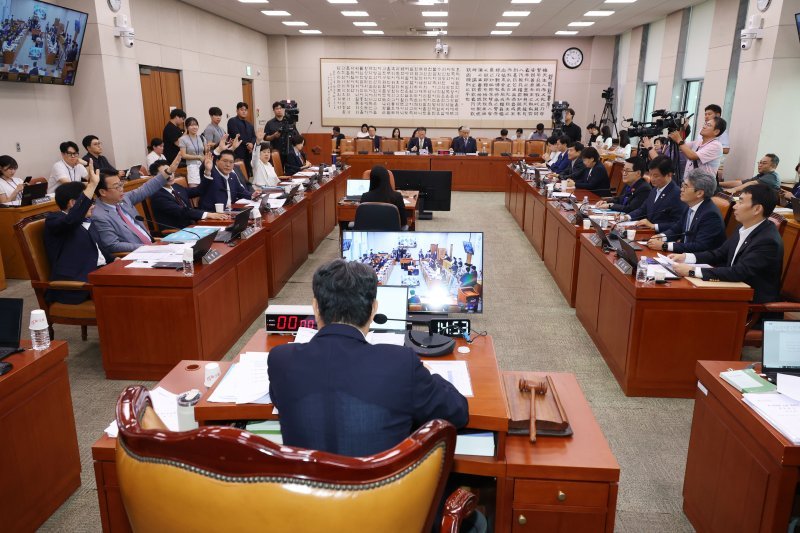
The second half of the National Assembly is expected to show the ultimate extreme confrontation. In the August extraordinary session, a heated battle is anticipated due to the confrontation between the ruling and opposition parties over the Broadcasting Act, Yellow Envelope Act, and Commercial Act amendment. The People Power Party is poised to block the legislative push through a filibuster. However, the Democratic Party of Korea plans to handle them one by one with the so-called 'salami' strategy. This is expected to lead to a repeated war of attrition with filibusters and forced votes on bill proposals. More intense clashes are foreseen in the September regular session. The Democratic Party has declared its intention to process the four prosecutorial reform bills and has even mentioned a demand for the dissolution of the unconstitutional party against the People Power Party.
The bigger problem is that it is unlikely that this political conflict structure will be resolved in the short term. When the Lee Jae-myung government was inaugurated, it advocated pragmatism and cooperation, raising public expectations. However, after the new government was launched, the ruling party's unilateral dominance has continued. The Democratic Party, which became the ruling party with an overwhelming majority of 180 seats, is pushing for excessive legislation. In the case of the Commercial Act amendment and the Yellow Envelope Act, there are serious concerns in the business community, but the ruling party, which holds the legislative initiative, shows no willingness to compromise. It is questionable whether healthy democracy is functioning properly in the face of the ruling party's behavior of pushing forward without even minimal concessions.
Moreover, with the new leader of the Democratic Party expressing strong messages, rough clashes with the opposition are anticipated. The new leader, Jeong Cheong-rae, in his acceptance speech, defined the People Power Party as a 'rebellious force' and declared, "I will not talk until they apologize for the rebellion." He also announced the completion of prosecutorial, media, and judicial reforms before the Chuseok holiday and hinted at the possibility of dissolving the unconstitutional party against the People Power Party.
Amid the political dominance of the giant ruling party, the emergence of a hardline leadership in the opposition party seems imminent. The People Power Party is undergoing the process of electing a new leader to resolve internal disputes and break through the ruling party's all-out political pressure. As the ruling party's pressure intensifies, there is a high demand for a hardline leadership within the party. If both parties are reorganized into hardline leadership structures, there will be no room for compromise and negotiation. Overall, not only the National Assembly schedule but also the leadership structure of both parties show signs of leading to a parliamentary breakdown.
The public's political disgust is already at a dangerous level. Pushing legislation with numerical superiority undermines the spirit of democracy, which is based on tolerance and compromise. Moreover, the confrontation between the ruling and opposition parties is likely to fall into political engineering without the people. If the power struggle, detached from the lives of the people, becomes entrenched, political apathy will become severe.
Our country is now facing a huge domestic and international crisis. At a time when we need to come together for tariff negotiations with the United States, domestic politics are on the verge of disintegration. At a time when the ruling and opposition parties need to unite to overcome the economic crisis and strengthen external negotiation power, the political circle is heading towards internal conflict. The new leader of the giant ruling party must first demonstrate a genuine attitude of cooperation to support the success of the Lee Jae-myung government.