Signal for Full-scale Investment in the US... 'Non-tariff Pressure' Remains a Spark
- Input
- 2025-08-03 14:29:06
- Updated
- 2025-08-03 14:29:06
[Financial News] After agreeing to create a US investment fund through Korea-US tariff negotiations, Korea Trade Insurance Corporation decided to provide financial guarantees for projects in the US, marking the start of full-scale investment movements. However, since this agreement is merely a 'broad framework agreement' centered on tariffs and investments, concerns are growing that the spark surrounding non-tariff barriers such as digital regulations and agricultural market openings still remains.
On the 3rd, Korea Trade Insurance Corporation announced that it would provide a guarantee of 1 billion dollars for the new cathode material plant construction project by LG Chem in Tennessee, USA. This plant is the first cathode material production facility built in the US by a domestic company, with an annual capacity of 60,000 tons, capable of producing battery materials for about 600,000 electric vehicles, making it the largest in the US.
With the financial guarantee from Korea Trade Insurance Corporation, LG Chem will be able to secure long-term funds at low interest rates through global banks.
Jang Young-jin, President of Korea Trade Insurance Corporation, said, "It is meaningful to support the largest cathode material plant in the US" and "As the entry of our companies with excellent technology into the US is expected to expand after the tariff negotiations, we will ensure there are no setbacks in providing financial guarantee support."
Although investment in the US is becoming a reality, the conflict elements of Korea-US trade negotiations are still ongoing. The two countries have reached a general agreement at the level of exchanging investment/purchase and tariff reductions, but the core non-tariff barrier issues have been left as 'ambiguous areas.'
Deputy Prime Minister Gu Yoon-cheol said at a press conference held in Washington DC, USA, immediately after the conclusion of the negotiations, "The future is more important. Isn't it said that the devil is in the details?" and "Based on this negotiation plan, we will actively respond in detailed negotiations by establishing specific strategies."
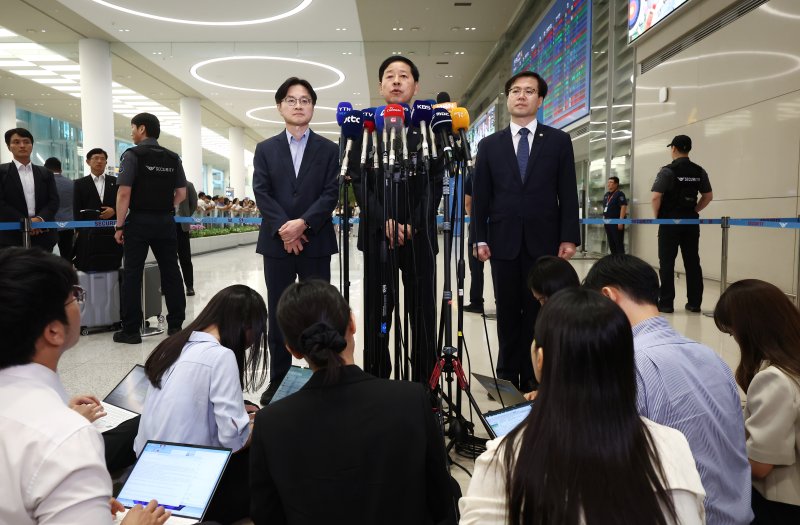
Yeo Han-gu, Head of Trade Negotiations, also emphasized immediately after returning home on the 1st, "Although we have overcome a major crisis this time, we do not know when tariff or non-tariff pressure will come again," and "It is necessary to actively respond by simultaneously improving domestic systems as a result of this event."
The US is likely to raise issues of digital regulations and agricultural market openings in earnest soon. In particular, President Trump and White House spokesperson Caroline Levitt simultaneously stated, "Korea has promised historical openings for US products such as cars and rice."
However, the Korean government is immediately refuting this by stating, "Agricultural products, including rice, were not on the negotiation table at all."
The Korean government considers the statements of the Trump administration as political rhetoric aimed at US voters, but such differences in perspective between the two sides could become a spark for future non-tariff negotiation conflicts.
Trade experts believe that this agreement is likely to lead to additional demands from the US in various fields such as agriculture, digital, online platform regulations, and precision map exports. It is expected that these issues will be discussed in earnest at the upcoming Korea-US summit.
aber@fnnews.com Park Ji-young Reporter