[Exclusive] Despite Spending 5 Billion Won Annually in National Funds, Prosecutors' Thesis Plagiarism and Overseas Training Reimbursement Details Remain Confidential
- Input
- 2025-08-04 16:34:12
- Updated
- 2025-08-04 16:34:12
610 Million Won Per Person Invested... 'Sincerity Standard' Reimbursement Rate and Plagiarism Rate Not Disclosed
Planned Office "Non-disclosure of Data Infringes on Deliberation Rights"... Unlike Precedents, Judges, and Civil Servants
Ministry of Justice "Disclosure May Disrupt Work and Invade Privacy"
Planned Office "Non-disclosure of Data Infringes on Deliberation Rights"... Unlike Precedents, Judges, and Civil Servants
Ministry of Justice "Disclosure May Disrupt Work and Invade Privacy"
The Ministry of Justice has been confirmed on the 4th to be spending nearly 5 billion won annually on national funds for prosecutors' overseas training, yet not disclosing any details about the figures caught plagiarizing theses locally or the training expenses reimbursed due to this. This contrasts with judges or general civil servants who provide information on reimbursement amounts and plagiarism rates.
The Ministry of Justice maintains that disclosure could "hinder the fair execution of duties," but does not provide a clear explanation of what hindrance it would cause. There are already numerous court precedents that state financial information unrelated to investigation or prosecution should be disclosed.
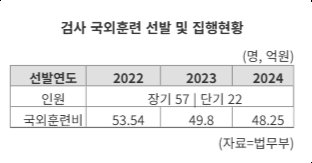
According to the National Assembly Budget Office's '2024 Fiscal Year Settlement Committee Analysis' report, a total of 4.876 billion won was allocated for prosecutors' overseas training support last year. Considering that 79 people, including 57 for long-term training and 22 for short-term training, went abroad during the same period, a simple calculation shows that an average of 61 million won of national funds was spent per prosecutor.
The prosecutors' overseas training fund is a system that supports airfare, tuition, and living expenses during the period of overseas study. Typically, tuition is provided up to 60,000 dollars annually (about 84 million won), living expenses (subsistence) 2,356 dollars per month (about 3.5 million won), and airfare is also supported.
The 'Prosecutors' Overseas Training Operation Regulations,' a directive of the Ministry of Justice, applies to prosecutors' overseas training. It was established in 2008 to appropriately select and systematically support overseas training candidates, and includes degree programs and visiting scholar programs.
The regulation states that for both programs, long-term training candidates with a duration of more than one year must prepare a research paper outline within six months from the dispatch date and a draft within nine months. Short-term training candidates of less than six months must submit a draft within four months from dispatch. Also, they must submit the thesis three weeks before returning, and after returning, they must finalize and supplement the thesis within one week, followed by a review by the review committee. If the trainee's thesis is found to be unrelated to the task or plagiarized, 20% of the training expenses will be reimbursed.
However, despite these regulations, the Ministry of Justice is not providing the Planned Office with data such as △the number of prosecutors subject to overseas training reimbursement △the total amount of training expenses paid to all reimbursement subjects and the amount to be reimbursed △the total amount of reimbursement △the average plagiarism rate of all theses △the number of theses according to plagiarism rate intervals.
In response to our inquiry, the Ministry of Justice stated that "to enhance execution transparency, various execution information related to overseas training was provided to the National Assembly," but explained that "some data was inevitably kept confidential as its disclosure could hinder the fair execution of duties and invade the privacy of the subjects." Article 9 of the Information Disclosure Act allows for non-disclosure of information if it "significantly hinders the performance of duties" or "invades privacy or freedom."
However, Supreme Court precedents limit the scope of possible non-disclosure to information that reveals investigation methods or procedures. The Seoul Administrative Court's Administrative Division 8 (Presiding Judge Lee Jeong-hee) also ruled in March last year in an information disclosure lawsuit between the Ministry of Justice and Media A that while the entire overseas training thesis and review committee information may be kept confidential, the status of degree acquisition (prosecutor's name, then affiliation, study country/school, thesis title) should be disclosed.
The status of degree acquisition is not considered privacy-invading information, considering "the point that national budget was invested and the possibility of reimbursement if the target is not met." The case is in the appellate stage, and the Ministry of Justice plans to decide on disclosure based on the lawsuit outcome.
The Planned Office also pointed out that there is no possibility of hindering the prosecution's performance. It also stated that there is no concern about privacy invasion as specific prosecutors cannot be identified. The Planned Office criticized, "It could hinder the National Assembly's budget and settlement deliberations."
On the other hand, the Supreme Court submitted information on the training period, training expenses paid, report submission status, degree acquisition, and thesis plagiarism rate of judges who completed overseas training from 2022 to 2024 in an anonymous manner, and the Ministry of Personnel Management provided similar information related to general civil servant training. The Ministry of Personnel Management posted 484 out of 489 training result reports (99% disclosure rate) online, but the Ministry of Justice selectively discloses only some theses on the Ministry of Justice Training Institute website. There is no data for 2024.
Ha Seung-soo, co-representative of the civic group Catch the Tax Thief, said, "If reimbursement was made due to thesis plagiarism, the public has the right to know." Jeong Jin-im, director of the Center for Information Disclosure for Transparent Society, also criticized, "It is difficult to accept rejecting requests for government operation simply for 'work hindrance' reasons."
In the National Assembly, legislative discussions are also underway to expand the scope of information disclosure. The amendment to the Information Disclosure Act proposed by Heo Young, a member of the Democratic Party of Korea, with the intent that 'public institution information, excluding information on national security, etc., should be disclosed,' is currently pending in the standing committee. A representative from Heo's office stated, "There is no relation between prosecutors' overseas training and privacy invasion," and "Information disclosure is necessary to prove that public institution overseas training is producing results."
haeram@fnnews.com Lee Haeram Choi Eunsol Reporters