24-Hour Power Supply·High-Efficiency Cooling… LG U+ Pyeongchon Data Center Equipped with Dual Stability Network
- Input
- 2025-08-03 09:00:00
- Updated
- 2025-08-03 09:00:00
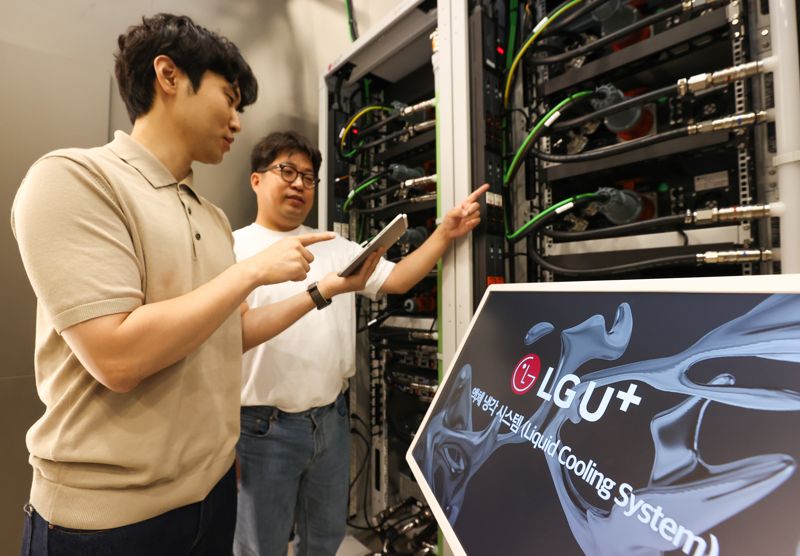
[Financial News] On the 31st of last month, a reporter visited LG Uplus 'Pyeongchon2 Center'. This place boasts a size that comfortably accommodates one U.S. military aircraft carrier. Pyeongchon2 Center was in a battle against heat generation. As the demand for artificial intelligence (AI) computation surged, data center cooling technology was also advancing. LG Uplus has been focusing on 'liquid cooling' technology to reduce the heat of high-performance graphics processing units (GPUs).
■"Quickly Cool GPUs with Liquid Cooling"
On this day, two types of liquid cooling methods were demonstrated in the facility inspection (PoC) demo room revealed by LG Uplus. One is 'direct chip cooling (D2C)', which attaches a plate with cold water flowing right next to the GPU inside the server to dissipate heat, and the other is 'immersion cooling', where the entire server is submerged in a tank filled with insulating oil. Managing GPU heat is a key element in data center operations. AI computation GPUs generate more than three times the heat compared to general server central processing units (CPUs), so if cooling is not properly conducted, performance degradation and equipment aging progress rapidly.
The direct chip cooling system consisted of a blue pipe where cooling water passes and a red pipe where hot water that absorbed heat flows. The liquid cooling method, which directly contacts the hardware, is said to have a thermal conductivity 20 to 30 times higher than air. Jung Sook-gyeong, Senior Vice President of AIDC Business Division, said, "We plan to build 9 out of 12 computer rooms in Pyeongchon2 Center with a direct chip cooling system" and "The Paju Data Center, which will be completed in 2027, is initially designed with a liquid cooling structure to support the method preferred by customers between direct chip cooling and immersion cooling."
Liquid cooling methods using water or insulating oil are also being actively researched by overseas big tech companies recently. In the case of Microsoft, they have even conducted experiments of putting small data centers into the sea. Bae Seong-jun, head of the AIDC Consulting Execution Team, who introduced the demo room, explained, "The insulating oil used in immersion cooling has a very high flash point, so there is no risk of fire even if a torch is applied."
■"Power for 35,000 Households Even if Electricity Goes Out"
Going down to the second basement, a gas-insulated switchgear (GIS) filled with insulating gas appeared. It is equipment that safely reduces the large-capacity power of 154,000V brought in from Korea Electric Power Corporation to 6,000V. After passing through the GIS, it is transformed again in the electric room and transmitted to the generator.
The inspected generators were all five units. Yoo Jae-kyung, Team Leader of IDC Facility 1 Team, said, "One unit can supply power to about 7,000 apartment households." Large fans cooling the generator heat and pipes discharging exhaust gas outside were also visible. In addition, an uninterruptible power supply (UPS) that handles emergency power for 15 minutes in case of a power outage was installed. Yoo added, "Pyeongchon2 Center is scheduled to be completed in four phases by 2027. Currently, it is in the second phase, so both transformers and generators will be expanded."
[email protected] Park Seong-hyun Reporter