15% Car Tariff, Japan May Laugh for Now.. Hyundai's 'Direct Breakthrough' Policy [Korea-US Tariff Negotiation Settlement]
- Input
- 2025-07-31 16:19:11
- Updated
- 2025-07-31 16:19:11
15% Car Tariff, Disappeared Duty-Free Premium
Same Tariff for Korean-Japanese-European Cars
Same Tariff for Korean-Japanese-European Cars
[Financial News] Although South Korea and the United States agreed to lower mutual tariffs from 25% to 15% on July 31, Korean cars lost their duty-free benefits in the US market and are now in a situation where they have to compete under the same tariff conditions as Japanese and European cars. With this tariff agreement, the 'duty-free' premium that Korean cars enjoyed for over 10 years under the Korea-US Free Trade Agreement (FTA) has disappeared. Korean cars, which had price competitiveness compared to Japanese and European cars with a 2.5% tariff burden, will now have to engage in a real battle with brand and technology. With the application of the same 15% tariff, enhancing the competitiveness of Korean cars has become more important than ever, and Hyundai and Kia, the leading domestic automakers, have pledged to "do our best to minimize the impact of tariffs by pursuing various measures."
■For Now, Japanese Automakers May Laugh
Our government actively requested the US to lower the car tariff to 12.5% to take advantage of the 2.5% tariff reduction effect, but the US did not accept it, and eventually, Korean, Japanese, and European cars were all subjected to the same 15% tariff.
As the average car selling price in the US market exceeds $50,000 (approximately 69 million won), the 2.5% difference is evaluated as a range that significantly affects demand.
In the end, the actual tariff increase rate became 15% for Korea and 12.5% for Japan and Europe, leading to the expectation that Japanese automakers, who are fiercely competing with Korean cars in the US, will gain an advantage for now.
Since the competitive areas of Korean and Japanese cars overlap, noticeable differences are expected in the short term, while European cars are expected to be relatively less affected due to different customer bases.
An industry expert said, "Korean cars have maintained an advantage in the US market with a subtle 2.5% price competitiveness over Japanese cars, but now Japanese cars have become somewhat advantageous," adding, "Whether to raise the price by 2.5% or not plays a very big role in the field. Korean and Japanese cars have similar quality, so price competition is fierce."
There is also a growing burden in competition with US automakers. In the case of General Motors (GM), Korean GM relies entirely on exports to the US, but overall, the competitive conditions for Korean automakers have worsened due to the solid production base in the US.
Lee Ho-geun, a professor at Daedeok University’s Future Automotive Department, said, "Although there is talk of being fortunate in misfortune, the competitiveness will inevitably decline in terms of the actual tariff increase rate. Moreover, the parts tariff rate is still undecided for us, compared to Japan's confirmed 15%, which is also a burden," adding, "Compared to not only Japan and Europe but also local companies with a solid production base in the US, competitiveness will inevitably lag behind."
■Hyundai and Kia "Minimizing Tariff Impact by Enhancing Competitiveness"
Contrary to these concerns, Hyundai and Kia have made it clear that they will minimize the impact of tariffs and strengthen their internal stability through competitiveness enhancement and technological innovation.
Hyundai and Kia said on this day, "We deeply appreciate the dedicated efforts of all government departments and the National Assembly to resolve the US tariff issue," adding, "As the 15% tariff is applied, enhancing the competitiveness of Korean cars is crucial, and we plan to further strengthen our internal stability through quality and brand competitiveness enhancement and technological innovation."
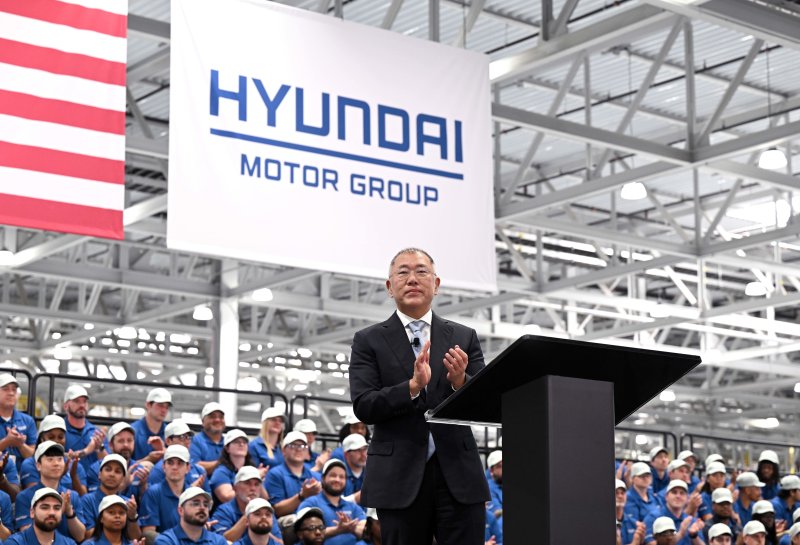
Chung Eui-sun, chairman of Hyundai Motor Group, visited Washington, USA, the day before and met with US government officials, supporting our government's tariff negotiations from the side.
Lee Hang-gu, a research fellow at the Korea Automotive Research Institute, said, "If the 25% tariff was temporary, the 15% tariff is likely to be prolonged, making Hyundai's future strategic direction important," adding, "Hyundai said it would expand its US production capacity to 1.2 million units, but since last year's US sales were at the level of 1.7 million units, it is deeply concerned about whether to bear the revenue loss for 500,000 units or decide on a price increase."
Fortunately, with this tariff reduction, Hyundai and Kia's tariff burden is expected to be significantly alleviated.
The securities industry estimated that if the 25% tariff rate had been maintained, Hyundai alone would have inevitably faced losses exceeding 1 trillion won per quarter from the third quarter onwards.
NH Investment & Securities analyzed that if the 25% tariff rate was maintained, Hyundai would face a tariff burden of 3.068 trillion won this year and 4.058 trillion won next year. However, if the tariff rate is lowered to 15%, Hyundai's tariff burden this year and next year is expected to be 2.6 trillion won and 2.7 trillion won, respectively, reducing the tariff burden by 500 billion to 1.8 trillion won. hjkim01@fnnews.com Kim Hak-jae, Jeong Won-il Reporter