Aribio Announces Clinical and Mechanism Results of Dementia Treatment AR1001 at AAIC
- Input
- 2025-07-31 10:44:43
- Updated
- 2025-07-31 10:44:43
Focus on the Therapeutic Effect of AR1001 Monotherapy
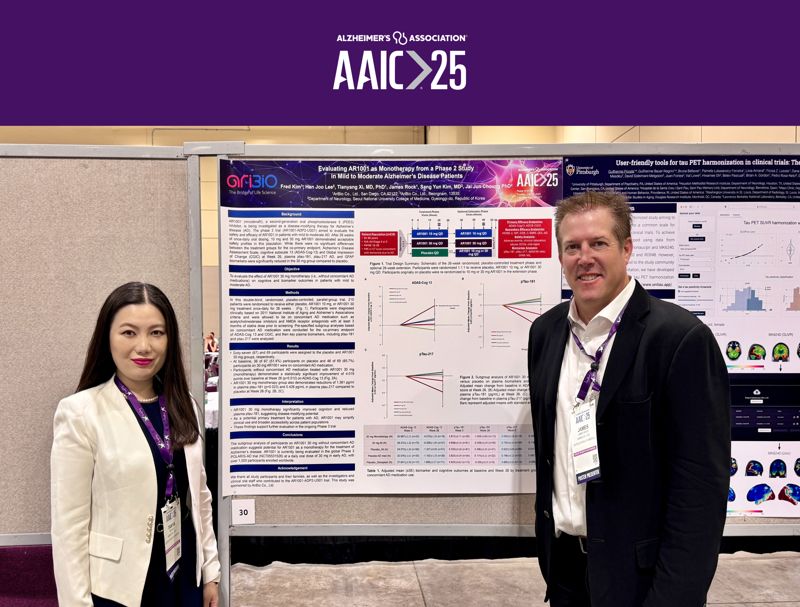
[Financial News] Aribio announced on July 31 that it officially presented four research results related to the Alzheimer's treatment candidate 'AR1001' at the 'Alzheimer's Association International Conference (AAIC 2025)' held in Toronto, Canada.
AAIC is the world's largest international conference in the field of Alzheimer's and dementia research, where global pharmaceutical companies, biotech firms, and researchers gather annually to share the latest scientific achievements and therapeutic innovation directions.
The research presented by Aribio at this conference includes △ Confirmation of the potential for AR1001 monotherapy △ Survey of neurologists' perceptions of oral dementia treatments △ Demonstration of multi-neuroprotective effects in human mini-brain models (in collaboration with Professor Cho Han-sang's team at Sungkyunkwan University) △ Reliability analysis of the clinical diagnostic platform Lumipulse, totaling four studies.
The most notable content among these is the clinical analysis result that AR1001 can show sufficient therapeutic effects as a monotherapy in the treatment of Alzheimer's disease.
Based on global Phase 2 clinical data, Aribio conducted a retrospective subgroup analysis and found that in the patient group taking 30mg of AR1001 alone, there was a significant improvement in cognitive function after 26 weeks, along with a marked decrease in the levels of phosphorylated tau protein (pTau-181, pTau-217), a key biomarker of Alzheimer's.
Aribio stated, “The effect of improving pTau levels was statistically significant in all patient groups, but in the AR1001 monotherapy group, the levels were observed to be more than twice as high, further emphasizing its potential as a monotherapy.”
Another study also presented survey results showing that neurologists showed a high willingness to accept oral small molecule-based disease-modifying therapies (DMT) like AR1001. Aribio plans to use this as a key reference in establishing commercialization and insurance reimbursement strategies for AR1001 in the future.
In a joint study using human-derived mini-brain (Organoid) models, it was also confirmed that AR1001 simultaneously activates various neuroprotective mechanisms.
This study, conducted in collaboration with Professor Cho Han-sang's research team at Sungkyunkwan University's Department of Biophysics, is evaluated as a result that academically supports the mechanistic excellence and therapeutic expansion potential of AR1001.
Through collaboration with the global in vitro diagnostics company Fujirebio, data proving the reliability of AR1001 clinical biomarker measurement using the Lumipulse platform was also released.
Fred Kim, President of Aribio's US Branch, emphasized, “With the global Phase 3 topline results of AR1001 scheduled to be announced in the first half of 2026, these studies serve as an opportunity to demonstrate both scientific evidence and market competitiveness,” and added, “We will continue to solidify the foundation for the global commercialization of AR1001 through continuous collaboration with partners.”
Meanwhile, Aribio signed an exclusive license agreement with China's Fosun Pharma for the Greater China region on the 28th and is currently pursuing a merger with Kosdaq-listed Sorux. The merger date is set for November 4.
vrdw88@fnnews.com Kang Jung-mo Reporter