[Concall] Hanwha Aerospace "Initial Stage Negotiations for US Investment with 4.2 Trillion KRW Capital Increase"
- Input
- 2025-07-31 10:27:30
- Updated
- 2025-07-31 10:27:30
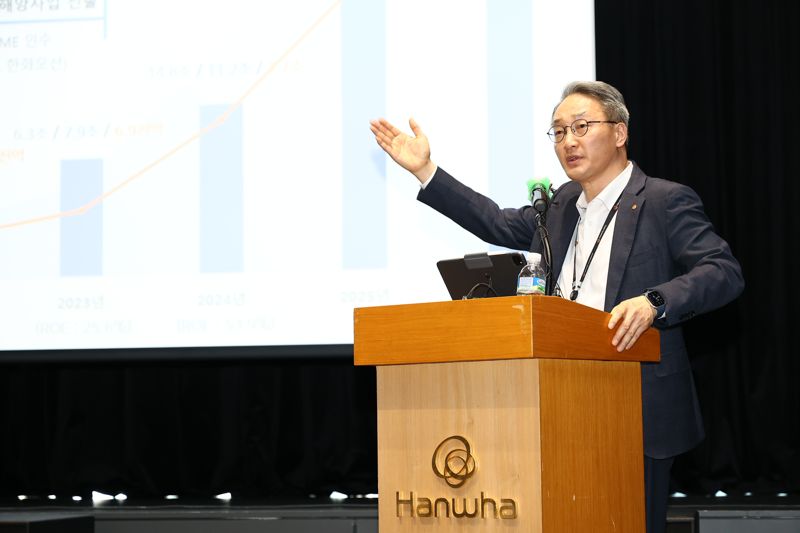
[Financial News] Hanwha Aerospace announced on the 31st through a conference call regarding the use of the 4.2 trillion KRW capital increase fund, "We are in the initial stage of negotiations for investment in the US. We are reviewing and negotiating investment in the US propellant business," and "This year, we are setting up the framework, so we will not use a large amount. In the short term, there is a domestic MCS (Modular Charge System) expansion," it stated.
Previously, Hanwha Aerospace successfully completed a general capital increase of a total of 2.9188 trillion KRW. Three companies, including Hanwha Energy, Hanwha Impact Partners, and Hanwha Energy Singapore, participated in the third-party allocation capital increase, investing 1.3 trillion KRW, and the largest shareholder, Hanwha, also participated, securing a total of 4.2 trillion KRW.
Hanwha Aerospace emphasized the necessity of a localization strategy through large-scale investment as major countries such as Europe are rearming due to the global geopolitical crisis. Through this, it presented a mid-to-long-term vision of expanding global weapon systems businesses such as the K9 self-propelled howitzer and Chunmoo multiple rocket launcher in major strategic markets, and strategic cooperation with NATO and European countries.
Hanwha Aerospace plans to invest the funds raised through this capital increase in building overseas production capacity (1.3 trillion KRW), establishing joint ventures (918.8 billion KRW), acquiring securities of other corporations, and building a smart factory for MCS (600 billion KRW) to respond to domestic and international demand, as well as investing in factory equipment operation (100 billion KRW).
ggg@fnnews.com Kang Gu-gwi Reporter