"Strike Omnipotence Reduces Competitiveness" Business Community Appeals to Stop Yellow Envelope Act
- Input
- 2025-07-30 16:36:42
- Updated
- 2025-07-30 16:36:42
13 Industry Organizations Including KEMC
Joint Press Conference Urging 'Stop Amendment to Labor Union Act'
"Frequent Strikes, Concern Over Industrial Ecosystem Collapse"
Joint Press Conference Urging 'Stop Amendment to Labor Union Act'
"Frequent Strikes, Concern Over Industrial Ecosystem Collapse"
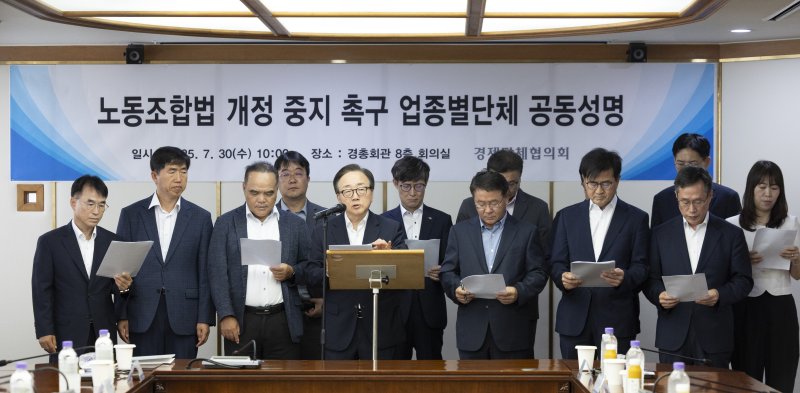
[Financial News] The business community and industry organizations have expressed their greatest concern over the so-called Yellow Envelope Act (Amendments to Articles 2 and 3 of the Labor Union and Labor Relations Adjustment Act) recently passed by the National Assembly's Environment and Labor Committee, which is 'strike omnipotence.' If the Yellow Envelope Act passes the National Assembly, it will not only create a vicious cycle of 'expanding the scope of users → frequent demands for negotiation rights by subcontractors → collapse of the ecosystem between primary and subcontractors → decline in industrial competitiveness,' but also broaden the justification for strikes from 'working hours and wages' to 'corporate management decisions,' leading to more frequent strikes by unions.
■"Strike Omnipotence of Subcontractors Due to Yellow Envelope Act"
The Korea Employers Federation (KEMC), Korea Automobile Mobility Industry Association, Korea Petroleum Association, Korea Iron & Steel Association, Korea Construction Association, and 13 other major industry organizations held a press conference at the KEMC Hall in Mapo-gu, Seoul on the 30th, stating that "if the Yellow Envelope Act passes, it will collapse the industrial ecosystem between primary and subcontractors and severely undermine our industrial competitiveness," and issued a joint statement urging the cessation of the amendment to the Labor Union Act.
The amendment to the Labor Union Act includes expanding the scope of users and the subjects of strikes in labor relations, and limiting companies' claims for damages against union strikes.
Lee Dong-geun, Executive Vice Chairman of KEMC, argued that "in the domestic manufacturing industry, which is composed of a multi-level collaboration system by industry such as automobiles, shipbuilding, and construction, if constant strikes occur against the primary contractor, the industrial ecosystem between primary and subcontractors will collapse." Above all, he warned that the expansion of the concept of labor disputes and the limitation of liability for damages would spread 'strike omnipotence.'
He added, "If a subcontractor goes on strike, it will be difficult to cooperate with that company afterward," and "not only will there be conflicts between primary and subcontractors, but also between unions, which could harm workers."
Kim Joo-hong, Executive Director of the Korea Automobile Mobility Industry Association, said, "If even one of the over 10,000 subcontractors goes on strike and even one part is not supplied, it will be difficult to produce finished cars," and "at an important time of transition to future cars with the rise of China, I feel despair about the current amendment." Jung Seok-joo, Executive Director of the Korea Shipbuilding & Offshore Plant Association, explained, "The strengths of Korean shipbuilding in the global market are reliability and stability," and "if production becomes unstable due to the Labor Union Act, the reliability of the Korean shipbuilding industry will decrease."
■"Corporate Decision-Making Also Needs Union Approval? Constitutional Appeal Possible"
Until now, unions could strike due to differences in positions on working hours and wages, but with this amendment to the Labor Union Act, the possibility of unions intervening in corporate management decision-making processes has increased.
Lee stated, "Previously, working hours and wages were the reasons for strikes, but if business decisions are included, overseas investment, mergers and acquisitions, and factory relocations can also become reasons for strikes," and "the labor relations law is for labor and management to talk, and then the government mediates."
In the process of handling the Labor Union Act in the National Assembly's Environment and Labor Committee, which was led by the ruling party, KEMC emphasized that the pressure from the Korean Confederation of Trade Unions was strong, and warned that if the law is implemented, it will practically harm subcontractor workers.
In response, Lee even mentioned the possibility of a constitutional appeal against the Labor Union Act.
He explained, "If business decisions are included in the conditions for labor disputes, it could violate the constitutional rights of management and private property," and "there is a grace period, but once it ends, a constitutional appeal is possible." Amid such concerns, Song Kyung-sik, Chairman of KEMC, will also hold a press conference at the KEMC Hall on the 31st to actively express opposition to the handling of the related law. hjkim01@fnnews.com Kim Hak-jae, Park Kyung-ho Reporter