Representative Andogeol: "Bank of Korea's Stablecoin 'Shadow Currency' is an Overreaction" [Crypto Briefing]
- Input
- 2025-07-30 16:03:09
- Updated
- 2025-07-30 16:03:09
Bank of Korea, Concerns Over Lack of Binding Power in Issuance and Distribution with Only Financial Commission Approval
Representative An: "Good Monetary Policy Capability... Important to Consider Added Value Management"
Legislation Briefing Also Held... "Balancing Advantages and Concerns for Legislation"
Representative An: "Good Monetary Policy Capability... Important to Consider Added Value Management"
Legislation Briefing Also Held... "Balancing Advantages and Concerns for Legislation"
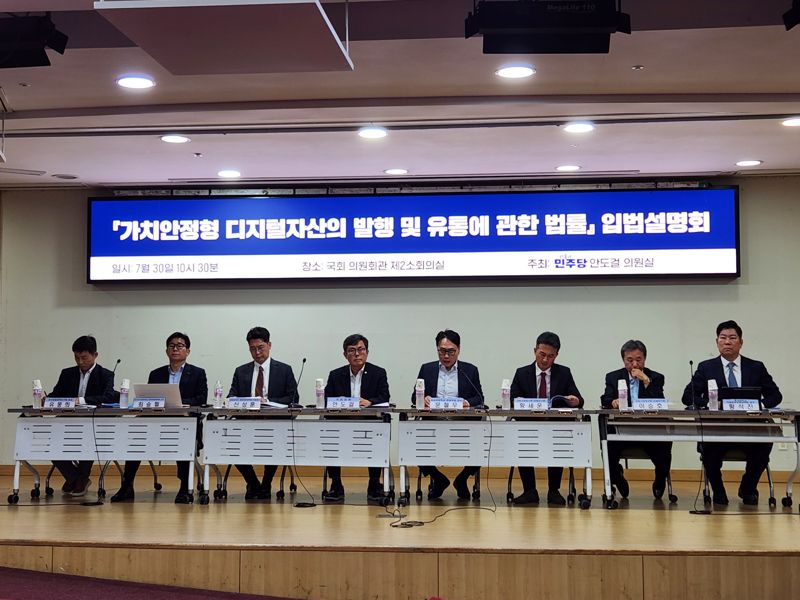
[Financial News] "The Bank of Korea is concerned that stablecoins could become 'shadow currencies' beyond control. However, stablecoins are not currencies controlled by the Bank of Korea, but currencies issued and distributed by the market system. Our monetary policy capability is good, so there seems to be no need to worry too much."
Representative Andogeol of the Democratic Party of Korea responded to the Bank of Korea's concerns at the legislative briefing on the 'Law on the Issuance and Distribution of Value-Stable Digital Assets' held on the 30th at the National Assembly Members' Office Building Room 2.
Previously, Representative An proposed a bill on the 28th to institutionalize stablecoins, virtual assets that minimize price fluctuations by fixing their value to the dollar, won, etc. The Bank of Korea reportedly expressed concerns about this bill, stating that 'issuance is possible with only the Financial Commission's approval, and the adjustment of issuance and distribution volumes is decided by the Value-Stable Digital Assets Committee, making it non-binding.' In response, Representative An emphasized, "It is worrying based on a potentially bleak scenario," and "It is more important to discuss how to manage the added value of stablecoins within our monetary policy framework."
Experts from various fields also presented diverse opinions on the legislation of stablecoins. Professor Shin Sang-hoon of Yonsei University pointed out, "Stablecoins have the advantages of low fees and fast transfer speeds, attracting global companies to enter the business," but also noted, "However, they could have a significant impact on monetary and foreign exchange policies and pose a risk of being used for money laundering." Professor Choi Seung-pil of Korea University School of Law viewed stablecoins as △a means of payment △a new industry formation infrastructure function △utilizable from a public sector perspective. Professor Choi stated, "Issuing won stablecoins can serve as a defense mechanism against the domestic inflow of dollar stablecoins and stimulate the internationalization of the won."
[email protected] Lim Sang-hyuk, Kim Hyung-gu, Reporters