Mokdong Complex 6 Reconstruction 'Accelerates'... 'Up to 7 Years Shortened with Intensive Process Management'
- Input
- 2025-07-30 13:40:00
- Updated
- 2025-07-30 13:40:00
Mayor Oh's 'Housing Market Normalization' Steps
Following Jayang 4-dong and Sindang 9 District, Mokdong... 'Supply Promotion Leading Model'
Starting with Complex 6, 13 Complexes to Begin Early Construction... 'Supplying 47,000 Households'
Following Jayang 4-dong and Sindang 9 District, Mokdong... 'Supply Promotion Leading Model'
Starting with Complex 6, 13 Complexes to Begin Early Construction... 'Supplying 47,000 Households'
[Financial News] Mayor Oh Se-hoon of Seoul visited the 'Mokdong Complex 6 Reconstruction' area on the 30th and announced, "We will shorten the project period by up to 7 years through intensive process management."
Mayor Oh has been continuing his 'housing market normalization' steps, starting with the redevelopment area of 'Jayang 4-dong' on the 14th and then visiting the 'Sindang 9 District', where the project has been delayed for over 20 years, on the 24th. In 'Sindang 9 District', Mayor Oh also announced a plan to shorten the average period required for urban redevelopment projects in Seoul from 18.5 years to 13 years, a reduction of 5.5 years.
The third visit, 'Mokdong Complex 6' in Yangcheon-gu, Seoul, is one of the representative areas where the city and district are intensively promoting process management. It is considered a leading model for completing the housing supply promotion standards through rapid project promotion with active cooperation from residents and proactive conflict management. The designation of a redevelopment area, which usually takes about 5 years, was completed in 1 year and 9 months, and the establishment of a cooperative, which usually takes 3 years and 6 months, was also completed in 9 months with public support.
The city plans to further shorten the period by 1.5 years through intensive process management and efficient project promotion according to the 'Housing Supply Promotion Plan'. When combined with the period shortened in the designation of redevelopment areas and establishment of cooperatives, a total of 7 years will be shortened.
The key to additional shortening is intensive 'process management'. The city is shortening the period by implementing the 'pre-concurrent system', where the next stage procedures are conducted in advance or simultaneously. It becomes possible to prepare implementation approval documents and review documents simultaneously or to select an appraiser in advance at the approval stage to immediately start the evaluation.
The city explained, "We are processing administrative procedures related to redevelopment projects, which were previously promoted sequentially, simultaneously by introducing the 'pre-concurrent system'. Mokdong 6 District is fully possible due to the cooperation between the city and district as well as the cooperation of residents."
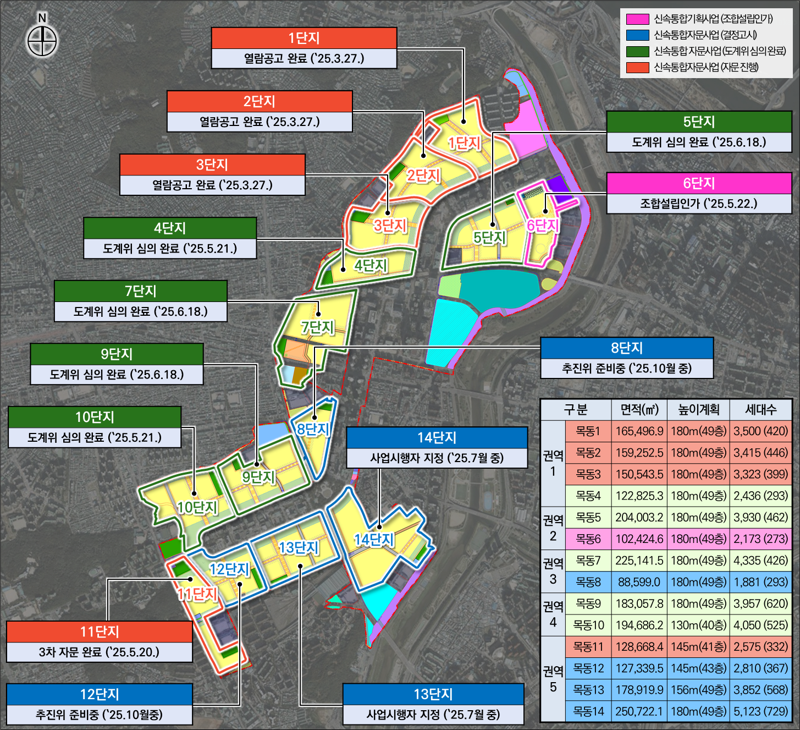
The city plans to complete the decision and announcement of the maintenance plans for all 14 complexes, including this Mokdong 6 District, by the end of the year and to promote early construction through the formation of a 'Public-Private Process Management Council'. Currently, the maintenance plans for Mokdong Complexes 6, 8, 12, 13, and 14 have been announced. The urban planning committee review for Mokdong Complexes 4, 5, 7, 9, and 10 has been completed. Mokdong Complexes 1, 2, 3, and 11 will proceed with the urban planning committee review after completing the rapid integrated planning consultation.
In the 14 complexes of Mokdong and Sinjeong-dong, 26,629 households are currently residing. If reconstruction progresses quickly, it is estimated that 47,458 households, 1.8 times more, will be supplied quickly. The additional supply includes 3,027 units of 'My Future Home', a long-term rental housing for newlyweds, and about 20,829 units of public housing, including 6,145 units of public housing.
Plans are also in place to expand a total of 12 sites (56,008㎡) of infrastructure and public facilities, including social welfare facilities such as daycare centers reflecting urban structural changes like single-person households and aging, public open spaces for schools (2 sites), public parking lots (2 sites), and women's development centers (3 sites).
chlee1@fnnews.com Lee Chang-hoon Reporter