"KOSDAQ 3000 Era Must Open" Joint Proposal by Venture, KOSDAQ, and VC Organizations
- Input
- 2025-07-30 13:52:18
- Updated
- 2025-07-30 13:52:18
Venture Industry: "Stagnation in the Exit Market Blocks Startup-Investment Virtuous Cycle... Government Policy Roadmap Needed"
[Financial News] "The venture ecosystem is thirsty. KOSDAQ activation is necessary to improve the exit market."
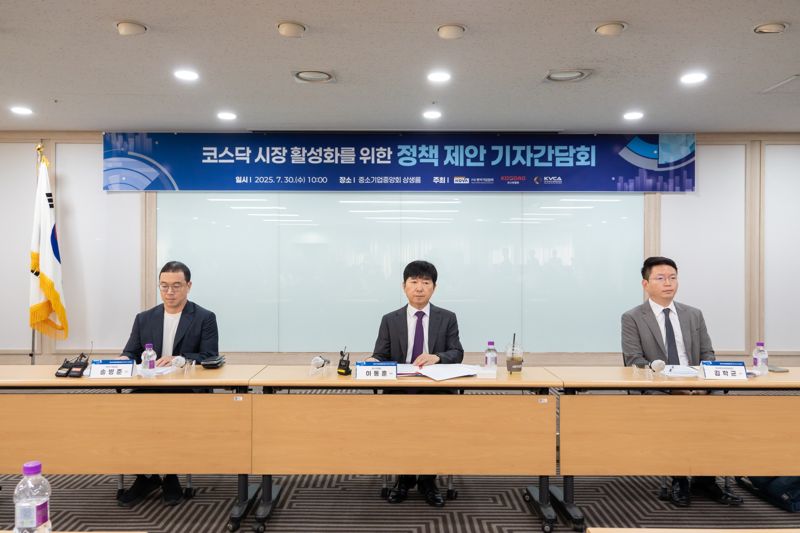
In line with the government's 'KOSPI 5000 Era' blueprint, key organizations in the venture industry and capital market urged a policy roadmap for the 'KOSDAQ 3000 Era'. Three organizations, including the Venture Business Association, KOSDAQ Association, and Korea Venture Capital Association, held a press conference on the 30th at the Korea Federation of Small and Medium Business in Yeouido, Seoul, proposing key policies such as market-centered structural improvement, expansion of institutional investor inflow, and introduction of KOSDAQ activation funds.
KOSDAQ, established in 1996 as the world's second growth stock market, surpassed KOSPI in daily trading volume in just four years, leading the venture boom as a key foundation. However, the current index remains at 800 points, 20% lower than at its inception. Although the number of listed companies has increased, the short-term trading centered on individual investors and the sluggish exit market have halted the virtuous cycle of startup-investment-exit-reinvestment, according to the industry's common diagnosis.
Song Byeong-jun, Chairman of the Venture Business Association, emphasized, "If KOSDAQ does not recover its function as an exit for innovative companies and a recovery platform for venture capital, the venture ecosystem will inevitably stop." He stressed the need to transition to a privately-led responsible listing structure and establish a flexible entry and strict exit system based on the 'Many Births, Many Deaths' principle. He further urged the government to present a roadmap in collaboration with related ministries such as the Ministry of SMEs and Startups and the Financial Services Commission.
Lee Dong-hoon, Chairman of the KOSDAQ Association, pointed out the necessity of long-term capital inflow. He said, "The KOSDAQ investment proportion of public funds like the National Pension is only in the 4% range, falling short of the market capitalization proportion (about 17%)." He suggested that if the National Pension gradually increases its KOSDAQ investment ratio, about 37 trillion won could flow in as long-term funds. He also proposed long-term investment tax incentives, improvement of the business succession system, and the introduction of the principle of business judgment.
Kim Hak-gyun, Chairman of the Korea Venture Capital Association, argued for the introduction of a 'KOSDAQ Activation Fund', stating, "There is a need for cases like Tesla, which raised large-scale funds after listing and leaped to become a global company." He added, "The government and policy financial institutions should act as priming water, matching pension and institutional funds to create a scale of 30 trillion won over three years, with 10 trillion won annually, and promote private participation through tax benefits such as priority loss compensation and income deduction."
Statistics also show the vulnerability of KOSDAQ. Last year, KOSDAQ's turnover rate of listed stocks was 425%, more than double that of KOSPI (187%). The proportion of individual investors is 65%, overwhelming institutions (30.6%) and foreigners (4.4%). As of the end of 2023, the National Pension's KOSDAQ investment amount is 6.1 trillion won, only 1/23 of KOSPI's 140 trillion won.
The conference also discussed the reality that domestic unicorn companies like Coupang and Naver Webtoon are pursuing NASDAQ listings. Chairman Song said, "The reason domestic companies are turning overseas is not simply to target the global market but because of the 'KOSDAQ discount'." He emphasized, "We must provide a global level of evaluation and investment environment domestically."
The industry unanimously stated that the government should pursue not only the KOSPI 5000 vision but also the KOSDAQ 3000 vision. They emphasized that the KOSDAQ market must revive its function as a recovery channel for venture capital for technology innovation companies. Chairman Kim stressed, "If we fail to restore the exit market where innovative companies can grow, startup policies will only be half successful," and "the scope of venture policies should be expanded to include KOSDAQ."
The three organizations plan to continue discussions with the government, National Assembly, and financial authorities for policy implementation, including △ improvement of the private-centered listing structure △ mandatory venture investment by statutory funds △ expansion of long-term investment tax benefits △ introduction of KOSDAQ activation funds. Chairman Lee mentioned Japan's case, saying, "Japan expanded the domestic stock investment proportion of pension funds from 12% to 25%, leading to the stabilization of the Tokyo Stock Exchange and an increase in corporate value," and added, "Strategic asset allocation is necessary."
[email protected] Shin Ji-min Reporter