France to Take 1st Place.. '25% US Tariff' Imminent, K-Beauty on Thin Ice
- Input
- 2025-07-29 18:19:55
- Updated
- 2025-07-29 18:19:55
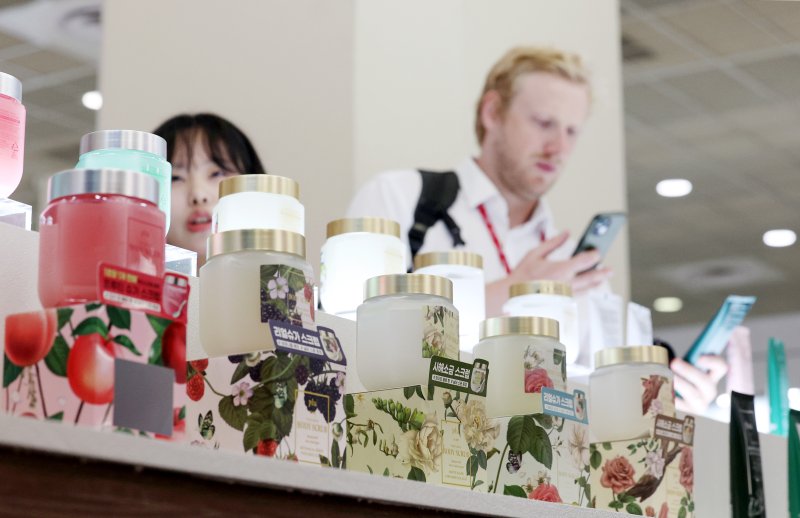
[Financial News] As the implementation of the '25% reciprocal tariff' by the US Trump administration is imminent, tension in our country's beauty industry, the largest exporter of cosmetics to the US, is reaching its peak. Last year, Korean cosmetics, which overtook France in the US market to become the top exporter, have grown rapidly with price competitiveness as their weapon. If they fail to enforce the '15% tariff' like the European Union (EU), significant damage is expected to be inevitable. The beauty industry considers price adjustment as the 'last resort' in case of tariff increases and is focusing all efforts on preparing indirect countermeasures such as logistics optimization, marketing efficiency, and diversification of production sites.
According to the Korea Customs Service on the 29th, last year, Korea's cosmetics exports to the US amounted to $1.7 billion (2.5 trillion won), making it the largest exporter. If the US's 25% reciprocal tariff, set to take effect on August 1, is simply applied, an additional burden of up to 620 billion won annually could arise. The tariff to be imposed this time is in addition to the existing 10% basic rate and is applied to the import cost based on customs declaration.
Last year, Korea overtook France to become the top importer of cosmetics in the US market for the first time. Meanwhile, with the conclusion of tariff negotiations between the US and the EU, a 15% reciprocal tariff has been confirmed for French cosmetics. On the other hand, if a 25% reciprocal tariff is applied to Korean products, there is growing concern that they could lose their price competitiveness and yield the top spot back to France.
The industry fears that as the core competitiveness of K-Beauty is 'cost-effectiveness', price increases due to tariff hikes will accelerate consumer departure. It is said that it is difficult for K-Beauty to reflect the tariff increase in prices. A beauty industry official said, "In a situation where there is room for tariff negotiations, we are considering absorbing the tariff shock through internal efficiency rather than price increases."
However, experts point out that if the tariff burden is prolonged, strategic adjustments such as price increases or restructuring of distribution channels will be inevitable. Professor Kim Joo-deok of Sungshin Women's University, Department of Beauty Industry, said, "A tariff level of 10% is bearable for companies, but 25% shakes both profitability and price competitiveness."
Although the North American market share of major domestic beauty companies is not large, the US is the most important global core market in the mid to long term. In the case of Amorepacific, as of the end of last year, North American sales accounted for 12.3% of the total. Based on overseas sales, it accounts for 31%. An Amorepacific official said, "Tariffs may affect the cost of sales," and "we are considering additional responses such as future price increases or promotion cost management."
LG Household & Health Care's North American sales share is relatively low at 8%, but it is focusing on the US market along with China and Japan. Therefore, in case of tariff increases, it plans to respond with a marketing efficiency strategy while accepting margin reductions. APR, which has a relatively high US sales share of 22%, is considering various scenarios.
There is a possibility that local production by the K-Beauty industry will expand to respond to local demand and avoid tariff burdens. Korea Kolmar recently started operating its second plant in Pennsylvania, USA, capable of producing 120 million units annually.
Professor Kim emphasized, "K-Beauty has grown significantly due to external factors such as the Korean Wave, Korea-US cooperation, and K-Culture, so its product technology or R&D infrastructure is relatively weak compared to France and Japan," and "government deregulation and R&D support are urgently needed to strengthen long-term competitiveness."
clean@fnnews.com Lee Jeong-hwa Reporter