"Will we not be able to eat chicken and eggs for a while?".. Aftermath of mass livestock deaths.. Signs of 'heatflation' spreading
- Input
- 2025-07-30 06:00:00
- Updated
- 2025-07-30 06:00:00
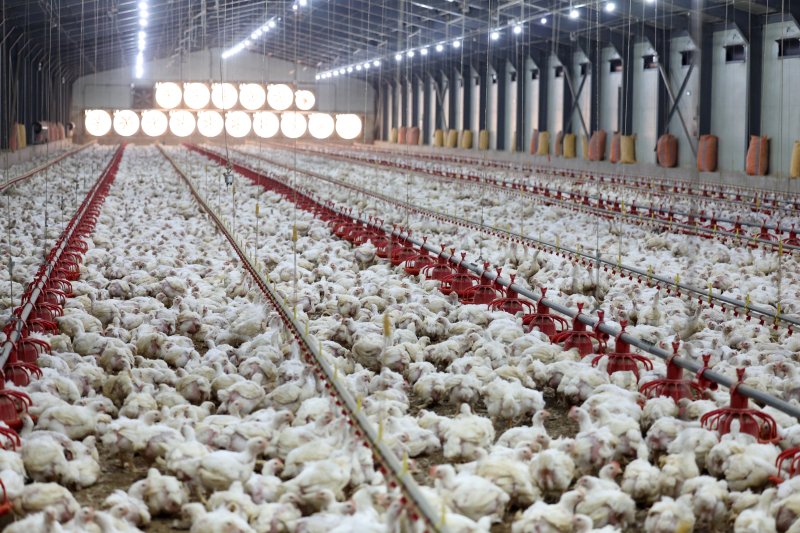
[Financial News] The shockwave of 'heatflation' is spreading as chicken and egg prices rise due to the mass deaths of livestock caused by heavy rain and heatwaves. In particular, the retail price of eggs (30 special eggs), which had been stabilizing, is approaching 7,000 won again in just over 10 days, continuing the summer price chaos. In addition, as the milk production of dairy cows exhausted by the heat decreases, attention is being paid to whether this will lead to price increases for processed foods using milk such as cream, cheese, and bread.
According to the Livestock Products Quality Assessment Service on the 29th, the average retail price of broilers per 1 kg rose from 5,764 won on the 1st to 6,135 won on the 28th, a 6.43% increase in one month. This is a 2.58% increase compared to the previous year and a 5.63% increase compared to the average year.
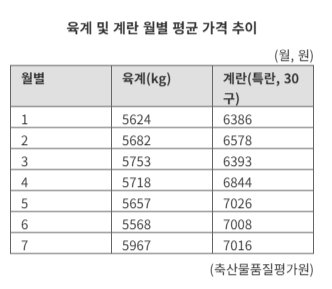
Since the beginning of the year, the average price of broilers rose from 5,624 won in January to 5,682 won in February, and 5,753 won in March, then fell to 5,718 won in April, 5,657 won in May, and 5,568 won in June. However, it has turned to an upward trend again in July.
The demand for the summer "Boknal" (dog days) overlaps, and the impact of continued livestock deaths due to heavy rain and heatwaves is significant.
According to the Ministry of Agriculture, Food and Rural Affairs, as of the 22nd, 1.48 million chickens, 151,000 ducks, 150,000 quails, 864 cows, 775 pigs, and 223 goats, totaling about 1.78 million livestock, have died due to heavy rain. Livestock deaths due to heatwaves are also continuing. As of the 10th, 506,238 poultry, including chickens, and 10,768 pigs, totaling 526,006 animals, have died.
The average price of eggs (special 30 eggs), which soared due to the impact of avian influenza (AI) outbreaks at home and abroad and recently entered a stable phase, is also approaching 7,000 won again. In the first half of this year, AI occurred in Brazil, temporarily suspending imports of Brazilian hatching eggs, edible eggs, and chicks.
On the 10th, the average retail price of a carton of eggs was 7,218 won, which fell to 6,820 won on the 15th, seeming to enter a stable phase. However, it rose again to 6,978 won the previous day, approaching the 7,000 won range. In this atmosphere, there is a possibility that the situation from 2021, when the price of a carton of eggs exceeded 7,200 won due to the spread of AI, may be repeated.
In addition, as milk production decreases due to heatwaves, the dairy industry is on edge. Currently, most domestic dairy cows are Holstein breed, and it is known that when the temperature rises above 32 degrees, milk production decreases by about 20%.
In the case of Seoul Milk Cooperative and Maeil Dairy, it is understood that the average daily raw milk production has decreased by 5-10% recently due to continued heatwaves. There is no change in raw milk prices, so there is not much reason to raise the price of white milk, but cream prices have risen due to temporary supply shortages.
Due to abnormal weather, the phenomenon of milk supply shortages continues every year as heatwaves persist. In fact, during the summer heatwave in 2021, Seoul Milk stopped supplying 1.8L white milk products to convenience stores, and Maeil Dairy also reduced supply.
A dairy industry official said, "As raw milk production decreases, we are recently restricting the shipment of cream," and "In the case of cream, since there is little stock and distribution volume, it seems that it is being traded at 2-3 times the price on some online sites."
ssuccu@fnnews.com Kim Seoyeon, Lee Hwanju reporters