Korea's Population Would Have Decreased Without Foreigners... The Era of 10 Million Elderly Becomes Reality
- Input
- 2025-07-29 13:55:10
- Updated
- 2025-07-29 13:55:10
Statistics Korea Announces 2024 Population and Housing Census Results
Foreigners Surpass 2 Million but Domestic Population Declines for 4th Year
Aging Increases Support Burden... Single-Person Households Surpass 8 Million
[Financial NewsForeigners Surpass 2 Million but Domestic Population Declines for 4th Year
Aging Increases Support Burden... Single-Person Households Surpass 8 Million

Last year, the foreign population exceeded 2 million for the first time, slightly increasing the total population, but the domestic population continued to decline for the fourth consecutive year, indicating a stagnant population trend. Due to aging, the population aged 65 and over surpassed 10 million for the first time, and the median age reached 46.2 years, indicating a rapid aging of the population structure.
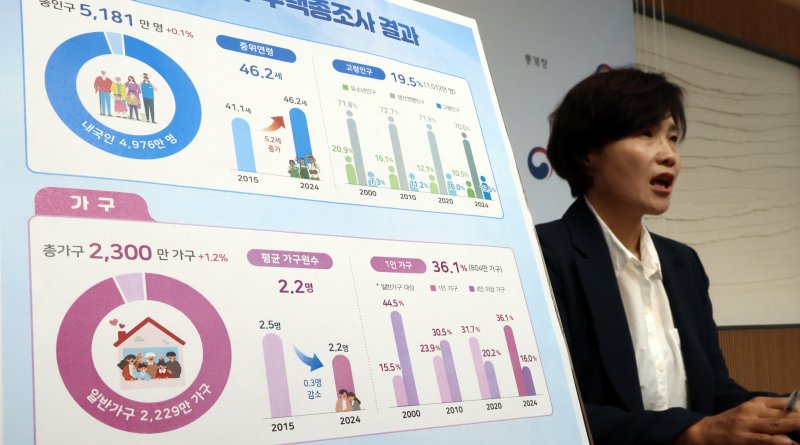
According to the '2024 Population and Housing Census Results (Registration Census Method)' released by Statistics Korea on the 29th, the total population as of November 1 last year was 51.806 million, an increase of 31,000 (0.1%) from the previous year. The total population, which had decreased for two consecutive years since 2021, showed an increase for the second year in a row in 2023, but the growth rate was smaller than the previous year (0.2%), indicating a trend close to 'stagnation'.
Among the total population, the domestic population was 49.763 million (96.1%), a decrease of 77,000 (-0.2%) from the previous year. In contrast, the foreign population was 2.043 million (3.9%), an increase of 108,000 (5.6%), offsetting the decline. The domestic population has been declining for four consecutive years since 2021.
The foreign population, which decreased due to the pandemic in 2020-2021, rebounded in 2022 and surpassed 2 million for the first time last year. The expansion of the employment permit system and the attraction of international students to regional universities are analyzed as major factors.
By nationality, China (including ethnic Koreans) had the largest number at 538,000 (26.3%), followed by Vietnam (285,000·14.0%) and Chinese nationals (223,000·10.9%). The nationality with the largest increase compared to the previous year was Vietnam (38,000), followed by Myanmar (12,000) and Nepal (10,000).
In terms of age structure, the trend of low birth rates and aging has become more pronounced.
The elderly population aged 65 and over was 10.122 million, an increase of 513,000 from the previous year, surpassing 10 million for the first time since statistics were compiled. The proportion of the elderly population compared to the total population was 19.5%, meaning 'one in five people is elderly'. The median age also increased by 0.6 years to 46.2 years.
The working-age population (15-64 years) was 36.263 million, a decrease of 283,000 from the previous year, and the youth (0-14 years) population also decreased by 199,000 to 5.421 million. In contrast, the elderly population continues to increase, exacerbating the imbalance in the population structure.
The aging index (elderly population per 100 youth population) was 186.7, a sharp increase of 64.4 from five years ago in 2019 (122.3).
The youth dependency ratio per 100 working-age population was 14.9, a decrease of 0.4 from the previous year, while the elderly dependency ratio increased by 1.6 to 27.9. The burden on the younger generation is increasing.
The household structure is also rapidly changing. The total number of households was 22.997 million, an increase of 269,000 (1.2%) from the previous year. Among them, single-person households accounted for 8.045 million, or 36.1% of the total, surpassing 8 million households. This is an increase of 216,000 (2.8%) from the previous year.
In contrast, family households decreased by 30,000 (-0.2%) to 13.669 million, while non-family households increased by 35,000 (6.5%) to 580,000. As a result, the average household size decreased by 0.03 to 2.19.
The unmarried rate by age was highest among those in their 20s and below at 96.0%, followed by those in their 30s at 53.4% and those in their 40s at 21.0%.
Meanwhile, this survey was conducted based on administrative data such as the resident registration, foreigner registration, and building register as of 0:00 on November 1 last year, using the registration census method. It is designed to capture changes in the national population and households in real-time without a full survey.
spring@fnnews.com Lee Bomi Reporter