KAIST Develops On-Site Disease Diagnosis Platform in 3 Minutes
- Input
- 2025-07-29 09:03:02
- Updated
- 2025-07-29 09:03:02
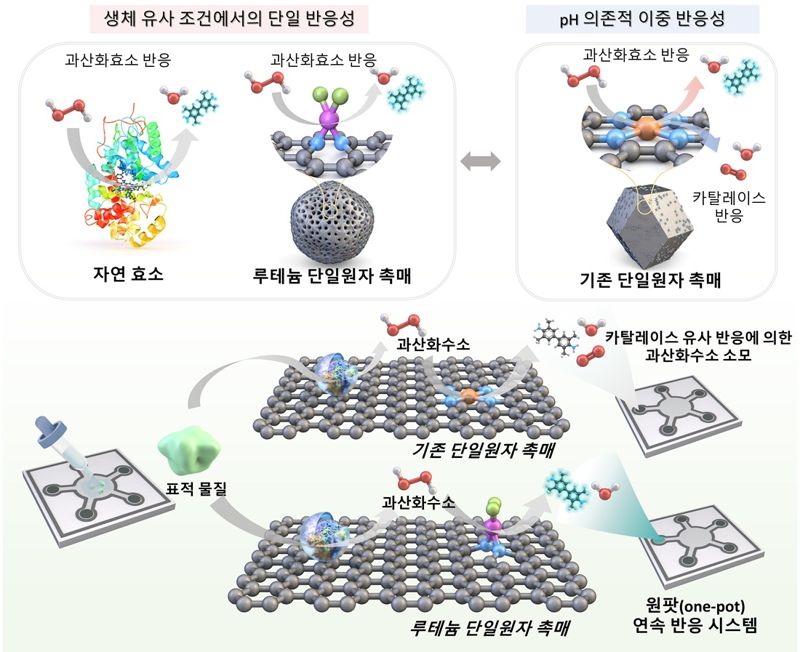
[Financial News] A domestic research team successfully developed a high-sensitivity sensor platform that implements selectivity improved by more than 38 times compared to existing enzyme-mimicking catalysts, allowing visual diagnosis results to be confirmed in just 3 minutes.
KAIST (Korea Advanced Institute of Science and Technology) announced on the 28th that a research team led by Professor Lee Jin-woo of the Department of Biological Chemistry and Engineering, in collaboration with Professor Han Jeong-woo of Seoul National University and Professor Kim Moon-il of Gachon University, developed a new single-atom catalyst that selectively performs only peroxidase reactions while maintaining high reaction efficiency.
Previously, 'enzyme-mimicking catalysts (nanozymes)' that visually detect changes in body fluids such as blood, urine, and saliva for on-site diagnosis have been developed, but they have limitations due to low selectivity of reactions. When using hydrogen peroxide as a substrate, a single catalyst simultaneously induces peroxidase (color change induction) reactions and catalase (reaction substrate removal) reactions, resulting in low diagnostic signal accuracy.
The research team succeeded in detecting only accurate diagnostic signals by utilizing an 'innovative structural design strategy' that combines a 'chlorine (Cl) ligand' in a three-dimensional direction to control the chemical properties by binding with the metal 'ruthenium (Ru)', the central metal of the catalyst, to control the reaction selectivity of the catalyst at the atomic level.
Experimental results showed that the catalyst developed this time was improved by more than 38 times compared to existing enzyme-mimicking catalysts, and the reaction sensitivity and speed according to hydrogen peroxide concentration also increased significantly. In particular, it stably maintained reaction selectivity and activity even in environments close to the conditions of body fluids (pH 6.0), proving its applicability in actual diagnostic environments.
The research team implemented a diagnostic system that can simultaneously detect four types of biomarkers—'glucose, lactate, cholesterol, and choline'—which indicate the health status of our body, through the oxidative enzyme-enzyme-mimicking catalyst linkage reaction by applying the developed catalyst to a paper sensor.
This platform, which can be universally applied to various disease diagnoses, allows visual determination of results within 3 minutes through color change without separate pH adjustment or complex equipment, and this achievement shows that diagnostic performance can be dramatically improved by controlling the catalyst structure without changing the platform itself.
Professor Lee Jin-woo of KAIST emphasized, “This study is significant as it is an example of implementing enzyme-level selectivity and reactivity by controlling the reaction selectivity of single-atom catalysts through atomic structure design,” adding, “This catalyst design strategy based on structure-function relationships can be applied to the development of various metal-based catalysts in the future and can be expanded to various reaction areas where selectivity control is important.”
KAIST doctoral students Park Sun-hye and Choi Dae-eun, who are co-first authors, published the research results in the prestigious international journal in the field of materials science, 'Advanced Materials', on July 6, 2025.
jiany@fnnews.com Reporter Yeon Ji-an