Labor Sector: 'Yellow Envelope Act' Must Pass Quickly Without Retreat
- Input
- 2025-07-28 13:44:23
- Updated
- 2025-07-28 13:44:23
Press conference at the National Assembly to prevent retreat of the Labor Union Act by the two major labor unions
Government's proposal for the Labor Union Act is a step back from last year's National Assembly passage
"Protection for special employment workers, prohibition of individual liability lawsuits must be included"
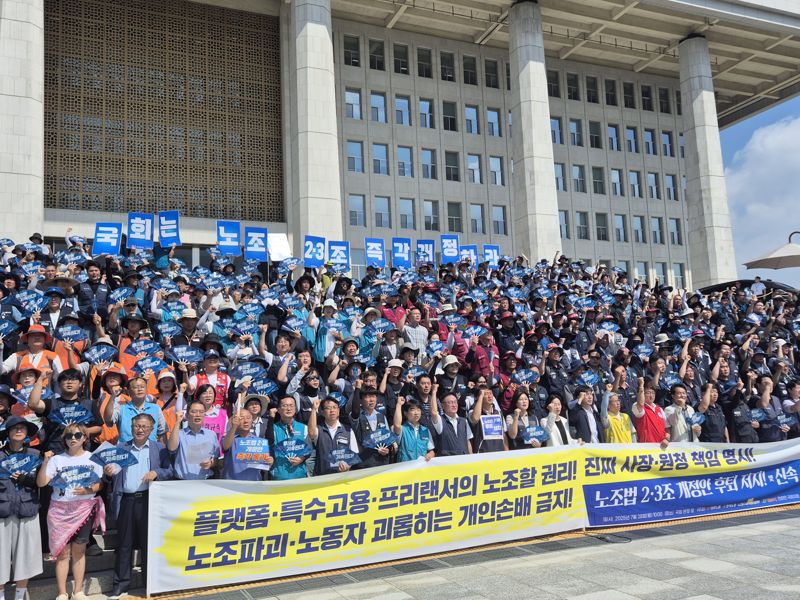
[Financial News] As the review of the amendments to Articles 2 and 3 of the Labor Union Act is underway at the National Assembly's Environment and Labor Committee, the labor sector has urged for the swift passage of the bill without retreat.
The two major labor unions, the Korean Confederation of Trade Unions (KCTU) and the Federation of Korean Trade Unions (FKTU), held a 'Press Conference to Prevent Retreat of Amendments to Articles 2 and 3 of the Labor Union Act' on the morning of the 28th in front of the main building steps of the National Assembly in Yeouido, Seoul, emphasizing that "the amendments to Articles 2 and 3 of the Labor Union Act must pass swiftly without retreat."
The amendments to Articles 2 and 3 of the Labor Union Act, commonly referred to as the 'Yellow Envelope Act', aim to strengthen the responsibility of the main contractor for subcontracted workers, expand the scope of industrial action, and limit companies' claims for damages against striking workers. It is considered one of the long-standing goals of the labor sector.
These amendments passed the National Assembly's plenary session twice in November 2023 and August last year, led by the current ruling party, the Democratic Party of Korea, but were vetoed by then-President Yoon Seok-yeol. The Environment and Labor Committee of the National Assembly has since reintroduced the amendments on the 18th.
However, recently, news has emerged that the ruling party is considering limiting the concept of 'substantial control' in the expansion of main contractor responsibility or delaying the implementation period after holding discussions with economic organizations, leading the labor sector to oppose the "retreating bill."
In particular, they pointed out that the Ministry of Employment and Labor's decision to delay the implementation of the substantial employer provisions of Article 2, Clause 2 of the Labor Union Act by one year and to have the minister establish the subjects, methods, and procedures of collective bargaining by the implementation date was "a retreat plan made without any discussion with the parties involved." They also criticized the delegation of the subjects, methods, and procedures of collective bargaining to an enforcement decree as "directly contrary to the principle of legal reservation defined by the Constitution and the purpose of the Labor Union Act, which guarantees labor-management autonomy."
Accordingly, the labor sector has put forward key demands such as △ the introduction of a presumption clause for workers (protection of special employment workers) △ recognition of the main contractor's employer status for in-house subcontracting △ insertion of a clause prohibiting claims for damages against individual workers.
Yang Kyung-soo, chairman of the KCTU, said, "A world where anyone can join a labor union, a workplace where subcontracted workers can negotiate with the main contractor, and a society where claims for damages and provisional seizures do not infringe on the three labor rights are the minimum standards we have demanded," adding, "We must put an end to this today to create a structure where the three labor rights are guaranteed, and the main contractor and subcontractor can negotiate."
Jeong Yeon-sil, senior vice-chairman of the FKTU, also criticized, "The amendments, known as the Yellow Envelope Act, are the first step to guarantee the minimum rights for workers who have been in the blind spot of labor rights," adding, "However, in the government proposal, the clause limiting liability for damages has been significantly reduced, and the scope of users and labor disputes has also lost its meaning, which is not an expansion of labor rights but a neutralization of labor rights."
She continued, "We see the amendments to the Labor Union Act as a watershed that will determine the relationship between the Lee Jae-myung government and labor," emphasizing, "If the government proposal passes the National Assembly in a retreating form today, we will mobilize all organizations and capabilities to fight to the end for a complete amendment, without accepting any political justification."
Meanwhile, the Democratic Party of Korea and the government have decided to push for the handling of the amendments to Articles 2 and 3 of the Labor Union Act within the July extraordinary session of the National Assembly.
welcome@fnnews.com Jang Yuha reporter