[fn Editorial] "Korean Labor Market is Rigid" 64%, Perspective of Foreign Companies
- Input
- 2025-07-27 19:14:29
- Updated
- 2025-07-27 19:14:29
Hankyung Association, Survey of 439 Foreign-Invested Companies
Urgent Union Practices to Improve are 'Political Strikes'
Urgent Union Practices to Improve are 'Political Strikes'
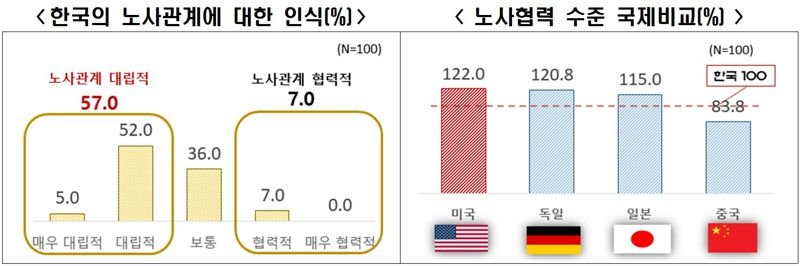
64% of foreign-invested companies (foreign companies) evaluated Korea's labor market as rigid. Only 2.0% said it was flexible. This is the result of a survey conducted by the Korea Economic Association on 439 foreign companies with more than 100 employees. Although not new, it reminds us of the problems of Korea's labor market, which differ from those of advanced countries.
The part where foreign companies feel difficulties in labor-management relations is 'the difficulty of employment adjustment such as dismissal and reassignment' (34%) was the largest. 'Rigid working hour systems such as the 52-hour workweek' (22%) followed. 13% said they had considered withdrawing from business due to strengthened regulations such as working hour regulations or the Serious Accident Punishment Act. As an urgent union practice to improve, 'political strikes linked with higher-level unions' (35%) were pointed out. 57% said labor-management relations were confrontational.
This result is a problem that has been consistently raised by our business community and companies. It is not that we have a particularly negative perception of unions. The influence of unions in Korea's labor-management relations is excessively large compared to foreign countries. Since the 1980s, as the backlash against union suppression intensified, the freedom of labor movements has been expanded beyond global standards.
As a result, the treatment and welfare of union members have improved, but the problem is that union power has become so enormous that it is holding back not only companies but also the entire economy. Large unions have expanded their fighting power based on their strength to the point of being criticized as 'noble unions'. Large unions have become the main force of the upper organization Minnochong, inciting political strikes and becoming an entity difficult for the government to touch.
In this situation, the new government is pushing for legislation to further increase the authority of unions, such as the Yellow Envelope Act. The intention to enhance the activity of subcontracting unions, which are relatively in the shadows, is understandable, but if this bill passes, the burden will be very heavy, and companies will be eager to escape Korea. We saw in the semiconductor sector that the reality of our labor world, where even flexible application of the 52-hour workweek is difficult, can delay technological innovation.
For the industry to develop, Korean companies must be held back from leaving our land, and foreign companies must be more actively attracted and invested in. However, whether it is a Korean company or a foreign company, who would think of operating a business in Korea, where a strong union culture is entrenched?
We need to keep an eye on the movements of companies in the future. If more strengthened laws are implemented while foreign companies are already struggling to operate against unions, the exodus of companies from Korea could accelerate. The power of unions has already grown strong enough to sway the regime.
If more authority is institutionally granted here, it could indeed become a dinosaur-like power. Once given, authority is hard to take back. Therefore, more caution is needed. To make matters worse, even the additional amendment of the Commercial Act is being pursued, dampening the enthusiasm of companies. We must not ignore the earnest appeal to "let companies run."