China Containment-Agricultural Products-Online Platform Law.. Key to Tariff Negotiations for Ruling and Opposition Parties' US Delegation
- Input
- 2025-07-27 06:00:00
- Updated
- 2025-07-27 06:00:00
Korea-US Parliamentary Alliance US Delegation Completes Schedule from 20th to 26th
Contacted not only US Congress but also Trump Administration
Agricultural Products and Online Platform Law were addressed by the government and parliament
The issue is containment of China.. Ruling party is reserved, opposition urges
"Repeatedly heard about China.. Lee government should convey its stance"
Lee government uses shipbuilding cooperation as a major negotiation card
Trump, desperate for cooperation in building and maintaining naval vessels
Contacted not only US Congress but also Trump Administration
Agricultural Products and Online Platform Law were addressed by the government and parliament
The issue is containment of China.. Ruling party is reserved, opposition urges
"Repeatedly heard about China.. Lee government should convey its stance"
Lee government uses shipbuilding cooperation as a major negotiation card
Trump, desperate for cooperation in building and maintaining naval vessels
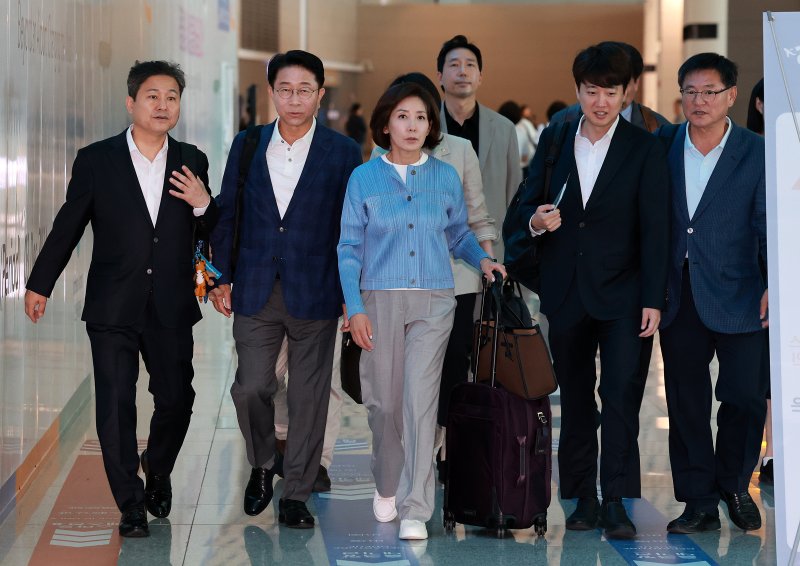
[Financial News] Participation in US's containment of China, easing of non-tariff barriers on agricultural products, reconsideration of the Online Platform Law (Onple Law). These are the main demands conveyed to the 13-member US delegation of the Korea-US Parliamentary Alliance during their 5-night, 6-day visit to the Trump administration and US Congress.
The Trump administration is currently imposing item-specific tariffs of 25% and 50% on automobiles and steel, respectively, and plans to apply a 25% reciprocal tariff starting August 1. As the Lee Jae-myung government is urgently negotiating, the ruling and opposition US delegation identified the main demands of the US side.
According to political circles on the 27th, the US delegation met with more than 20 members of the US House and Senate, officials from the US State and Commerce Departments, think tanks such as RAND and America First Policy Institute (AFPI), and more than 10 members of the Georgia state legislature, where Hyundai and Kia factories are located, to discuss tariff negotiations.
Cho Jung-sik of the Democratic Party met with reporters at Incheon International Airport on the 26th and said, “There are quite a few lawmakers talking about non-tariff barriers on agricultural products and the Onple Law, making it an issue in this negotiation,” and Na Kyung-won of the People Power Party said, “One of the demands was for Korea to take the same stance as the US on containing China.”
The easing of non-tariff barriers on agricultural products is known to be a negotiation card presented by the government. It includes easing the 30-month age limit on US beef and expanding imports of apples and genetically modified organisms (LMO). In the case of the Onple Law, which big US tech companies are strongly protesting as excessive regulation, the National Assembly's Political Affairs Committee has halted its review considering the tariff negotiations.
The problem is the pressure to participate in the US's containment of China. Given that our country is a geopolitical key point in the US-China strategic competition, it is the biggest demand from the US, but it is difficult to comply as we are economically dependent on China as much as the US.
Perhaps because of this, lawmakers from the ruling Democratic Party in the US delegation avoided mentioning China, while opposition lawmakers who value the Korea-US alliance urged that a stance on China be determined.
Representative Na, before returning home on the 25th, said on social media (SNS), “The core message from the US side was to 'definitely bring a negotiation card to the US' and 'definitely participate in the containment of China.'”
Lee Jun-seok of the Reform New Party also wrote on SNS on the same day, “The word repeatedly heard from not only the House and Senate but also think tanks was China,” and demanded, “The Lee Jae-myung government should convey Korea's clear stance to the US around August 1.”
A lawmaker who participated in the US delegation also answered this paper's question about what the US side wanted most, saying, “They wanted participation in the containment of China and practical cards that could be presented to the US.”
Meanwhile, the Lee Jae-myung government, which is the main body of tariff negotiations, revealed that the main demand conveyed by the US side was cooperation in the shipbuilding industry. The presidential office said on the 26th, “We confirmed the US side's high interest in the shipbuilding sector and decided to create mutually agreeable measures including shipbuilding cooperation between the two countries.”
The Trump administration is in a desperate position for cooperation with our country in building new naval vessels and maintaining, repairing, and overhauling (MRO) old vessels. To this end, institutional improvements, including the amendment of the 'Jones Act,' are also being pursued. The Jones Act stipulates that ships operating within the US must be built at ports or facilities located in the US or owned/operated by US citizens.
uknow@fnnews.com Kim Yun-ho Reporter