[fn Editorial] While the U.S. Loosens AI Regulations, South Korea Remains Shackled
- Input
- 2025-07-24 18:18:40
- Updated
- 2025-07-24 18:18:40
Trump promises swift approval and export support
Domestic AI Basic Law 'Fine Suspension' Needed
Domestic AI Basic Law 'Fine Suspension' Needed
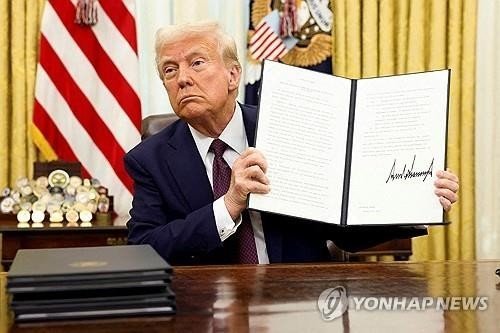
The core of the executive orders signed by President Trump includes speeding up the federal government approval process for the establishment of AI data center infrastructure, promoting the export of U.S. AI models overseas, and excluding ideological bias in AI models. Looking at the details, it promises to expedite the approval process for data centers and semiconductor fabs, which are key to the AI ecosystem. It also includes an action plan to boldly remove regulations that hinder AI development and deployment. There is also content that the U.S. government will roll up its sleeves and actively support private companies to dominate overseas AI standards and expand the export path of AI-related industries.
The U.S., the world's number one AI powerhouse, is not resting on its laurels but is driving to loosen regulations significantly to seize absolute supremacy. President Trump, feeling threatened by China's fierce AI offensive, seems to be going all-in to secure leadership. Even the number one country is removing regulations in a state of anxiety and providing full support, so what about us?
Since the inauguration of the Lee Jae-myung government, our country is also pursuing a bold plan to leap into the top three global AI powers. To achieve such results, the government has promised to invest 100 trillion won in the AI sector. Considering our country's annual budget and economic scale, it is a very large amount. However, compared to the investment scale of major countries like the U.S. and China, it is just a drop in the bucket.
It's not that pouring policy funds makes a country an AI powerhouse, but the reality is that countries around the world that have entered the advanced technology war are competing with a volume offensive. If various regulations are spread like a spider web while the investment scale is far behind, there is nothing more to expect. How can we become number one in the infinite competition towards AI with sandbags tied to our ankles?
A representative issue is the debate surrounding the AI Basic Law. The AI Basic Law, which passed the National Assembly last December, is set to be fully implemented from next year. This law is evaluated as the first comprehensive AI regulatory bill in the country. When the AI Basic Law is implemented, it will certainly help promote the industry by institutionalizing related industries. However, if the Basic Law contains excessive regulations and penalties, companies operating in new industries will inevitably be discouraged. Therefore, the nature of the bill is very important.
In particular, a key issue is that some provisions of this bill make violations of the AI Basic Law's obligations subject to fines. The industry is demanding a suspension, arguing that the AI Basic Law contains excessive regulations that are out of touch with reality. Hoon Bae-gyeong, Minister of Science and ICT, also stated during the personnel hearing period that "a suspension of fines related to the AI Basic Law is necessary."
Compared to President Trump's declaration to remove excessive federal regulations that hinder AI development, our country is still trapped in the framework of regulation. It is desirable for the government to provide maximum support while minimizing intervention for companies running in the industrial field. Excessive regulatory provisions of the AI Basic Law should be relaxed or suspended, and barriers that block development and innovation should be dismantled. We have no room to be tied up in the shackles of regulation ourselves.