Seoul Housing Issue 'Fast Supply' is the Answer... Reducing Redevelopment Period by 5 Years and 6 Months
- Input
- 2025-07-24 18:13:48
- Updated
- 2025-07-24 18:13:48
City Announces Measures to Promote Housing Supply
Introduces Deadline System at All Project Stages
Also Designates Officers for Fairness and Conflict Management
Ensures No Delays After Construction Starts
Introduces Deadline System at All Project Stages
Also Designates Officers for Fairness and Conflict Management
Ensures No Delays After Construction Starts
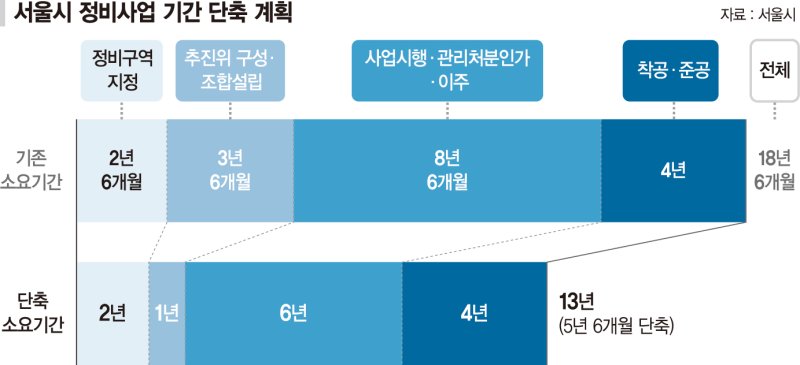
The Seoul Metropolitan Government is introducing a 'processing deadline system' throughout the redevelopment process to significantly shorten the designation period of redevelopment zones and allow 'simultaneous promotion of step-by-step procedures,' such as promoting the establishment of associations simultaneously with zone designation.
Oh Se-hoon, the Mayor of Seoul, visited the Sin-dang-dong 9th district in Jung-gu on the 24th to announce the 'Housing Supply Promotion Plan' including these contents. A city official said, "The core of this announcement is to start construction quickly and proceed with speed."
In detail, the core of this measure is largely 'shortening the redevelopment period' and 'meticulous process management' to prevent project delays. The plan is to enhance both effectiveness and speed by preemptively blocking regulatory barriers and administrative bottlenecks. Specifically, the designation of redevelopment zones will be reduced from 2 years and 6 months to 2 years, the establishment of promotion committees or associations from 3 years and 6 months to 1 year, and project implementation, management disposition approval, and relocation from 8 years and 6 months to 6 years.
First, the designation of redevelopment zones will be completed within 2 years by supporting the establishment of redevelopment plans immediately after selecting candidates for rapid integrated planning redevelopment and omitting separate zone designation consent forms, reducing the existing average of 2 years and 6 months.
The requirements and procedures for public subsidy payments will also be improved. Public subsidies, which were previously paid only after meeting the resident consent rate of 50% or more and completing the rapid integrated pre-planning consultation, will now be provided without separate resident consent procedures. The formation of promotion committees will be possible immediately upon candidate selection.
An 'administrative procedure pre- and parallel system' will also be introduced to process redevelopment-related procedures simultaneously. Appraisal companies will be selected in advance to start evaluations immediately after project implementation approval, and plans are to prepare and apply for the urban planning documents in advance during integrated review. Additionally, structural and excavation reviews will be conducted simultaneously before demolition work to advance the construction start date.
A process management system will also be activated to ensure that permits and construction start without delay after the start of redevelopment projects.
The processing deadline system, which was only applied at the zone designation stage, will be expanded to all stages of redevelopment projects. Standard processing deadlines will be set for each stage, and delays will be monitored by dividing into 42 detailed processes.
'Process Promotion Officers' and 'Conflict Management Officers' will be designated at each project site to identify and resolve potential causes of project delays at the permit stage in real-time, establishing a process and conflict management system.
Meanwhile, the Sin-dang 9th district visited by Mayor Oh is located in the forest zone of Namsan and the station zone of Beotigogae Station, but has been delayed for over 20 years due to difficulties in securing business feasibility due to height restrictions and small-scale development.
The Seoul Metropolitan Government is considering applying the 'Height Regulation Area Public Contribution Relaxation' policy, which has been in effect since last month, to the target site for the first time, reducing the public contribution rate from 10% to a maximum of 2% when upgrading the zoning.
Meanwhile, since the introduction of the rapid integrated planning in 2021, the Seoul Metropolitan Government has actively promoted redevelopment activation measures and various regulatory relaxation policies, resulting in the selection of a total of 241 redevelopment and reconstruction sites (378,000 households) and the designation of 145 sites (194,000 households) as redevelopment zones.
going@fnnews.com Choi Ga-young Reporter