[Companies and Old Newspaper Ads] Car Phones and Brick Phones, and 'Anycall'
- Input
- 2025-07-24 18:01:52
- Updated
- 2025-07-24 18:01:52
Wireless communication gave birth to the mass media known as radio, and the first commercial radio broadcast began in Pittsburgh, USA, in August 1920. The two-way radio was invented by Australian Victoria State police officer Frederick William Downey in 1923. During World War II, Motorola introduced a convenient radio called 'Walkie-Talkie SCR-300', which was crucially used in combat. The walkie-talkie became synonymous with radios. Although the communication distance is short, radios with the advantage of instant communication are used not only for military purposes but also for industrial and police purposes.
The car phone, a vehicle-mounted wireless phone, was first introduced in St. Louis, Missouri, USA, in 1946. It was so large and heavy that it was mainly installed in police cars or taxis. In Korea, car phone service began on August 15, 1961. According to an article at the time, the price of one unit was very expensive at 600 dollars, and it was installed in only 19 official vehicles, 1 mobile post office vehicle, and 80 private vehicles. In an era when even landline phones were rare, making phone calls from a car was a privilege and a luxury. Initially, it was used only by top government officials, including the president, and chaebol chairmen like Samsung and Lucky. Cars with car phones had a long antenna on the back along with a radio frequency permit sticker, which was also a sign that the privileged were riding in them.
By around 1980, there were 306 car phones distributed nationwide. Since frequency sharing was not developed, the communication method was the same as a radio, making it difficult to increase the number of lines, so the number of users was still limited. At that time, the installation cost of a car phone was about 10 million won, which is equivalent to nearly 100 million won in today's value. In October 1982, the world's fourth advanced mobile phone system (AMPS) was introduced, and with the establishment of Korea Mobile Telecommunications Service (now SK Telecom) in 1984, the era of mobile communication began in earnest. By 1985, the number of car phone subscribers increased to about 2600. However, the cost was still comparable to the price of a passenger car.
Research on lightweight portable mobile phones, rather than vehicle-fixed ones, continued. On April 3, 1973, Martin Cooper, an electrical engineer at Motorola, succeeded in making the first mobile phone call in Manhattan, New York, USA. The mobile phone developed by Cooper weighed 1.1 kg. In 1983, the first commercial mobile phone, the Motorola DynaTAC 8000X, was released. It weighed 794g, which was slightly lighter, but its enormous size of 33 cm in length earned it the nickname 'brick phone'. The launch price was 3995 dollars, similar to the price of a small car. Nevertheless, the emergence of a practically portable mobile phone was a 'revolution in telephony'.
In Korea, around 1994, personal communication service (PCS) providers were selected, and mobile phones rapidly penetrated daily life. Unexpected incidents occurred, such as mobile phones being used in college entrance exams' 'tactics' or for exam fraud. Before mobile phones were fully introduced, outgoing-only phones briefly appeared but soon disappeared.
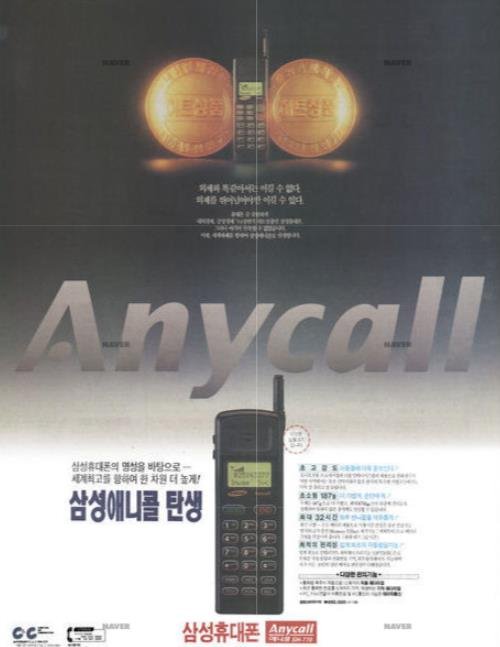
Before Samsung and Hyundai entered the mobile phone manufacturing industry, Motorola almost monopolized the domestic market. Samsung launched the SH-100, followed by the SH-770 under the name 'Anycall' in 1995 (Dong-A Ilbo, October 19, 1995, photo). It was the phone that Chairman Lee Kun-hee ordered to burn 500,000 defective units. Samsung significantly improved quality thereafter, rising to the forefront in a market where Motorola had a 90% dominance.
tonio66@fnnews.com Seongjin Son, Editorial Director