"Why should only we sacrifice?".. Opposition to Importing 30-Month-Old Beef 'Angry Farmers'
- Input
- 2025-07-24 17:28:45
- Updated
- 2025-07-24 17:28:45
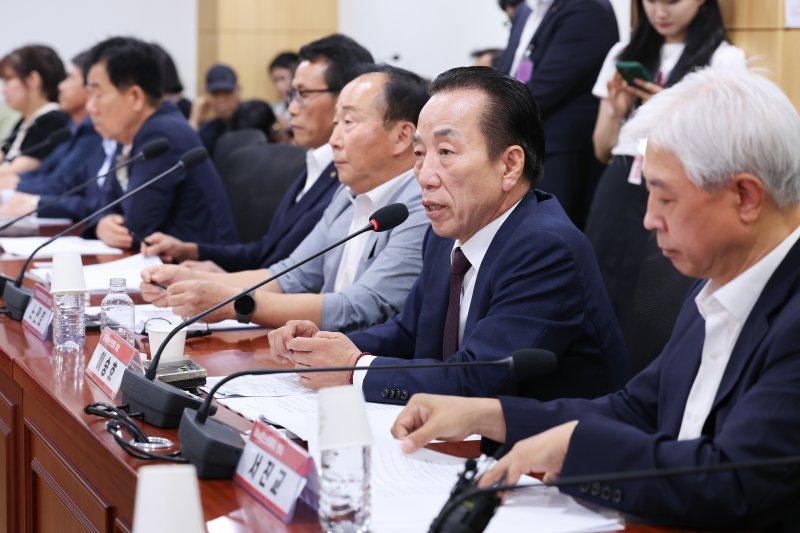
[Financial News] "Under the pretext of national interest, how long must our farms sacrifice?"
On the 24th, at the 'Korea-US Tariff Negotiation, Agricultural and Livestock Market Opening Expansion Review Related Farmers' Group Emergency Meeting' hosted by the People Power Party at the National Assembly Members' Office in Yeouido, Seoul, representatives of farmers' groups showed a unified and agitated response.
Currently, while Korea and the US are negotiating tariffs, the Ministry of Trade, Industry and Energy, which holds the key to the negotiations, is reportedly planning to lower export tariffs on automobiles and steel in exchange for concessions such as importing US beef over 30 months old, easing apple quarantine, and expanding rice imports. Farmers' groups criticized that the agricultural sector, a party to the tariff negotiations, is being 'ignored' by the Ministry of Agriculture, Food and Rural Affairs.
Mingyeongcheon, Chairman of the National Hanwoo Association, said, "US beef over 30 months old is not even well consumed in the US, and I want to ask what can be gained by threatening the survival of domestic farms and unsettling the public's dining table." Lee Seungho, Chairman of the Korea Agricultural and Livestock Federation, said, "Although the Ministry of Agriculture, Food and Rural Affairs was present at the tariff negotiation team, it was effectively 'passed over' in the negotiation strategy process, and the collection of opinions from the agricultural sector was just a formal public hearing," adding, "On the 14th, Yeo Han-gu, head of the Ministry of Trade's Trade Negotiation Headquarters, hinted at the possibility of concessions on agricultural and livestock products, but even if the government brings a negotiation plan, it should be opposed at the parliamentary level."
Hanwoo farmers criticized that they suffered damage from the import of US beef during the Korea-US Free Trade Agreement (FTA) in 2010, but the government's response was inadequate. Nomanho, Chairman of the Korea Comprehensive Agricultural Organizations Council, argued, "Although it was promised to pay 10 trillion won over 10 years, 1 trillion won per year, to support farms suffering from FTA damages, it is unclear whether it was actually implemented," and "It is questionable whether there is any real benefit for our country by conceding the agricultural sector."
According to the Ministry of Agriculture, Food and Rural Affairs, the current domestic beef market is composed of 40% domestic and 60% imported, with imported beef significantly surpassing domestic. Among imports, US beef accounts for 48%, surpassing Australian beef (45%) as the largest importer.
Farmers' groups also criticized the political circles' inconsistent stance on expanding US agricultural imports. "When the People Power Party was the ruling party, they didn't listen to the agricultural sector, but now as the opposition, they have arranged such a meeting," they said, "The Democratic Party should also implement long-term policies for our farmers regardless of being the ruling or opposition party for 5 or 10 years."
Seo Jinkyo, a trade expert at GSnJ Institute, said, "In a situation where the trade deficit between Korea and the US is 65 billion dollars, the impact of increasing the import volume of US agricultural and fishery products, which is at the level of 8.5 billion dollars, may be minimal," adding, "It is more likely that the US will use it as a means to obtain digital tax reductions for US companies in Korea, participation in Alaska LNG development investment, etc., rather than increasing agricultural exports for profit." He added, "Before negotiations, it is necessary to conduct a perception survey on allowing the import of US beef over 30 months old and consider it from the perspective of public health rights."
[email protected] Lee Hwanju Reporter