Government Trust Targeted by Text Scams... "Beware of Livelihood Coupon Smishing"
- Input
- 2025-07-24 16:34:40
- Updated
- 2025-07-24 16:34:40
Concerns about crimes exploiting trust in government messages
"No URLs included in support fund messages"
"No URLs included in support fund messages"
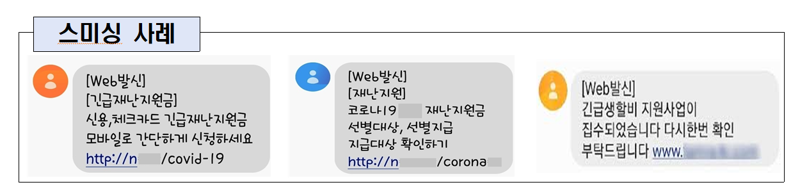
[Financial News] The government has started distributing 'Livelihood Recovery Consumption Coupons' to boost domestic demand, raising concerns about text payment scams (smishing) targeting this initiative. Due to the nature of the policy targeting the entire nation, there is a high possibility of crimes exploiting the public's trust. Authorities are strengthening monitoring to prevent the spread of smishing damage and urging citizens not to click on guide links that appear to be government texts.
According to the Ministry of the Interior and Safety and the Ministry of Science and ICT on the 24th, recent attempts at smishing impersonating the inquiry and application for Livelihood Recovery Consumption Coupons have been discovered, increasing concerns about related damage. Smishing is a portmanteau of 'SMS' and 'phishing', referring to a method where a large number of text messages containing malicious URLs are sent, leading to the installation of apps that steal personal and financial information.
Regarding Livelihood Recovery Consumption Coupons, the main methods include impersonating the government or card companies to induce URL clicks with phrases like 'eligible person' and 'support fund', or connecting to phishing sites to install malicious apps. In some online communities, posts such as "I thought it was an application link, but it turned out to be smishing" and "I almost clicked on a text pretending to be from the government" have been posted.
This type of smishing has occurred in the past as well. In 2020, when the government provided 'Emergency Disaster Relief Funds' to overcome the COVID-19 crisis, similar smishing methods were rampant. At that time, smishers used text messages with keywords like Emergency Disaster Relief Funds to induce URL clicks and install malicious apps to steal personal information.
The reason smishing repeats every time a government policy is implemented is that the public's trust in government messages is easily exploited by criminals. Typically, when the government implements universal policies, it sends out guidance messages to the entire nation in the same manner, which can be a persuasive scam tool for smishers. In fact, the number of smishing cases detected by the Korea Internet & Security Agency last year was 2,196,469, more than four times the number in 2023. Among them, cases impersonating public institutions accounted for 1,258,228, or 60% of the total.
A representative from the Korea Internet & Security Agency's Smishing Response Team said, "Government-implemented policies are often trusted without suspicion by the public, which criminals exploit," adding, "As the application for consumption coupons is currently underway, smishing impersonating related content can be a very good target for criminals."
Authorities believe that new types of smishing may emerge even after the consumption coupon application period ends. Therefore, to preemptively block risks, they are strengthening monitoring of smishing occurrences and reports in cooperation with the Financial Supervisory Service, the National Police Agency, and the Korea Internet & Security Agency. The Seoul Metropolitan Police Agency is also deploying mobile patrol units and local police officers to conduct on-site response activities to prevent smishing damage related to consumption coupons.
A police official emphasized, "Support fund application guide messages do not include URLs or links, so such links should never be clicked," and "If you receive a suspicious text or suspect malicious app infection, please report it to 112 (National Police Agency) or 118 (Korea Internet & Security Agency)."
welcome@fnnews.com Jang Yuha Reporter