12 Billion Mapo Apartment Sold for 8 Billion... Seoul Apartment Prices Slow for 4 Consecutive Weeks
- Input
- 2025-07-24 14:00:00
- Updated
- 2025-07-24 14:00:00
Seoul growth rate at 0.16%, one-third of the peak
Gangnam·Mayongseong slow.. Spread of wait-and-see in outskirts of metropolitan area
Gangnam·Mayongseong slow.. Spread of wait-and-see in outskirts of metropolitan area
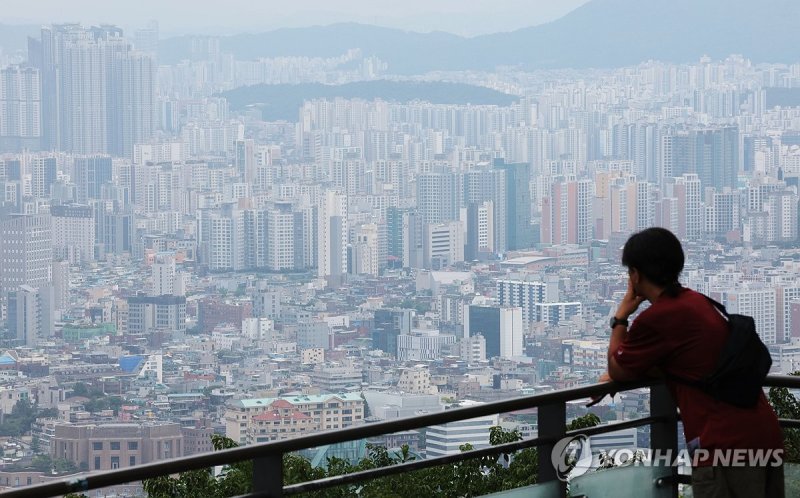
[Financial News] Since the 6·27 loan regulation, the increase in Seoul apartment prices has slowed for four consecutive weeks. As the regulatory effect spreads throughout the market, the overheating trend in Seoul is calming down. In the outskirts of the metropolitan area, such as Gyeonggi and Incheon, buying sentiment is weakening, showing signs of adjustment.
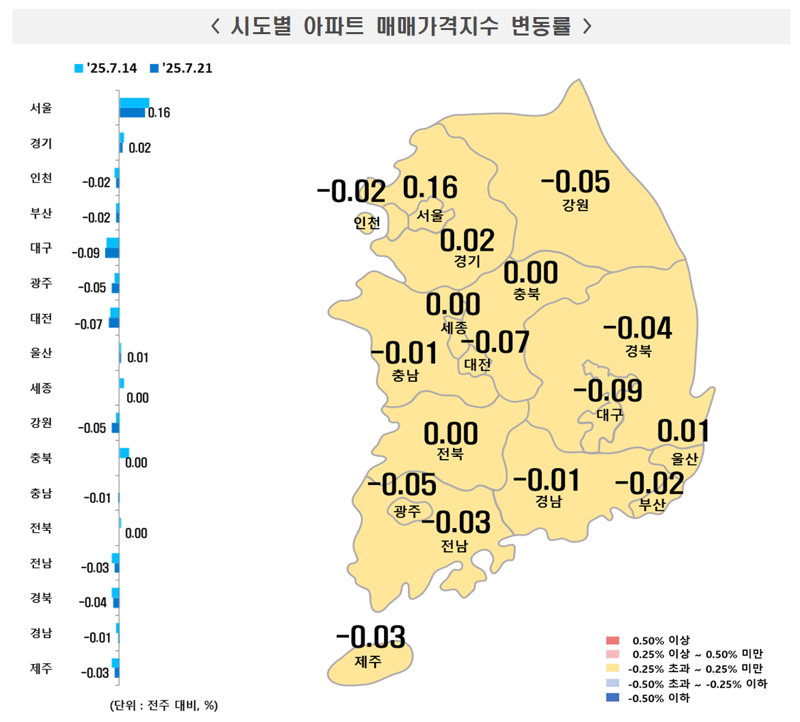
The Korea Real Estate Board announced on the 24th that according to the 'Weekly Apartment Price Trend for the 3rd Week of July (as of July 21)', Seoul apartment prices rose by 0.16%, reducing the increase by 0.03%p compared to the previous week (0.19%). This is one-third of the peak level reached four weeks ago on the 23rd of last month, when it recorded a 0.43% increase, the highest in 6 years and 9 months.
■Gangnam·Mayongseong·Nodogang all slow down
By region, the increase slowed in most preferred areas, including the three Gangnam districts and Mayongseong (Mapo·Yongsan·Seongdong-gu). Seocho-gu decreased from 0.32% to 0.28%, and Gangnam-gu decreased from 0.15% to 0.14%. Only Songpa-gu slightly expanded from 0.36% to 0.43%, but it is interpreted as the effect of local transactions rather than a rebound in market prices. Among the 25 districts, the only areas where the increase expanded were Songpa-gu, Gangseo-gu (0.09%→0.13%), and Jungnang-gu (0.03%→0.05%), making a total of three.
Mayongseong, identified as a balloon effect area of the land transaction permission zone, also faced an adjustment phase. Mapo-gu decreased from 0.24% to 0.11%, Yongsan-gu from 0.26% to 0.24%, and Seongdong-gu from 0.45% to 0.37%, respectively. In Sangam-dong, Mapo-gu, the 'Sangam World Cup Park 3 Complex' exclusive 84㎡ was sold for 1.2 billion won (7th floor) in May but was contracted for 800 million won on the 1st of this month.
Nodogang (Nowon·Dobong·Gangbuk-gu), where apartments under 600 million won are concentrated, also showed signs of adjustment. Nowon-gu decreased from 0.12% to 0.09%, Dobong-gu from 0.06% to 0.02%, and Gangbuk-gu from 0.06% to 0.03%.
In terms of growth rate, Songpa-gu (0.43%), Seongdong-gu (0.37%), Seocho-gu (0.28%), Yangcheon-gu (0.27%), Yongsan-gu (0.24%), Yeongdeungpo-gu (0.22%), and Dongjak-gu (0.21%) were recorded in order.
■Spread of wait-and-see in outskirts of metropolitan area
In the outskirts of the metropolitan area, such as Gyeonggi and Incheon, the adjustment trend is spreading. Although these areas were not initially overheated, the buying trend has weakened further since the loan regulation. Gyeonggi rose by 0.02%, reducing the increase compared to the previous week (0.03%), and Incheon fell by 0.02%, reducing the decrease compared to the previous week (-0.03%).
In Gyeonggi, Gwacheon decreased from 0.39% to 0.38%, and Seongnam from 0.31% to 0.25%. On the other hand, Gwangmyeong (0.11%→0.13%), Hanam (0.04%→0.12%), and Yongin (0.04%→0.07%) showed increased growth, revealing regional differences.
Park Won-gap, Senior Real Estate Expert at KB Kookmin Bank, said, “Due to the high-intensity loan regulation, buyers' sentiment has been dampened, entering a typical adjustment phase,” adding, “Rather than a sharp decline, the wait-and-see trend with reduced transaction volume and slowed growth rate will continue for the time being.” He continued, “Depending on policy variables such as additional government supply measures or changes in the base interest rate, the future trend may change.”
[email protected] Jang In-seo Reporter