Domestic Demand Revives with 0.6% Growth in Q2... Annual 1% Achievement Uncertain [Update]
- Input
- 2025-07-24 08:00:00
- Updated
- 2025-07-24 08:00:00
Q1 Growth Rate Dragged Down by 0.5%p Due to Domestic Demand
Rebounded in Q2 Contributing 0.3%p to GDP
Net Export Contribution from 0.2%p to 0.3%p
ADB Forecasts 0.8% Growth This Year... Attention on 1% Entry
Rebounded in Q2 Contributing 0.3%p to GDP
Net Export Contribution from 0.2%p to 0.3%p
ADB Forecasts 0.8% Growth This Year... Attention on 1% Entry
■Q1 Negative Growth Turns to Increase in 'Private Consumption and Exports'
According to the '2025 Q2 and Annual Real Gross Domestic Product (GDP) Flash Report' released by the Bank of Korea on the 24th, the GDP for Q2 this year grew by 0.6% compared to the previous quarter. It also increased by 0.5% compared to the same period last year.
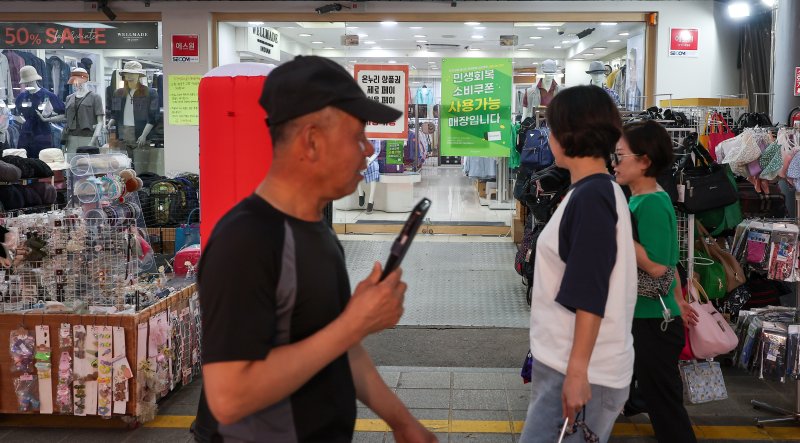
The growth engines driving the domestic economy, private consumption and exports, both increased. In Q2 this year, the growth rate of private consumption decreased by 0.5% compared to the previous quarter, increasing by 0.6%p compared to the previous quarter (-0.1%). This was due to improvements in the consumption of goods such as passenger cars and services such as entertainment and culture.
Exports also turned from a 0.6% negative growth to a 4.2% growth during the same period. Semiconductors, petroleum, and chemical products increased. It was the highest since Q3 2020 (14.6%).
Investment was sluggish. Construction investment decreased by 1.5% as building and civil engineering construction declined. Facility investment also decreased by 1.5% as machinery (including semiconductor manufacturing equipment) decreased. It was the lowest since Q3 2023 (-3.6%). Investment in intellectual property products also experienced a 0.4% negative growth.
Imports decreased by 3.8%, focusing on energy products such as crude oil and natural gas. It was the highest since Q1 2023 (3.3%). Government consumption increased by 1.2%, focusing on health insurance benefits.
By sector, manufacturing turned from a 0.6% negative growth in the previous quarter to a 2.7% increase. It was the highest since Q1 2022 (3.2%). Although the information and communication industry decreased, the service industry, including wholesale and retail trade, accommodation and food services, and real estate, increased, turning from a 0.2% negative growth in the previous quarter to a 0.6% growth. The construction industry expanded its negative range from a 0.4% negative growth to a 4.4% negative growth during the same period.
■Robust Domestic Demand... Lifts GDP by 0.3%p
In terms of growth contribution by entity, the government was surveyed at 0.1%p and the private sector at 0.5%p. The government's growth contribution was the same as in the previous quarter, while the private sector rebounded by 0.8p compared to the previous quarter (-0.3%p).
By item, domestic demand lifted GDP by 0.3%p in Q2. Although construction investment (-0.2%p) and facility investment (-0.1%p) were sluggish, they turned from a 0.5%p negative growth in the previous quarter to an increase.
Net exports slightly improved compared to the previous quarter (0.2%p), contributing 0.3%p to the growth rate, while private consumption, which dragged down the growth rate by 0.1%p in the previous quarter, and government consumption, which recorded a flat trend, both recorded a contribution of 0.2%p, showing improvement.
By economic activity, agriculture, forestry, and fisheries decreased by 1.4%, focusing on fisheries. The electricity, gas, and water supply industry decreased by 3.2%, focusing on electricity.
Real Gross Domestic Income (GDI) significantly improved from the previous quarter (-0.6%), increasing by 1.3%. It was a figure that exceeded the real GDP growth rate (0.6%), marking the highest since Q1 last year (1.9%) on a quarterly basis.
■Annual Economic Growth Rate Entry into 1% Range Still Uncertain
However, despite the 0.6% growth in Q2, the achievement of a 1% economic growth rate this year remains uncertain. This is because the overall growth trend may slow down due to the imposition of item-specific tariffs by the Trump administration and the pressure of mutual tariff imposition, which could lead to export contraction. The sluggish construction market is also evaluated as a factor slowing down growth.
The Asian Development Bank (ADB) also significantly lowered its forecast for Korea's economic growth rate this year to 0.8% in its economic outlook released on the 23rd. It lowered it from the 1.5% presented in April to the 0% range. The ADB cited △decrease in construction investment △export sluggishness △weak real estate market as factors for Korea's growth slowdown.
In particular, the ADB predicted that exports would be further contracted due to the overlapping of U.S. tariff increases and global trade uncertainty. Accordingly, the ADB adjusted Korea's economic growth rate for next year from 1.9% in April to 1.6%, a 0.3%p downward adjustment. The ADB's analysis is that the impact of trade uncertainty caused by the Trump administration's tariff war will continue until next year.
The biggest growth momentum in the second half of the year is expected to be the recovery of consumption due to the supplementary budget. Lim Hye-yun, a researcher at Hanwha Investment & Securities, said, “Over the past two years, the household consumption growth rate has consistently fallen below 1% because income recovery has been slow and interest costs have increased,” adding, “Strengthening income growth, expanding financial assets, and reducing interest costs are positive factors for consumption, and these indicators, which are closely related to purchasing power, are turning around.”
She added, “If consumer sentiment improves and the supplementary budget is added, consumption recovery can be expected.”
eastcold@fnnews.com Kim Dong-chan Reporter