[fn Editorial] Hardening 0% Growth, Difficult to Overcome Anti-Business Moves
- Input
- 2025-07-23 18:05:02
- Updated
- 2025-07-23 18:05:02
ADB also lowers growth rate to 0.8%
Yellow Envelope Act and corporate tax increase should be reconsidered
Yellow Envelope Act and corporate tax increase should be reconsidered
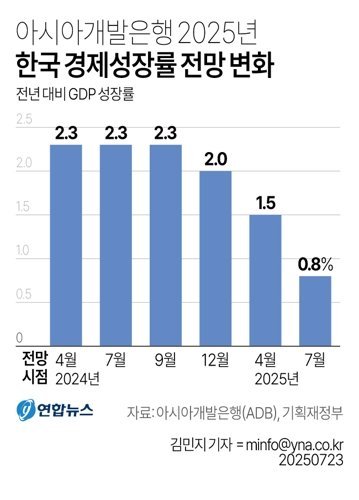
The decline was the third largest after Thailand and Singapore. Major countries such as China, Hong Kong, Taiwan, and India have seen little change in the past three months. Not only this year's 0% growth but also next year's 1% growth is unique to us among major countries. Earlier, the Bank of Korea and the Korea Development Institute (KDI) also lowered this year's growth rate to 0.8%, predicting a gloomy economy. With ADB joining in with similar forecasts, it should be seen that Korea's growth rate is effectively solidifying at 0%.
Since the new government took office, political uncertainty has somewhat eased, and there are forecasts that domestic demand will recover in the second half of the year thanks to expansionary fiscal policies such as consumption coupons. ADB also emphasized this, but the problem is the tariff risk and the export that has started to backtrack. ADB predicted that despite the government's strenuous efforts to revive domestic demand, Korea's only pillar of growth, exports, will be severely shaken due to the impact of tariff shocks from the U.S. in the second half. This is not the end; it pointed out that growth constraints will not improve until next year, and we must be prepared for a dark outlook, which should not be taken lightly.
The government is rushing to execute a supplementary budget of 35 trillion won in two stages to revive domestic demand. However, as advised by ADB, the limitations of this method of growth traction are clear. While consumption coupons may bring a temporary warmth to local markets, it is nothing more than a symptomatic treatment. For sustainable warmth, there must be vibrancy in the industrial field, and a new engine sound must resonate to break through external uncertainties.
Above all, what must be guarded against is the populism in front of us. It means that policies should not be stubbornly adhered to just to satisfy the tastes of the support base in pursuit of approval ratings. Nevertheless, looking at the recent actions of the government and ruling party, there are quite a few bills that only look at the support base, ignoring institutional reform. The Yellow Envelope Act, which would allow 'blind' strikes, or the 4.5-day workweek without wage cuts, and uniform retirement extension are typical examples. These are all policies that hold back businesses.
The current labor market is too dominated by unions for global standards to apply. Even the proposal to lift the 52-hour workweek restriction for advanced professionals has been met with opposition from the labor community, preventing any progress. Despite this, the government and ruling party are pushing ahead with the Yellow Envelope Act, which expands union power, and are insisting on extending retirement and reducing working hours, making one doubt whether they have any will to pursue growth. The same goes for the amendment to the Commercial Act, which has turned into a stock market boost measure, or the corporate tax increase plan to secure tax revenue.
What the Korean economy needs is a growth breakthrough based on principles. It is urgent to change the structure and build a system that increases productivity, even if it involves harsh pain. The shoulders of companies, which should be at the forefront of growth, must become heavier, and there is no way to overcome low growth other than for the government to remove the sandbags tied to companies' ankles. According to the August Business Survey Index (BSI) survey of the 600 largest companies released by the Korea Economic Association that day, the business outlook has been negative for 41 months. Anti-business bills must be put down first.