Osan Retaining Wall Collapse, Suspicion of Shoddy Construction Over Cause of Accident.. Road Left Unattended for 12 Years, Collapsed 2 Years After Opening
- Input
- 2025-07-23 12:49:42
- Updated
- 2025-07-23 12:49:42
Different construction companies for sections 1 and 2 of the Western Bypass where the accident occurred, section 1 left unattended for 12 years
Collapse accident 2 years after completion of section 2, already collapsed once 7 years ago
Complaints of sinkholes, cracks, etc. continue... Concerns over the stability of the 'reinforced earth method' with weak drainage are also spreading
Collapse accident 2 years after completion of section 2, already collapsed once 7 years ago
Complaints of sinkholes, cracks, etc. continue... Concerns over the stability of the 'reinforced earth method' with weak drainage are also spreading
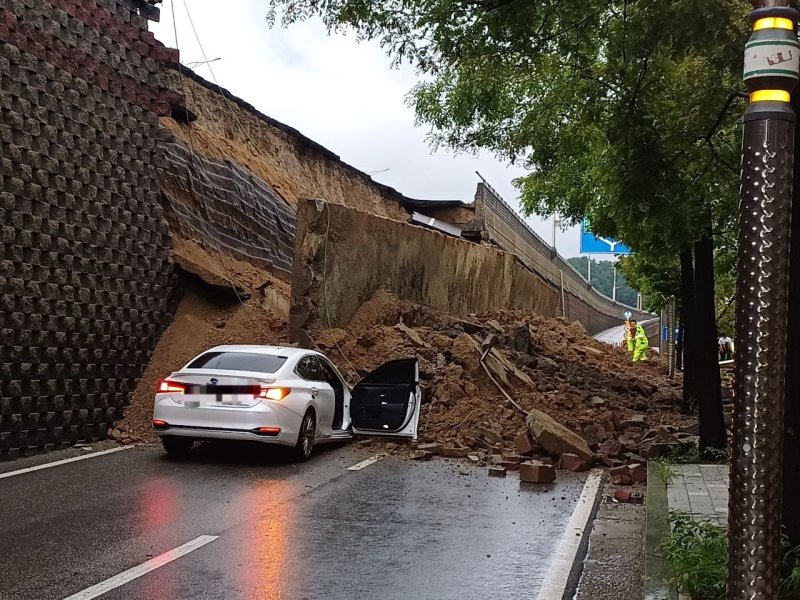
The road was left unattended for 12 years, and the collapse accident occurred only 2 years after it was opened for use, adding to the controversy over the 'reinforced earth retaining wall' method applied in the construction.
Different construction companies for sections 1 and 2, road left unattended for 12 years, collapse accident 2 years after opening... Suspicion of shoddy construction
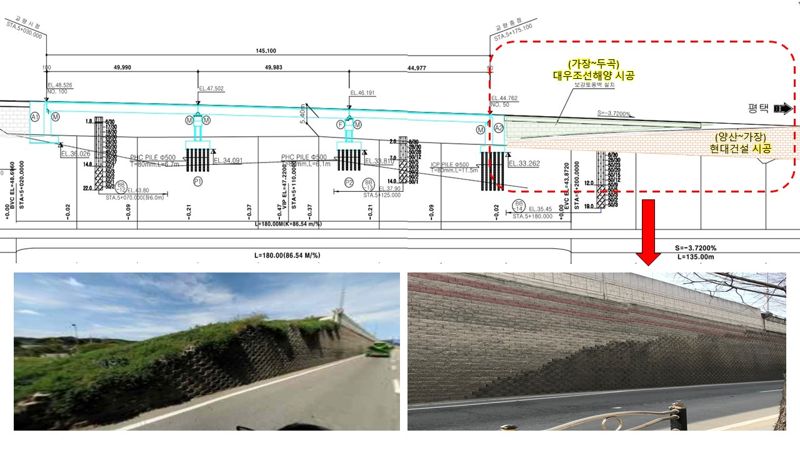
According to the coverage by Financial News on the 23rd, the collapsed retaining wall on the Western Bypass where the accident occurred was constructed by different contractors in two instances in 2011 and 2023, and the total length of 27.6 km was divided into sections 1 and 2 ordered by Korea Land and Housing Corporation (LH).Section 1 from Yangsan to Gajang was constructed by Hyundai Construction according to the Seogyo 1 District Metropolitan Transportation Improvement Plan and was completed in December 2011.
Subsequently, section 2 from Gajang to Dugok was constructed by Daewoo Shipbuilding & Marine Engineering according to the Seogyo 2 District Metropolitan Transportation Improvement Plan, and all sections of the Western Bypass were opened in September 2023.
The Suwon-bound retaining wall section where the collapse accident occurred on the 16th was a section completed by Hyundai Construction in 2011, and it was identified that the upper section completed by Daewoo Shipbuilding & Marine Engineering in 2023 was built over this section, and in this process, the section 1 section was left unattended for about 12 years.
The problem, in particular, is that while constructing section 2, the retaining wall of the section was not newly built, but the retaining wall was completed by stacking it on top of the lower retaining wall that had been left unattended for over 12 years.
In this case, even if it is a reinforced earth retaining wall, differences in construction methods, internal materials used, drainage, etc., by contractor can lead to reduced stability, which is why concerns are being raised.
Already collapsed once 7 years ago... Was the reinforced earth method appropriate
In addition, stability issues are being raised regarding the 'reinforced earth method' used in the collapsed retaining wall. The collapsed retaining wall is constructed using the reinforced earth method, which involves inserting reinforcement between soil layers to fix the wall structure.
Compared to concrete retaining walls, it is preferred due to lower construction costs and shorter construction periods, but experts say that 'drainage management' is very important as it involves filling the interior with soil.
Among nearby residents, there are reports of witnessing 'retaining wall bulging' phenomena or water leaking between retaining walls, and complaints have been continuously received about sinkholes, cracks, and ground subsidence occurring on the road that has been open for only 2 years.
In fact, a report of collapse concerns was received through the National Sinmungo the day before the accident occurred on the 15th.
Additionally, the retaining wall opposite the collapsed one had already experienced a collapse accident once in 2018, 7 years ago, and since both retaining walls were constructed using the 'reinforced earth method', the controversy over whether there was a problem with the method itself is also spreading.
According to an Osan-si official, although drainage was installed for the section 2 retaining wall, it is known that drainage was not installed for the section 1 retaining wall, raising the possibility that inadequate drainage may have been a cause of the accident.
Osan-si, which is in charge of road management, conducted a detailed safety inspection in June this year and received a B grade good rating, and planned to re-construct the site after inspecting the site following a complaint through the National Sinmungo the day before the accident.
Regarding this, an LH official said, "It is understood that the collapsed section is not a 'connection section' between the two construction companies, and the construction was carried out legally," adding, "Since the investigation into the cause of the accident is underway, it is difficult to provide specific answers now."
Earlier, at around 7:04 p.m. on the 16th, a 10-meter-high retaining wall of the elevated road in the Suwon direction of the Gajang Intersection in Gajang-dong, Osan-si collapsed, covering a passenger car passing below, killing the driver, a man in his 40s.
jjang@fnnews.com Jang Chung-sik Reporter