16.5% of National Land Area Houses 92.1% of Population.. Concerns Over Accelerating 'Metropolitan Concentration'
- Input
- 2025-07-23 14:02:49
- Updated
- 2025-07-23 14:02:49
Ministry of Land, Infrastructure and Transport and Korea Land and Geospatial InformatiX Corporation Announce '2024 Urban Planning Status'
Development Activity Permits Continue to Decline, Growth Management Plan Areas Increase 13.7 Times
Development Activity Permits Continue to Decline, Growth Management Plan Areas Increase 13.7 Times
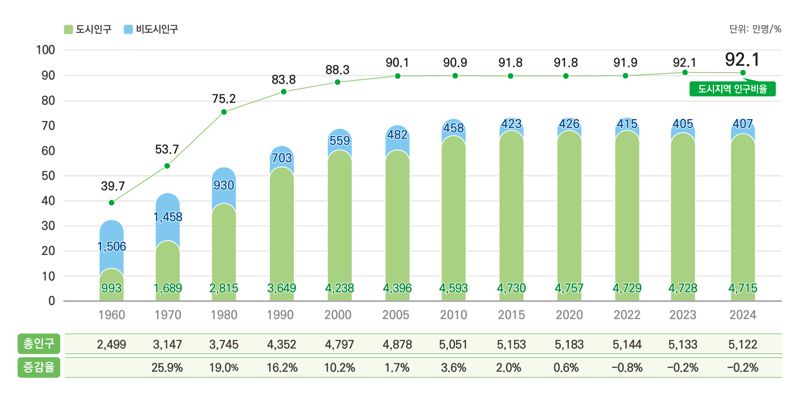
[Financial News] Although urban areas account for only 16.5% of the total national land, 92.1% of the total population is concentrated there. Within cities, residential and industrial areas are increasing while green areas are decreasing, indicating a change in usage structure. While development activity permits have decreased, growth management plan areas have surged. Despite urban policies shifting from development to management and maintenance, concerns about metropolitan concentration worsening persist.
The Ministry of Land, Infrastructure and Transport and Korea Land and Geospatial InformatiX Corporation announced on the 23rd the '2024 Urban Planning Status Statistics' containing such information. According to the statistics, urban area size is 17,639㎢, accounting for 16.5% of the total national land (106,567㎢), with 47.15 million residents registered. This means 92.1% of the total registered population (51.22 million) lives in cities.
By usage area, industrial areas within cities increased by 4.8% (58㎢) over five years, residential areas by 3.1% (83㎢), and commercial areas by 2.8% (10㎢) respectively. On the other hand, green areas decreased by 76㎢, a 0.6% reduction. Overall, the usage area size expanded by 0.3% (356㎢) compared to five years ago due to factors like reclamation projects.
The growth management plan area expanded from 899㎢ in 2023 to 4,259㎢ this year, an increase of 373.7% (3,360㎢) in terms of area. During the same period, the number of designations also surged from 336 to 11,975, a 13.7-fold increase. This is analyzed as an effect of the mandatory establishment of growth management plans for factory installations in planned management areas starting this year.
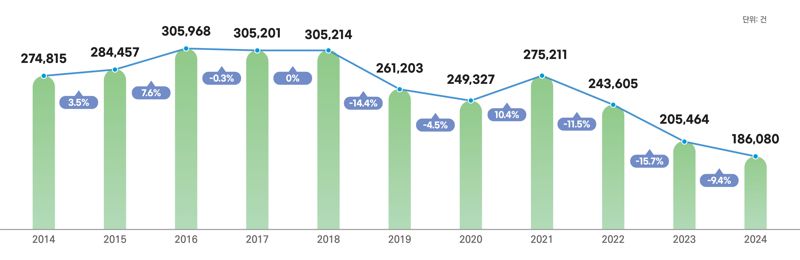
Development activity permits decreased for three consecutive years to 186,080 cases last year. By item, building construction was the most with 90,769 cases (48.8%), followed by land form changes (50,949 cases), and structure installations (27,401 cases). Long-term unexecuted urban and military planning facilities also decreased by 63.9% (603㎢) from 10 years ago to 340㎢. A Ministry of Land, Infrastructure and Transport official explained, "This is the result of continuously releasing unnecessary facilities in preparation for the urban planning facility effectiveness system since July 2020."
Experts analyze that these statistics show the trend of urban structure changes. Lee Eun-hyung, a research fellow at the Korea Construction Policy Institute, explained, "Most of our country is mountainous, so flat land available for housing and development is limited," and "The concentration of population in urban areas is a structural characteristic." He further diagnosed, "As population decline and aging progress, the concentration in metropolitan areas is likely to intensify further."
en1302@fnnews.com Jang In-seo Reporter