'1.8 Trillion Electronic Warfare' Battlefield Moved by Hanwha Systems-LIG Nex1
- Input
- 2025-07-23 14:21:56
- Updated
- 2025-07-23 14:21:56
Hanwha Systems, Complete Digital High-Power Jamming Gambit
LIG Nex1, Showcasing Technology such as Fixed-Wing Embedded Ultra-Wideband Array Transmission and Reception
LIG Nex1, Showcasing Technology such as Fixed-Wing Embedded Ultra-Wideband Array Transmission and Reception
[Financial News] Hanwha Systems and LIG Nex1 are competing in the 'Electronic Warfare' battlefield with a business scale of approximately 1.8 trillion won. Hanwha Systems is responsible for mission equipment in a consortium with Korea Aerospace Industries (KAI). LIG Nex1 is developing electronic warfare in a consortium with Korean Air, which is responsible for aircraft modification. It is the first showdown after LIG Nex1, which monopolized the Engagement Control System (ECS), and Hanwha Systems, which has strengths in ballistic missile operation control centers, MCRC, ADC2A, and other integrated air defense command systems, have started developing integrated air defense comprehensive solutions, drawing attention.
Hanwha Systems 'Jamming' Technology Specialization
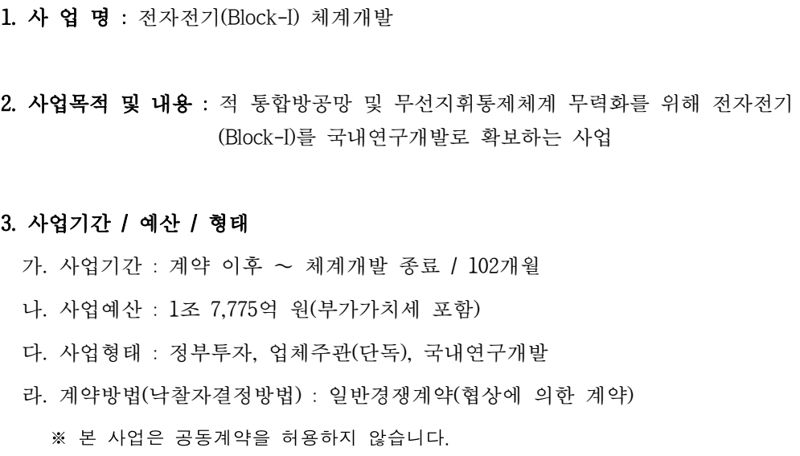
According to the industry on the 23rd, the Defense Acquisition Program Administration will hold a briefing session on the 'Electronic Warfare (Block-I) System Development' project, which is a project to secure electronic warfare (Block-I) through domestic research and development to neutralize enemy integrated air defense networks and wireless command and control systems. The project scale is 1.7775 trillion won, and it has entered the plan to build independent electronic warfare capabilities from the mid-2030s. With the electronic bidding registration closing on September 1, it is known that the Hanwha Systems-KAI and LIG Nex1-Korean Air consortiums will form camps and participate. 'Electronic warfare' uses jamming (radar interference) to neutralize or disrupt enemy air defense networks, supporting friendly fighter squadrons to safely carry out operations and protecting friendly fighter squadrons infiltrating enemy air defense networks. The jamming transmission equipment, which is the core of electronic warfare, is very important for its ability to simultaneously respond to multiple radar threats, unlike existing aviation jamming transmission equipment. The technology to generate jamming signals that can interfere with multiple radio waves simultaneously is a key element of electronic warfare.
Hanwha Systems participated as a prototype company for the 'Smart Multi-Beam High-Power Transmitter' led by the Agency for Defense Development, which is a preliminary core task of the electronic warfare project, to implement this technology. It successfully developed the 'completely digital-based high-power jamming transmitter' capable of generating simultaneous multi-jamming signals for the first time in Korea.
In addition, it is the only company in Korea to possess 'AESA technology and equipment' that can simultaneously generate and transmit various types of jamming signals to multiple frequencies to counter multiple threats. Unlike the existing analog method, it is manufactured based on a completely digital system, significantly improving signal processing speed and efficiency.
Hanwha Systems applied digital-based electronic warfare receiver design technology for the first time in Korea during the development of the KF-16 mounted tactical electronic intelligence collection system (TAC-ELINT), which is a fighter-mounted electronic warfare equipment. When developing radar warning equipment for small armed helicopters, it applied phase comparison direction-finding technology to radar warning equipment for the first time in Korea.
LIG Nex1 'Electronic Warfare System' Strengths
LIG Nex1 shows strengths in core technologies related to future electronic warfare platforms, such as fixed-wing embedded ultra-wideband array transmission and reception technology, real-time broadband multi-threat signal environment simulation technology, and electronically scanned radar response jamming technology. Based on this, it is developing integrated electronic warfare equipment for the KF-21, next-generation ship electronic warfare equipment, submarine electronic warfare equipment, and electronic information mission equipment to be mounted on the new Baekdu reconnaissance aircraft. It is expected to be in charge of electronic warfare system development based on 47 years of research and development and business performance related to electronic warfare.
LIG Nex1 is developing an electronic warfare platform that encompasses air, ground, sea, and unmanned vehicles. In the air, it is developing an integrated electronic warfare system to be mounted on the KF-21 fighter. On the ground, it is developing ground electronic warfare equipment that intercepts and disrupts enemy command and communication network signals, and at sea, it is developing ship electronic warfare systems that apply high-power semiconductor-based jamming transmission technology. It is also concurrently developing a counter-drone electronic attack weapon system for unmanned vehicle response.
An LIG Nex1 official said, "We will do our best to successfully carry out the Korean-style electronic warfare system development project, which can guarantee the stealth and maximize the survivability of air force operations, in collaboration with Korean Air, which is responsible for aircraft purchase and modification."
ggg@fnnews.com Kang Gu-gwi Reporter