[fn Editorial] SME Policy, from Survival Support to Growth Promotion
- Input
- 2025-07-22 18:03:04
- Updated
- 2025-07-22 18:03:04
Support increased but competitiveness declined
Shift focus from small enterprises to selective and concentrated approach
Shift focus from small enterprises to selective and concentrated approach
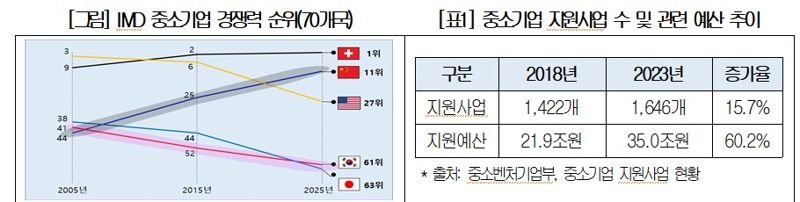
According to the report, the number of SME support projects increased from 1,422 in 2018 to 1,646 in 2023. The budget also increased significantly from 21.9 trillion won to 35 trillion won, a 60% increase. However, in the SME competitiveness ranking published by the International Institute for Management Development (IMD) in Switzerland, Korea fell from 41st in 2005 to 61st in 2025. This contrasts sharply with China, which rose significantly from 44th to 11th during the same period. Despite the large budget input, the results were contrary.
The report confirms fundamental issues in SME policies. Firstly, 96.7% of SME businesses in our country are concentrated in small enterprises with fewer than 50 employees. Only 3.3% have more than 50 employees. This is significantly lower compared to Germany (9.2%) and Japan (7.4%). Small enterprises cannot escape a labor-intensive structure. Labor costs are high, but wages are not.
No matter how much budget is poured into these small enterprises, it cannot dramatically enhance competitiveness. At best, it can only maintain the status quo. SME policies have focused solely on quantitative expansion, neglecting to enhance competitiveness in terms of scale.
The proliferation of small enterprises is due to SME policies being trapped in the principle and logic of 'supporting all companies equally'. The notion that even small companies should not fail led to the provision of policy funds as a benevolent supply, resulting in an increase in low-competitiveness companies.
The Lee Jae-myung administration has set an ambitious goal of raising the potential growth rate from 1% to 3%. However, without SMEs with global competitiveness, improving the growth rate is impossible. The conclusion is that the paradigm of SME policies must be fundamentally changed. A strategic mindset of 'nurturing competitive companies' is required instead of a benevolent approach of 'saving all companies'. Budgets and policies operate on the principle of scarcity in reality. Limited support measures should be selectively invested in companies with high growth potential to create a healthy SME ecosystem. Growing companies should be rewarded, and innovative companies should be incentivized to foster healthy competition among entrepreneurs. If policy funds can be steadily secured, only zombie companies that settle for reality will proliferate.
The direction of policy transition is clear. A systematic master plan for SME development must be devised. It is time to actively consider a plan to classify and provide differentiated support for 'promising and high-growth' SMEs. Tax benefits are also needed to actively support mergers and acquisitions to expand the size of SMEs with potential to enter global markets.
Conversely, SMEs based on traditional manufacturing should focus on digital transformation and productivity improvement to enhance capabilities. In the era of the Fourth Industrial Revolution, a labor-intensive structure cannot survive in global competition. Structural transformation must be achieved quickly through smart factories, automation equipment introduction, and data-driven management innovation. We hope the new government does not repeat the outdated SME policies of the past.