'34,000 Football Fields' of Farmland Submerged.. Table Prices to Rise Further
- Input
- 2025-07-22 17:23:17
- Updated
- 2025-07-22 17:23:17
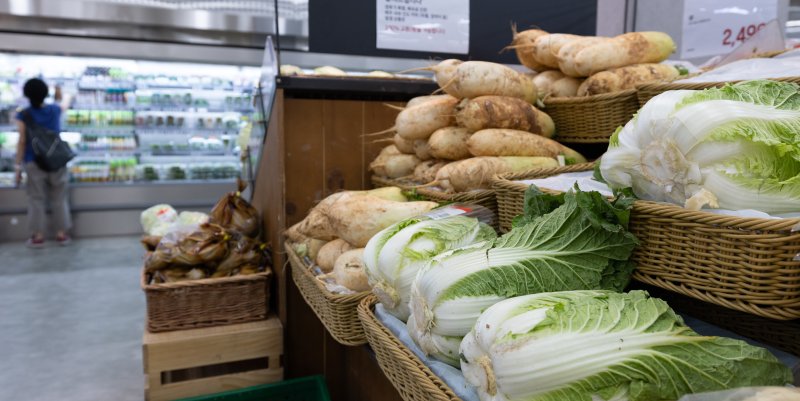
[Financial News] With the repetition of monsoon rains and heatwaves, the condition of major agricultural areas nationwide has rapidly deteriorated, raising concerns about a supply crisis for major crops frequently appearing on the table. Due to flood damage, the growth of fruits and vegetables has significantly declined, reducing their marketability, and the prices of some items have soared. As supply instability spreads, especially among popular summer items, the distribution industry is also taking emergency measures, such as securing alternative production areas.
Cabbage up 30%, Pork up 10%
According to the Ministry of Agriculture, Food and Rural Affairs on the 22nd, it was tentatively estimated that crops over an area equivalent to 34,000 football fields were submerged due to heavy rains from the 16th to the 19th. Flood damage was concentrated in the central and southern production areas, including peppers, soybeans, and rice, as well as summer fruits and vegetables like watermelons and strawberries. Leafy vegetables, which are prone to rot or decay, are rapidly suffering damage as heavy rains and heatwaves repeat.
The producer price index (PPI), a basic indicator of agricultural product prices, has also started to be affected by abnormal weather. The PPI for June, announced by the Bank of Korea, rose by 0.1% compared to the previous month, rebounding for the first time in three months. In particular, cabbage prices rose by 31.1%, pork by 9.5%, and eggs by 4.4%, leading the agricultural and fishery products index to rise by 0.6% compared to the previous month, driving the overall inflation trend. The Bank of Korea analyzed that "the reduction in agricultural production due to the late shipment of spring cabbage and the effects of abnormal high temperatures and heavy rains are major factors."
In the distribution industry, there is speculation that the price increase trend will begin in earnest from this weekend due to the aftermath of heavy rains. A distribution industry official said, "It seems that there will be disruptions in supply due to significant flood damage in the Jeonnam and Chungnam regions," adding, "MDs (merchandise planners) are all on-site checking the possibility of securing alternative production areas." Another industry official said, "It's not a shortage of supply to the extent of calling it a supply crisis," but added, "As the weather has affected the harvest, prices may rise, and as it gets rapidly hotter after the heavy rains, there is also concern about the occurrence of diseases, so we are closely monitoring the situation."
Distribution Industry Struggles to Secure Alternative Production Areas
As the supply of agricultural products is in a state of emergency due to flood damage, the distribution industry is struggling to secure alternative production areas. Emart is quickly deploying 'Mountain Watermelons' from high-altitude areas over 300m in Yanggu, Bonghwa, and Yeongyang in Gangwon Province, and is swiftly switching production areas to Gangwon before the zucchini and cucumber supplies from Chungcheong and Gyeonggi are exhausted. Mountain watermelons grown on hillsides are selected and sold with a sugar content of over 11 Brix, and the supply has been expanded by 20-30% compared to the previous year. In addition, the 'seedless watermelon', which is resistant to flooding due to its thick skin, is also being operated early. GS The Fresh is focusing on securing agricultural product supplies from northern and central regions with less heat damage in response to supply instability. An industry official said, "With the heatwave continuing, the heavy rains have further deteriorated growth, and after the summer monsoon, concerns about pests and diseases are also increasing," adding, "There is a high possibility that supply instability and price uncertainty will continue until mid-August."
As agricultural product prices, which directly affect shopping basket prices, fluctuate, the government has also stepped in. President Lee Jae-myung instructed at a cabinet meeting today, "Although coupon distribution to stimulate consumption has begun, there are many reactions that the prices of daily necessities like watermelons and meat have risen excessively," and ordered a swift and strict response to price management. In addition, President Lee also ordered each ministry to prepare additional consumption promotion programs.
clean@fnnews.com Lee Jeong-hwa, Jeong Sang-hee, Kim Dong-chan, Seo Young-jun reporters