Jeong Eun-kyeong, Minister of Health and Welfare: "Will Quickly Resolve Medical Conflicts"
- Input
- 2025-07-22 12:32:23
- Updated
- 2025-07-22 12:32:23
Expressed intention to quickly resolve medical conflicts through inaugural speech
Presented strengthening of public healthcare system as a key task
Focused on recovery of medical field and system reform, action-oriented administration
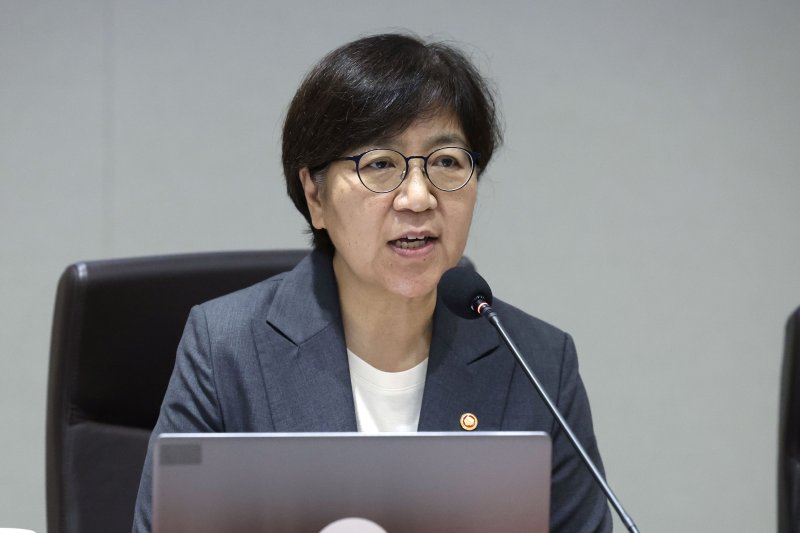
[Financial News] Jeong Eun-kyeong, the new Minister of Health and Welfare, officially took office on the 22nd and presented the reform of health care centered on the people, the quick resolution of medical conflicts, and the strengthening of the public healthcare system as key tasks.
In her inaugural speech, she emphasized, "Now is the time for the Ministry of Health and Welfare to refocus on its original role of 'promoting public health,'" stressing action-oriented administration for the recovery of the medical field and system reform.
Minister Jeong addressed the ongoing conflict with the medical community, emphasizing that restoring trust is a prerequisite for medical reform. She stated, "The prolonged medical conflict is shaking the medical field," and announced, "We will create a sustainable dialogue structure where the government and the medical community can empathize and cooperate."
She also stated, "Policy is not a one-sided delivery, but must be acceptable to both medical professionals and the public to be sustainable," making it clear that the Ministry of Health and Welfare will focus on listening to voices from the field and restoring trust with the medical community.
Minister Jeong mentioned the crisis of the collapse of public healthcare and the shortage of essential medical personnel, diagnosing, "It is difficult to guarantee the sustainability of the medical system as it is."
She announced the introduction of the 'Medical Workforce Supply and Demand Estimation Committee' to scientifically perform the estimation of medical workforce supply and demand, and based on this, she plans to establish an appropriate workforce scale and a stable supply system.
As a control tower for essential regional healthcare, national university hospitals will be systematized, and the central government plans to switch to direct management of public healthcare under the Ministry of Health and Welfare. Through this, the plan is to reduce regional medical disparities and restore public healthcare capabilities in neglected areas such as emergency and obstetrics.
Plans were also presented to establish an institutional foundation to meet the accelerated demand for non-face-to-face medical care following the COVID-19 pandemic. Additionally, it was announced that the primary healthcare system based on the community will be strengthened to improve efficient medical accessibility centered on patients with mild conditions.
Minister Jeong promised to pursue health and welfare policies that the public can actually feel, in addition to improving access to medical care. Plans to alleviate the medical expenses burden for patients with rare and intractable diseases, expand sickness benefits, and strengthen early detection and intervention for high-risk suicide groups were also emphasized for building a health safety net throughout the life cycle.
In particular, regarding suicide prevention, she stated, "The government will take the lead to remove the dishonor of having the highest suicide rate in the OECD," and announced plans to expand support for suicide attempters and make mental health policy a major agenda of the state.
Minister Jeong also presented plans to foster the K-bio and vaccine industry, along with the establishment of an AI-based digital healthcare ecosystem. Plans to support the safe use of health care data and establish a system for training physician-scientists to enhance future competitiveness were also outlined.
vrdw88@fnnews.com Kang Jung-mo Reporter