Losing Power: Japan's Abe Faction, 100 Members → 53 Members
- Input
- 2025-07-22 12:03:50
- Updated
- 2025-07-22 12:03:50
The largest faction within the Liberal Democratic Party, the former Abe faction, shrinks rapidly
From over 100 members last year, successive defeats
Impact on future presidential elections and government operations
From over 100 members last year, successive defeats
Impact on future presidential elections and government operations
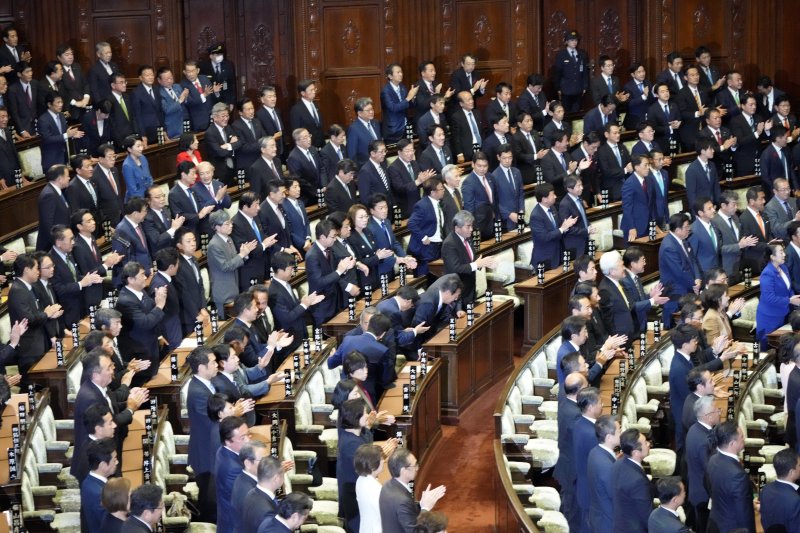
【Tokyo=Kim Kyung-min, Special Correspondent】 The Liberal Democratic Party's largest faction, the 'Abe faction', has noticeably weakened following a defeat in the House of Councillors (Upper House) election. Once numbering around 100 members, the faction has dwindled to about 40 members following a political funding scandal. The internal power dynamics of the party are rapidly being reshaped along with their decline.
According to local media and others on the 22nd, the factional forces within the Liberal Democratic Party have undergone significant changes over the past year through major elections. The current factional structure reflecting this election is △Former Abe faction 53 members △Former Motegi faction 44 members △Aso faction 43 members △Former Kishida faction 37 members △Former Nikai faction 29 members △Former Moriyama faction 7 members.
Except for the Aso faction, the other factions have formally dissolved, but the connections between former leaders and affiliated members remain, making it likely they will act as a single force in major situations such as presidential elections.
The Abe faction suffered a critical blow in last year's House of Representatives (Lower House) election. About 60% of the candidates were defeated, reducing the faction, which once numbered over 100 members, by nearly half. In the recent House of Councillors election, they continued to suffer defeats or failed to run, further reducing their seats.
As a result, compared to the presidential election last year, the former Abe faction has decreased by a total of over 40 members. Criticism remains within the party that they were the cause of distrust in the party due to omissions in the political funding report, preventing a recovery.
Key figures of the Abe faction, such as former Policy Research Council Chairman Hagiuda Koichi and former Minister of Economy, Trade and Industry Nishimura Yasutoshi, had their party membership and positions suspended until April, but have not regained their previous influence.
The Aso faction, former Motegi faction, former Kishida faction, and former Nikai faction also decreased by about 10 members each compared to last year's presidential election, but the Abe faction's decline was the greatest. As a result, the gap between the Abe faction and other factions has significantly narrowed, leading to changes in the party's power balance.
In last year's presidential election, the background to non-factional Prime Minister Ishiba Shigeru's victory was the dispersion of support from the Abe and Aso factions, while the former Kishida faction turned to support Ishiba in the runoff. In the Ishiba Cabinet, key positions are held by Kishida-affiliated members such as Chief Cabinet Secretary Hayashi Yoshimasa, Policy Research Council Chairman Onodera Itsunori, and Election Strategy Committee Chairman Kihara Seiji.
The defeat in the recent House of Councillors election has raised questions about the Prime Minister's responsibility both inside and outside the party. If some factions organize opposition against Prime Minister Ishiba, who has declared his intention to remain in office, the political burden could increase.
In terms of Japan-South Korea relations, the Abe faction, which led a hardline conservative stance, has weakened, and the political base of the Ishiba Cabinet is also shaken by the election defeat, raising questions about policy continuity. As the internal power structure of the Liberal Democratic Party fluctuates, uncertainty about the diplomatic stance towards South Korea is also increasing.
km@fnnews.com Kim Kyung-min, Reporter