'Supoja Decreased' Green Light for 11th Grade Math Proficiency Recovery
- Input
- 2025-07-22 12:00:00
- Updated
- 2025-07-22 12:00:00
2024 National Level Academic Achievement Assessment Results Announced
Recovery Trend After COVID-19... Confirming the Importance of School Classes
Some Subjects and Urban-Rural Gaps Remain as Challenges
Recovery Trend After COVID-19... Confirming the Importance of School Classes
Some Subjects and Urban-Rural Gaps Remain as Challenges
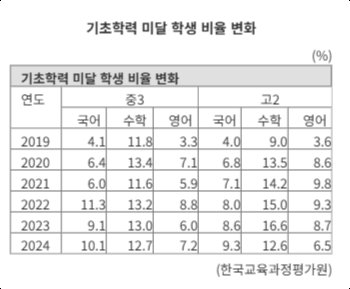
[Financial News] The number of 'math dropouts (Supoja)' in 11th grade has significantly decreased. Particularly, during the COVID-19 pandemic, the proportion of students with average and excellent academic achievement decreased, and the number of students below basic level increased, but this trend is gradually improving with positive changes.
The Korea Institute for Curriculum and Evaluation announced on the 22nd that according to the 2024 national level academic achievement assessment results, the proportion of 11th grade students below basic academic ability (level 1) in math decreased by 4.0%p compared to the previous year. This is a significant decrease from 16.6% in 2023 to 12.6% in 2024. Similarly, the proportion of 11th grade students at level 1 in English also decreased from 8.7% to 6.5% during the same period, showing a positive trend in academic recovery.
Jeong Yoon-gyeong, a director at the Ministry of Education, explained, "During the COVID pandemic, schools could not operate normally, leading to a drop in academic achievement, but it has gradually increased since then," adding, "This shows the importance of school classes." The improvement in 11th grade math and English is seen as the result of continuous efforts in the education field to recover from academic losses after the pandemic.
However, not all subjects showed such positive changes. In the case of 9th grade Korean, the level 1 proportion increased from 4.1% in 2019 to 10.1% in 2024, and 11th grade Korean also increased from 4.0% to 9.3% during the same period. This suggests that despite improvements in certain subjects, continuous attention and support are needed to reduce the overall number of students below basic academic ability. The proportion of students at level 3 or above, indicating excellent students, remains generally low compared to 2019, requiring more active efforts for academic recovery.
Additionally, the academic achievement assessment revealed a clear gap in academic achievement between urban and rural areas among middle school students. The proportion of 9th grade Korean students at level 3 or above was 68.2% in urban areas, compared to 57.3% in rural areas, showing a difference of 10.9%p. Similar gaps were observed in math and English. In math, the proportion of students at level 3 or above was 50.1% in urban areas and 37.8% in rural areas, while in English, it was 63.3% in urban areas and 51.5% in rural areas. Conversely, the proportion of level 1 students was higher in rural areas.
This gap in academic achievement between regions is analyzed to be due to complex factors such as educational infrastructure, teacher supply, and students' learning environment. Particularly, rural areas have relatively poor educational conditions compared to urban areas, and often have a high proportion of students from diverse backgrounds, such as multicultural students, making it difficult to provide tailored educational support. Therefore, there is a pressing need for customized policies and intensive investment to bridge the educational gap between regions.
Meanwhile, attention should also be paid to changes in students' emotional characteristics, in addition to academic achievement levels. The 2020 academic achievement assessment analysis showed a declining trend in emotional characteristics such as confidence, interest, and learning motivation based on subjects across middle and high schools compared to 2019. In fact, the 2024 academic achievement assessment showed that the proportion of students with 'low academic self-efficacy' was 6.1% for 9th grade and 4.9% for 11th grade, and particularly for 9th grade, the proportion of 'low resilience' increased significantly to 8.5%. Losing interest and confidence in subjects can have a significant impact on long-term learning motivation, so educational support for holistic growth through emotional stability and stress management capacity enhancement is essential.
monarch@fnnews.com Kim Manki Reporter