"Pioneering New Markets Beyond Electric Vehicles is Urgent"... K-Battery Discusses Finding New Paths
- Input
- 2025-07-21 17:00:08
- Updated
- 2025-07-21 17:00:08
Battery Association Holds 'OBBA Legal and Visa Response Strategy Seminar'
"Pioneering New Markets Such as ESS, Drones, and Robots is a Current Challenge"
"Pioneering New Markets Such as ESS, Drones, and Robots is a Current Challenge"
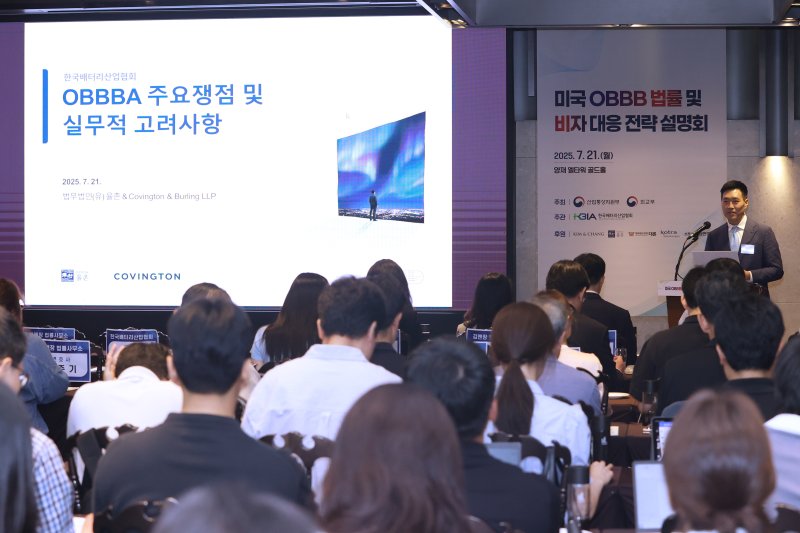
[Financial News] As US President Trump signed the 'One Big Beautiful Bill Act (OBBBA)', which includes the abolition of electric vehicle subsidies starting this year, it has been suggested that domestic companies urgently need to preempt new markets beyond the electric vehicle market.
The Korea Battery Industry Association held the 'US OBBA Legal and Visa Response Strategy Seminar' on the 21st at the El Tower in Seocho-gu, Seoul. The seminar was attended by Kim & Chang Law Office, Yulchon LLC, Korea Trade-Investment Promotion Agency (KOTRA), and over 150 industry officials related to the US OBBBA laws, including batteries, solar power, wind power, and heavy electrical equipment.
Park Tae-sung, Vice Chairman of the Korea Battery Industry Association, stated, "Although there is a burden on our companies to switch supply chains due to the introduction of the Prohibited Foreign Entity (PFE), there are opportunities due to the blockage of China's entry into the US market," adding, "We hope that the US and Korea will actively utilize OBBBA to strengthen US-Korea battery supply chain security cooperation and expand new cooperative projects in AI, robotics, defense, and next-generation battery fields."
Experts on the day agreed that as the demand for electric vehicles, the main source of income for battery companies, is expected to decrease, active pioneering of new markets must be carried out. New markets mentioned included not only Energy Storage Systems (ESS) but also wireless industries such as drones and robots.
Park So-yeon, a foreign attorney at Kim & Chang Law Office, analyzed, "Although the 45x (advanced manufacturing production tax credit for local battery production companies) has survived, if the 30d (electric vehicle subsidy) disappears, the 45x benefits will inevitably be reduced," adding, "For companies, pioneering new markets such as ESS could be an opportunity."
Yoo Seok-cheon, Team Leader of KOTRA's Global Supply Chain Business Team, also suggested, "Due to regulations on China, domestic battery companies could have an opportunity," adding, "By collaborating with companies entering new markets such as AI, robotics, and drones, battery demand expansion can be expected."
Hwang Kyung-in, Director of External Cooperation at the Korea Institute for Industrial Economics & Trade, pointed out, "So far, the domestic battery industry has tended to be influenced by electric vehicle sales," adding, "Creating new demand as infrastructure based on electrification, wireless, and decarbonization is a current challenge."
OBBBA is a large-scale tax cut bill signed by President Trump on the 4th. Until now, electric vehicles assembled in the US and meeting battery requirements could receive a subsidy of up to $7,500 (about 1 million won) under the Inflation Reduction Act (IRA). However, as the OBBBA bill becomes a reality, the end date of the electric vehicle subsidy system has been brought forward from the end of 2032 to September this year. one1@fnnews.com Reporter Jeong Won-il