Deputy Prime Minister Koo Yoon-cheol Visits 'Traditional Market', "Current Growth Rate 0%, Consumption Coupons Needed"
- Input
- 2025-07-21 17:00:00
- Updated
- 2025-07-21 17:00:00
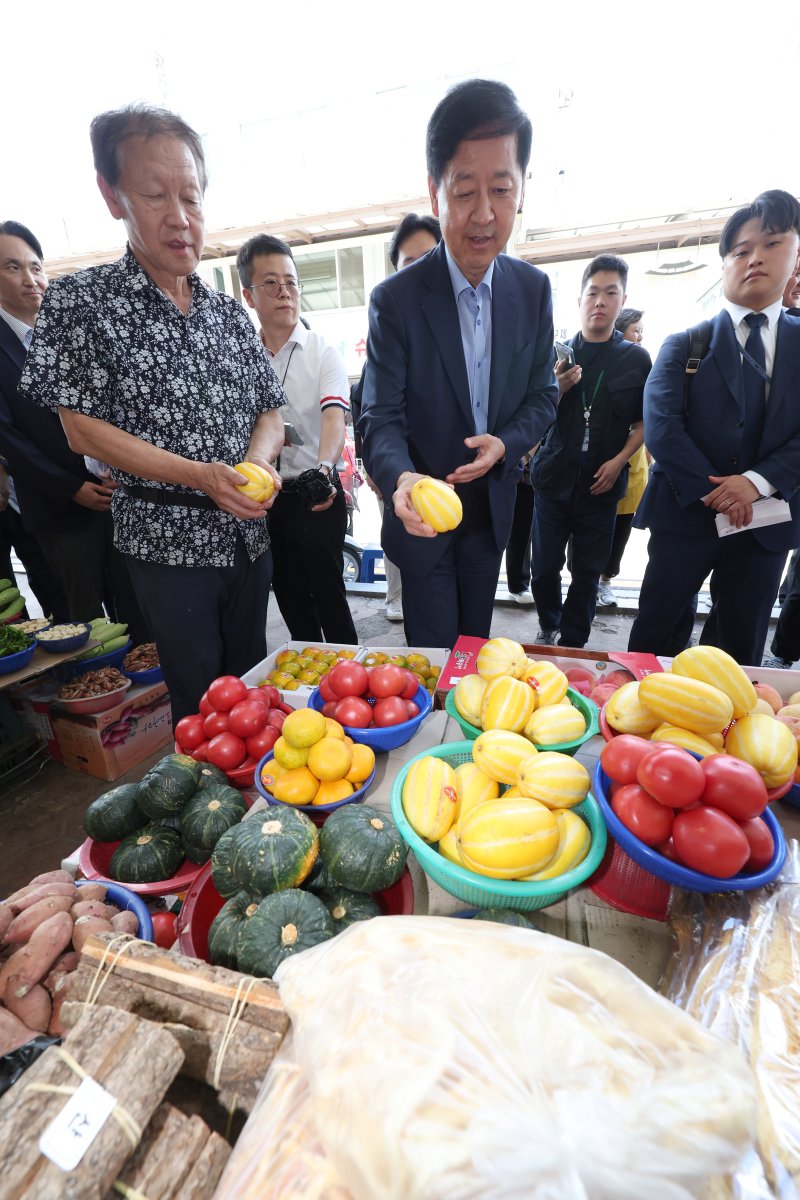
[Financial News] Deputy Prime Minister for Economic Affairs and Minister of Strategy and Finance Koo Yoon-cheol said on the 21st, the first day of issuing consumption coupons for livelihood recovery, "Except for the foreign exchange crisis and financial crisis, the current growth rate is almost 0%. The first quarter of this year was negative," adding, "Consumption coupons are needed in such times."
He cited the urgent need for domestic demand recovery as the reason for the consumption coupon policy, as the real GDP in the first quarter of this year decreased by 0.2% compared to the previous quarter.
Minister Koo visited Gongju Sanseong Market in Gongju City, Chungnam at 2 PM on this day as his first field visit since taking office. He listened to the opinions of small business owners at five places, including Woongjin Rice Cake Shop and Baekje Fisheries, for about 30 minutes. He checked whether the livelihood recovery consumption coupons, which began to be applied and issued from this day, were being used well. He directly used the local love gift certificate to purchase a box of peaches for 25,000 won. He inquired about the price trends of products with rising prices, such as domestic squid and watermelon.
Deputy Prime Minister Koo expected that the livelihood recovery consumption coupons would contribute to expanding sales for small business owners and self-employed people who have suffered from consumption stagnation. He also expected that consumption coupons would play a priming role in stimulating consumption and revitalizing the local economy amid economic recession and high inflation. However, he explained that consumption coupons are a "short-term response" for domestic demand recovery. He proposed a plan to create a virtuous cycle structure where consumption increases based on enhanced competitiveness centered on core industries and increased income in the medium to long term.
In response to a question about criticism related to the fiscal sustainability of consumption coupons, he said, "It's not about saving the region with consumption coupons, but about circulating the economy like circulating blood in difficult times," adding, "In the medium to long term, we must truly develop the country. We have the idea of growing the economy centered on specific industrial items. If we do this well, people's incomes will increase even without giving consumption coupons."
Deputy Prime Minister Koo believed that consumption coupons would be more effective in local areas.
He said, "The region is much more difficult than the metropolitan area," adding, "We have the idea of making Korea where regions live well as much as the metropolitan area through regional balanced development." Regarding the concern that consumption coupons could raise prices, he said, "Since demand has rather fallen now, inventories are piling up," adding, "We are considering increasing supply in cases where demand is concentrated on specific items."
Deputy Prime Minister Koo also conveyed a message that he would actively allocate the budget related to climate response in next year's budget. He said, "Recently, a lot of damage has occurred due to heavy rains. We will restore the damage as soon as possible," adding, "Climate variability is becoming very large. We will do our best to include as much budget as possible in next year's budget for preemptive prevention."
Meanwhile, the government started accepting applications for the 'Livelihood Recovery Consumption Coupons' for all citizens on this day and began the first payment. The first payment application is until September 12. The basic payment per person ranges from 150,000 won to a maximum of 450,000 won. Although all residents living in Korea are eligible, additional amounts are added depending on income level and regional conditions. Regionally, non-metropolitan residents are given an additional 30,000 won per person, and residents in rural population decline areas are given an additional 50,000 won. Separately from the first payment, the second payment goes through an income selection process using health insurance premiums. An additional 100,000 won per person will be given to the general public, excluding the top 10% of income earners.
junjun@fnnews.com Choi Yong-jun Reporter