[Exclusive] Korean Air issues corporate bonds "Properly evaluate the value"
- Input
- 2025-07-21 10:53:25
- Updated
- 2025-07-21 10:53:25
Approaching major securities firms with 7-year bonds included
Following this year's 700 billion won corporate bonds, additional issuance expected in the second half
Korean Air's credit rating returns to A0 grade after 11 years
Ahead of the launch of the integrated airline in the second half.. Raising the value
Following this year's 700 billion won corporate bonds, additional issuance expected in the second half
Korean Air's credit rating returns to A0 grade after 11 years
Ahead of the launch of the integrated airline in the second half.. Raising the value
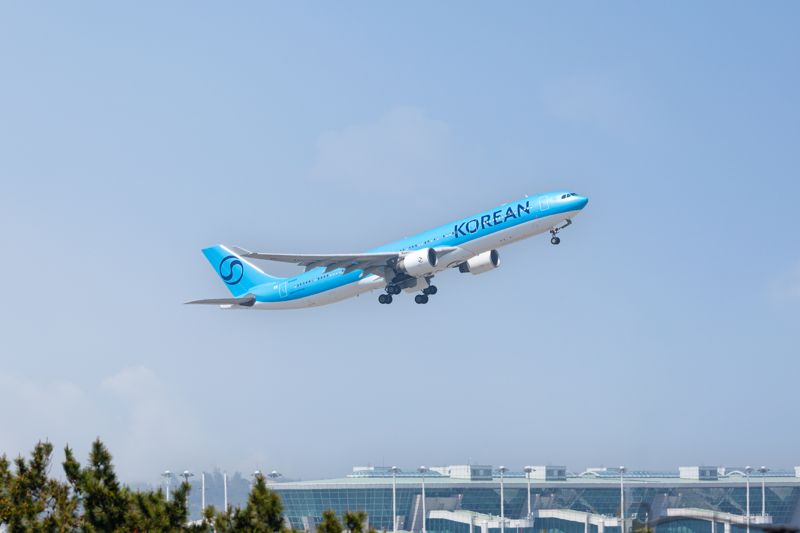
[Financial News] It has been confirmed that Korean Air is considering issuing corporate bonds, including 7-year bonds. This is to consider issuing long-term bonds favorable for securing funds for future business investments. In particular, expectations are rising as HD Hyundai's corporate bond demand forecast with the same credit rating has been successful. The recent tapping (demand survey) related to Korean Air's corporate bond issuance is also read as a signal to "properly evaluate the value."
According to the industry on the 21st, it has been confirmed that Korean Air recently conducted tapping (demand survey) related to corporate bond issuance targeting major securities firms. The main point is to positively review the issuance of 3-year, 5-year, and 7-year bonds. This follows the issuance of corporate bonds worth 350 billion won each in January and May this year.
It seems that HD Hyundai (A+/Stable), which recently succeeded in issuing the 17-3 series non-guaranteed public offering bonds with a maturity date until July 16, 2032, also stimulated Korean Air. HD Hyundai issued 7-year corporate bonds worth 40 billion won (with an issuance yield of 3.682% per annum). The competition rate for 7-year bonds in the demand forecast exceeded 8 to 1.
Already, Korean Air's 2-year and 3-year corporate bonds have been treated as AA credit ratings in the market. This is because it is creating a stable cash flow as a national airline and benefiting from the recovery phase after COVID-19. The market is also positively reviewing the issuance of Korean Air's 7-year bonds. A positive atmosphere has been formed, such as receiving orders worth about 790 billion won in the 200 billion won target corporate bond demand forecast.
If Korean Air succeeds in raising funds through long-term bonds, it is expected to gain momentum in future business. In April, Korean Air was selected as the preferred bidder for the 961.3 billion won UH-60 (Black Hawk) performance improvement project by the Defense Acquisition Program Administration. The first delivery of the performance-improved aircraft is targeted for 2029.
In the UAV sector, performance growth in the reconnaissance and strike sectors is expected to accelerate after 2027. Korean Air's UAV portfolio is diversified by operating altitude and weight, from small drones to multipurpose stealth aircraft and medium-altitude UAVs. Korean Air has also signed an MOU (Memorandum of Understanding) with the US defense company Anduril to enhance unmanned and manned complex capabilities.
In response, a Korean Air official said, "We are monitoring the market," adding, "No specific issuance plan has been decided yet."
Previously, Korean Air made a capital increase payment of 1.5 trillion won to acquire 63.9% of Asiana Airlines' new shares in December 2024. As a result, Korean Air and Asiana Airlines have secured a fleet of 234 aircraft, including 208 passenger aircraft and 35 cargo aircraft (12 of which are scheduled for sale).
Kim Jong-hoon, a researcher at Korea Corporate Rating, said, "Despite the burden of acquiring Asiana Airlines, Korean Air's sound financial stability is expected to be maintained," adding, "The combined financial indicators after the acquisition are expected to remain significantly improved compared to before the pandemic."
In fact, Korean Air's debt ratio, which reached 814% on a separate basis before COVID-19, fell sharply to 328% on a consolidated basis at the end of last year.
The EBITDA, which represents cash generation ability, also increased before and after the acquisition. EBITDA, which was 3.5129 trillion won in 2023, increased by 11.2% to 3.9062 trillion won in one year. At the same time, the impact of credit rating improvement is also positive as the burden of financial costs is expected to decrease in the future.
Korean Air aims to operate a total of 223 or more aircraft by the end of 2026 and to become one of the world's top 10 airlines. It is pursuing strategies to maximize integration synergies, such as readjusting overlapping routes, developing new routes, and turning Incheon Airport into a transfer hub.
The cost of purchasing aviation fuel accounts for more than 30% of the total cost for airlines. The launch of the integrated airline is expected to have the effect of reducing unit costs through bulk purchases. It is estimated that cost savings of about 200 billion won can be achieved in various areas, including airport slot negotiations and supply chain management.
ggg@fnnews.com Kang Gukui Reporter