Local Education Budget Decreases by 31.3 Trillion in 3 Years... Public Education on the Brink, What About the Students?
- Input
- 2025-07-20 12:00:00
- Updated
- 2025-07-20 12:00:00
18 Trillion Reduction in Grants Due to Reassessment of Tax Revenue for Two Consecutive Years
5.9 Trillion Transferred to Special Account for High School and Lifelong Education Support
Official Statement Released by National Association of City and Provincial Education Superintendents
5.9 Trillion Transferred to Special Account for High School and Lifelong Education Support
Official Statement Released by National Association of City and Provincial Education Superintendents
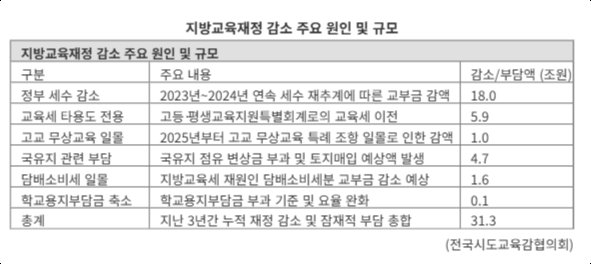
A representative from the National Association of City and Provincial Education Superintendents stated regarding some claims that education finances should be reduced due to the decrease in school-age population, "Although the number of students is decreasing, the need for customized education, care, and support for each student, including those with disabilities and those from migrant backgrounds, should be strengthened." They further stated, "The decrease in school-age population cannot be a basis for reducing education finances," and argued that "stable securing of local education finances is essential to guarantee the constitutional right to education and the state's educational responsibilities."
The National Association of City and Provincial Education Superintendents expressed deep concern over the recent discussions on 'reducing local education finances' at the 103rd general meeting held in Andong, Gyeongbuk on the 17th. The association emphasized that securing stable local education finances is the minimum foundation to protect public education and strongly condemned the discussions on financial reduction that threaten the public nature, equity, autonomy, and sustainability of local educational autonomy. The association pointed out that local education finances have faced serious structural difficulties over the past three years, experiencing a total reduction of 31.3 trillion won.
In particular, due to the government's tax revenue decrease over the two years of 2023 and 2024, about 18 trillion won of grants have been reduced. Additionally, in 2025, with the sunset of the special provision for free high school education, 1 trillion won of increased grants is expected to be reduced. Furthermore, with some education taxes being transferred to the special account for high school and lifelong education support, 2.2 trillion won has been reduced.
Moreover, the 3.1 trillion won special account for early childhood education support, established for the stable implementation of the Nuri Curriculum in 2017, is facing sunset at the end of this year, exacerbating the crisis. Furthermore, some in the government financial authorities are showing moves to adjust the current legal standard that automatically allocates 20.79% of the country's collected taxes to local education financial grants, amplifying concerns in the education sector.
The financial crisis does not stop here. The Council of Provincial Governors is continuously demanding to reduce the legal transfer rate of 7.5 trillion won in local education tax and 3.9 trillion won in city and provincial taxes by half. If this demand is accepted, there is a concern that education finances nationwide will be further reduced by 5.7 trillion won in 2025. Additionally, there are potential financial burdens such as the expected land purchase cost of 4.7 trillion won due to the abolition of the use of national land occupied by schools and the sunset of 1.6 trillion won in local education tax from tobacco consumption tax scheduled for 2026.
As such, the resources that should have originally been secured for local education finances are being diverted or reduced for other purposes, forcing city and provincial education offices to even use financial stabilization funds to maintain essential projects. The problem is that most education offices have either exhausted these funds or are on the verge of depletion, with some even considering issuing local bonds, facing the worst-case scenario.
With the government-led support projects for school sports instructors and cultural arts instructors being halted, there is growing concern that students' learning opportunities will be reduced, leading to a decline in the quality of public education.
monarch@fnnews.com Kim Manki Reporter