KAIST Develops New Technology for High-Performance, High-Efficiency Inference AI Diffusion Model
- Input
- 2025-07-20 12:00:00
- Updated
- 2025-07-20 12:00:00
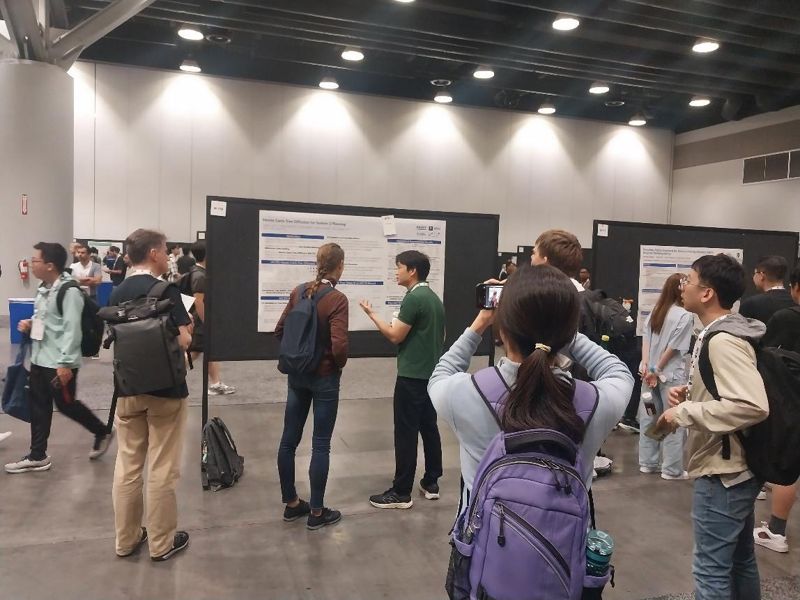
[Financial News] A new technology capable of high-performance, high-efficiency inference has been developed in the diffusion model actively used in artificial intelligence (AI) applications. This technology recorded a 100% success rate in a giant maze task that previous models never succeeded in. It is expected to be utilized as a core technology in various fields requiring real-time decision-making, such as intelligent robots and real-time generative AI.
KAIST (Korea Advanced Institute of Science and Technology) announced on the 20th that the research team led by Professor An Sung-jin of the School of Computing, in collaboration with Professor Yoshua Bengio of the University of Montreal, a world-renowned scholar in the field of deep learning, has developed a new technology that significantly improves the inference-time scalability of AI diffusion models. This research was conducted as part of a collaboration through the KAIST-MILA (Montreal Institute for Learning Algorithms) Prefrontal AI Joint Research Center.
This technology is attracting attention as a core AI technology that helps solve complex problems that cannot be solved by simply increasing data or model size by efficiently utilizing more computational resources in the inference stage after AI learning. However, there was a limitation in that the methodology to effectively implement such scaling was lacking in the diffusion models currently used in various application fields.
In response, Professor An's research team, in collaboration with Professor Bengio, proposed a new diffusion model inference technique based on Monte Carlo Tree Search.
This method is designed to efficiently find high-quality outputs with limited computational resources by exploring various generation paths in a tree structure during the diffusion process. Through this, it achieved a 100% success rate in the 'giant-scale maze finding' task, where existing methods showed a 0% success rate.
In subsequent research, they successfully developed a method to significantly improve the slow speed issue, a major drawback of the proposed methodology. By efficiently parallelizing tree search, they optimized costs and achieved results of equal or superior quality at speeds up to 100 times faster than previous methods.
Professor An Sung-jin stated, "This research fundamentally overcomes the limitations of existing diffusion models that required high-cost computation," adding, "It can be utilized as a core technology in various fields such as intelligent robots, simulation-based decision-making, and real-time generative AI."
The research results were presented as a Spotlight paper (top 2.6% of all accepted papers) at the 42nd International Conference on Machine Learning (ICML 2025) held in Vancouver, Canada, from July 13 to 19, with doctoral candidate Yun Jae-sik as the first author.
jiany@fnnews.com Reporter Yeon Ji-an