Korea, Even with Good Negotiations with Trump, Likely to Face Tariffs of 15∼18%
- Input
- 2025-07-18 08:35:14
- Updated
- 2025-07-18 08:35:14
Michael Beeman, Former Deputy USTR, Points Out "Trump's Goal is to Readjust Trade with Significantly Higher Tariffs"
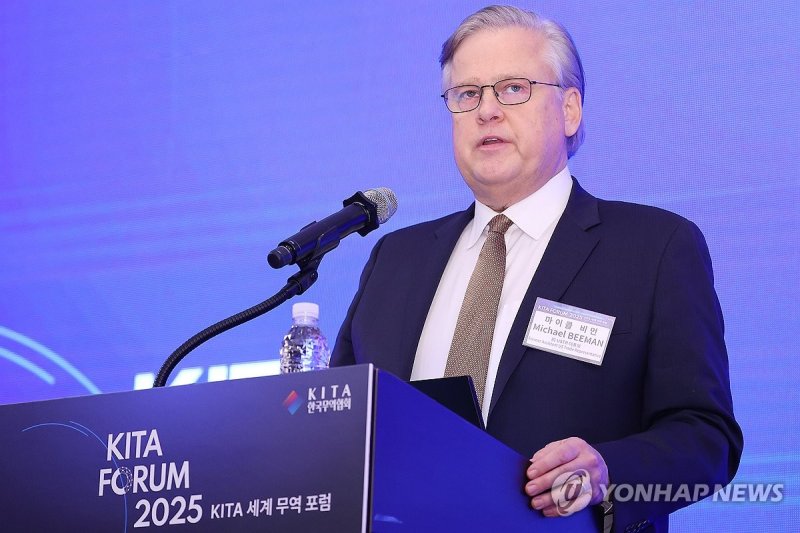
[Financial News] Donald Trump, President of the United States, is aiming to establish high tariffs as a new trade norm, making it difficult for Korea to avoid double-digit tariff rates despite efforts.
During the first Trump administration, Michael Beeman, former Deputy USTR, who negotiated trade with Korea, stated on the 17th (local time) on a KEI podcast that "If (Korea and the U.S.) reach an agreement that President Trump considers successful, (Korea's) tariffs are likely to be around 15∼18%."
He said, "That's just the average tariff rate. I think Korea might be able to ease some conditions on tariffs for cars, steel, and other (items), but even so, it would be a very large tariff."
President Trump has notified that unless the U.S. reaches a satisfactory trade agreement, a 25% reciprocal tariff will be imposed on Korea starting August 1. Beeman predicted that even with good negotiations, Korea might only be able to lower the average tariff to 15∼18%.
Beeman also mentioned that Japan and the European Union (EU) are in a similar situation as Korea, predicting that "somewhere between 10% and 20% will likely be the average tariff."
He stated, "This is clearly the world President Trump is trying to create, and I think (other) countries are just beginning to accept that reality."
He diagnosed that President Trump's "ultimate goal is to reset the conditions under which the U.S. trades with the world," and those conditions are "significantly higher tariffs."
He explained that President Trump's approach to trade is "zero-sum," meaning "the world gives and the U.S. receives."
Additionally, he interpreted that President Trump does not consider the "overall relationship" with other countries important, which is why he treats Korea the same as other countries in terms of tariffs.
Beeman diagnosed that the Trump administration is trying to "minimize tariff exemptions as much as possible" in terms of item-specific tariffs.
However, he also predicted that some countries might be able to ease certain aspects of item-specific tariffs, and if they secure such easements, they could gain an advantage over other countries exporting the same items to the U.S.
However, he warned that to ease item-specific tariffs, "a significant concession must be made."
Using the automotive industry as an example, he suggested that Korea could persuade the U.S. by implementing a voluntary export restraint (VER) on exports to the U.S. or by reducing tariffs on exports to the U.S. if cars are manufactured in the U.S. and exported to Korea.
june@fnnews.com Lee Seok-woo Reporter