US Tesla Faces Double Trouble with Trump Restraints and Sluggish Sales
- Input
- 2025-07-17 17:39:11
- Updated
- 2025-07-17 17:39:11
The crisis faced by Tesla, which had benefited from government subsidies and carbon credit trading
Political controversies surrounding Elon Musk also pose risks to the company
Currently, not only new cars but also used cars are experiencing sluggish sales
Political controversies surrounding Elon Musk also pose risks to the company
Currently, not only new cars but also used cars are experiencing sluggish sales

[Financial News] American electric vehicle company Tesla is facing double trouble as it is shaken by subsidy cuts and friction with the Donald Trump administration, with consumers also turning their backs. In particular, Tesla, which had a high dependency on government subsidies, is in an even more unstable position due to the political actions of CEO Elon Musk.
On the 17th (local time), British media Sky News reported on the new budget plan of the Trump administration, stating "Tesla is facing a loss of billions of dollars in government subsidies." Donald Trump, the President of the United States, signed the 2025 budget adjustment bill, known as the 'One Big Beautiful Bill Act (OBBBA)', on the 4th. The bill includes reducing the penalty for violating the US federal fuel efficiency standards (CAFE) to '0 dollars'. CAFE requires car manufacturers to achieve a certain level of average fuel efficiency for environmental protection, and those who fail to meet the standards must pay fines or purchase carbon credits. Tesla, which produces electric vehicles with no carbon emissions, has made significant revenue by selling surplus carbon credits to internal combustion engine car companies. The Trump administration's move is expected to be a fatal blow that will evaporate a significant portion of Tesla's income.
Moreover, OBBBA includes the early termination of subsidies for the purchase of new and used electric vehicles promised by the previous Joe Biden administration. Sky News emphasized that government subsidies played a key role in Tesla's growth from a startup to the world's largest electric vehicle manufacturer in less than 20 years.

Earlier this year, Trump, who was close to Musk, officially parted ways with him as he pushed for OBBBA. Musk, who had advocated for government budget cuts, openly criticized the tax cuts and spending increases included in OBBBA and announced plans to establish an independent political party. In response, Trump publicly expressed his disapproval, saying "Musk should close his shop and return to South Africa without subsidies."
Sky News pointed out, "Tesla earned $595 million (approximately 828.775 billion won) from carbon credits in the first quarter of this year, which is more than the net profit of $499 million (approximately 695.057 billion won), and without subsidies, Tesla would have been operating at a loss."
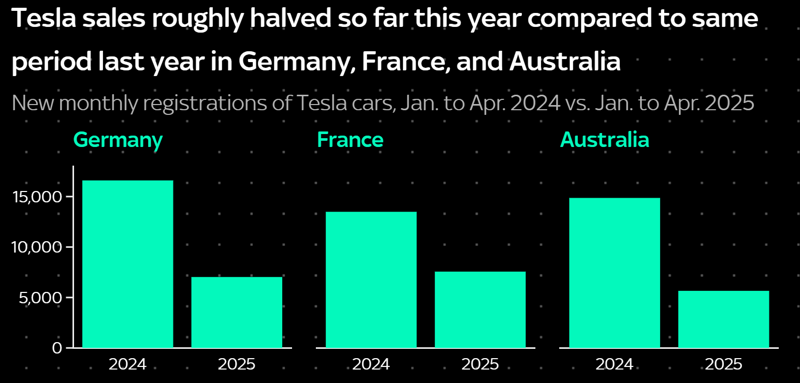
Additionally, Sky News diagnosed that Tesla is losing popularity not only with the government but also with consumers for various reasons. The media explained, "Due to consumer boycotts caused by Musk's past support for Trump, sales have decreased in markets outside the US." According to the report, Tesla's sales from January to April 2025 decreased by 58% in Germany, 44% in France, and 62% in Australia compared to the previous year.
On the 16th, the American economic magazine Fortune pointed out that Tesla's sluggish sales are not limited to new cars. Karl Brauer, chief analyst at the US used car trading platform iSeeCars, emphasized through Fortune, "Electric vehicles play an important role in both the new and used car markets." He added, "However, that role will not reach the level that governments and electric vehicle supporters around the world have previously promoted." Brauer stated, "The demand for electric vehicles has already peaked when considering market share and pricing, and it is likely to decline in the coming years."
In fact, according to Fortune, the price of the Tesla Model S last month fell by 15.8% compared to the same period last year. During the same period, the price of the Model X fell by 15.5%, and the price of the Model Y fell by 13.6%, with these price drops occurring around the time when incentives for purchasing used electric vehicles ended.
Sky News reported, "Some investors are expressing concerns about Tesla's recent performance as a combination of intensified market competition, withdrawal of government subsidies, and hostility from Trump and potential customers."
whywani@fnnews.com Hong Chaewan Reporter