The Opposition Party, Declaring Itself a 'Policy-Oriented Party', Launches 'Real Estate TF' to Face Challenges
- Input
- 2025-07-14 16:35:21
- Updated
- 2025-07-14 16:35:21
On the 14th, the first meeting of 'Real Estate TF', chaired by Kwon Young-jin
Attention on whether they can move beyond 'opposition for opposition's sake'
Attention on whether they can move beyond 'opposition for opposition's sake'
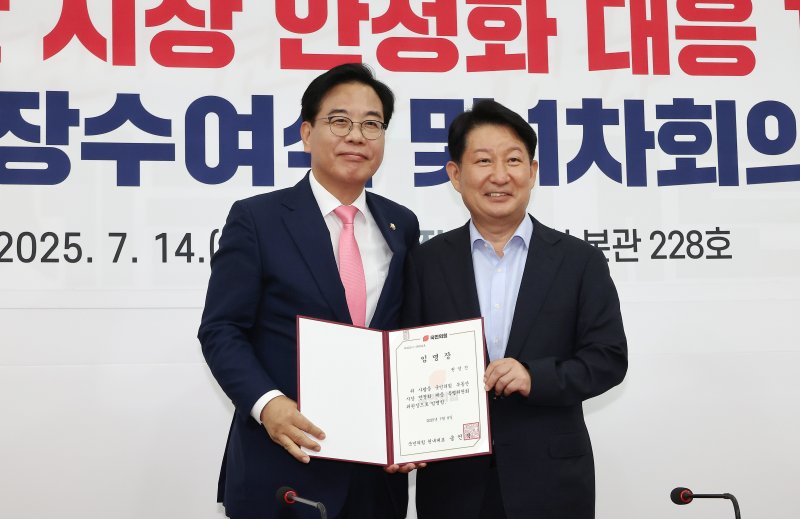
[Financial News] The People Power Party has officially launched the 'Real Estate Market Stabilization Response Task Force (TF)' and intensified its criticism of the Lee Jae-myung government's 6·27 loan regulation. While criticizing the government's 600 million won limit on housing mortgage loans as an anti-consumer and anti-market policy, they also argued for the need for financial support for real demand and expansion of housing supply. To transform into a 'policy-oriented party' beyond 'opposition for opposition's sake', it seems necessary to prepare effective alternatives.
The People Power Party held an appointment ceremony and the first meeting of the real estate TF at the National Assembly on the 14th. Kwon Young-jin, the chairman of the National Assembly's Land, Infrastructure and Transport Committee, was appointed as the chairman.
The People Power Party criticized the government's restriction of capital region housing loans to within 600 million won as an 'anti-consumer policy'. Interim leader and floor leader Song Eon-seok criticized at the meeting, "The average apartment sale price in Seoul exceeds 1.3 billion won," and "Limiting the loan limit to 600 million won is a notice to real demanders not to even dream of owning a home."
They also pointed out that as the 'ladder to home ownership' narrows, ordinary people are being driven to the rental market. TF Chairman Kwon Young-jin pointed out, "Real demanders cannot buy a house and are pushed into the rental market, and tenants who cannot get a loan for a deposit are driven into expensive monthly rents," adding, "It doesn't control the house prices but only targets innocent young people."
There was also criticism that the government's strong regulations do not apply to foreigners, leading to 'reverse discrimination against nationals'. Kim Jeong-jae, the policy committee chairperson, criticized, "They are implementing lenient policies on real estate cash shopping by foreigners, including Chinese," and "In short, it's reverse discrimination against nationals."
As interim leader Song recently declared to transform into a 'policy-oriented party', it seems crucial to prepare effective measures. The TF plans to discuss ways to provide financial support for real demand and expand the supply of quality housing. Chairman Kwon emphasized the need for a 'two-track strategy', pointing out the 'polarization of the housing market' between the capital region and non-capital regions. He argued that 'innovative supply measures and speculative demand suppression measures' are needed in the capital region where demand is concentrated, and that drastic tax support and financial policies should be pursued to solve the problem of unsold housing in the provinces. Additionally, they proposed △improving infrastructure to attract local population △promoting social overhead capital (SOC) development as measures.
The TF plans to hold three forums starting on the 30th to discuss regulations on foreign purchases and solutions for regional imbalances and prepare specific alternatives. They announced that specific legislative matters will continue to be discussed at the National Assembly's Political Affairs Committee, Land, Infrastructure and Transport Committee, and Planning and Finance Committee.
haeram@fnnews.com Lee Haeram Reporter