Greece Bans Daytime Food Delivery.. Vietnam Engages in Night Farming to Avoid Heat
- Input
- 2025-07-13 18:48:07
- Updated
- 2025-07-13 18:48:07
The World is at War with Heatwaves… World Meteorological Organization Warns "Situation Will Worsen"
June's Global Average Temperature Third Highest on Record
WMO "We Must Learn to Live with the Heat"
Cooling Demand in China and India Up 31% and 19% Year-on-Year
More People in the US Carrying Hand Fans
International Organizations Predict Negative Impact on Labor Market
"Annual Productivity Loss of 3,229 Trillion by 2030"
June's Global Average Temperature Third Highest on Record
WMO "We Must Learn to Live with the Heat"
Cooling Demand in China and India Up 31% and 19% Year-on-Year
More People in the US Carrying Hand Fans
International Organizations Predict Negative Impact on Labor Market
"Annual Productivity Loss of 3,229 Trillion by 2030"
■"Heatwaves are the New Normal"…Could Get Worse
Antonio Guterres, the UN Secretary-General, stated on social media on the 30th of last month that "heatwaves are no longer rare and have become the new normal. The Earth is getting hotter and more dangerous, and no country is immune." Claire Nullis, spokesperson for the World Meteorological Organization (WMO) under the UN, warned in a briefing on the 1st that "we must learn to live with heatwaves" and that "the current situation may continue or worsen."
John Marsham, a professor of climate science at the University of Leeds in the UK, emphasized through Deutsche Welle on the 9th that the recent heatwave in Europe is clearly due to climate change. He argued that "one of the clear results of climate change is extreme weather events, which are particularly evident in heatwaves and high temperatures."
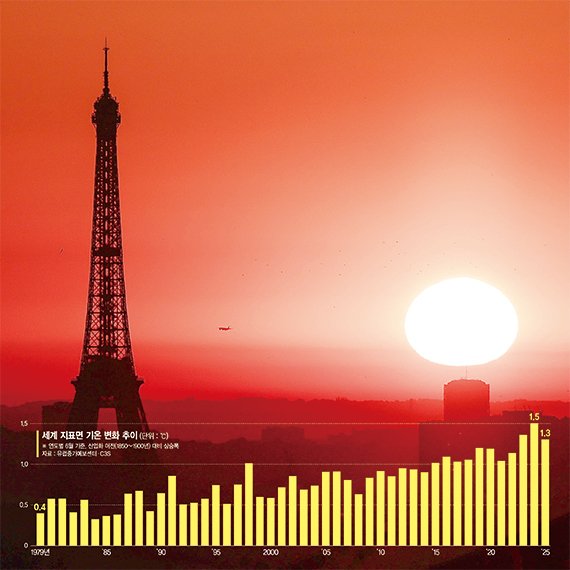
About 60 scientists involved in the international research project 'Indicators of Global Climate Change (IGCC)' warned in an annual report published in the international journal Earth System Science Data (ESSD) on the 19th of last month that humanity has little time left to control the Earth's temperature. According to the report, last year's Earth's surface temperature was 1.52 degrees Celsius higher than pre-industrial levels (1850-1900), with 1.36 degrees of that increase due to human activity.
Previously, 195 countries around the world promised through the Paris Climate Agreement (COP21) in 2015 to keep the long-term increase in global average temperature within 1.5 degrees compared to pre-industrial levels. Scientists have assessed that the amount of carbon dioxide that can be emitted while achieving the 1.5-degree target is decreasing, and that it will be difficult to achieve the target in three years.
■Cooling Equipment Popular…Outdoor Activities Decrease and Deliveries Increase
The World Economic Forum (WEF·Davos Forum), an international non-profit organization, argued on its website in March that heatwaves are changing the way people live and work around the world. The British energy think tank Ember reported in the same month that cooling demand in the US increased by 37% when comparing the period from April to September 2023 with the same period the following year. During the same period, cooling electricity demand in China and India also increased by 31% and 19%, respectively. The International Energy Agency (IEA) predicted that the number of air conditioners worldwide, which was about 1.76 billion units in 2018, will increase to 5.58 billion units by 2050.
Last August, the New York Times (NYT) reported that due to the heatwave, personal mini fans, which were popular in Asia, are also gaining popularity in the US. The WEF predicted that the personal fan market, which was worth $550 million worldwide last year, will grow to $1.06 billion (about 1.4578 trillion won) by 2033.
In response, the British medical journal The Lancet analyzed that if the surrounding temperature exceeds 35 degrees, it is difficult to expect a drop in body temperature even when using a fan, and it is better to go to a cool place. The Massachusetts Institute of Technology (MIT) diagnosed in a 2023 report that when the temperature rises to 30 degrees and 35 degrees, the population going to outdoor parks decreases by 5% and 13%, respectively.
Movement restrictions due to heatwaves could lead to a boom in the delivery industry similar to the period of the COVID-19 pandemic. The international journal Nature claimed in an article last January that it observed 100 cities in China between 2017 and 2023 and found that as temperatures rise, more people order lunch for delivery. The number of lunch deliveries increased by 12.6% when the temperature rose from 20 degrees to 35 degrees. When the temperature reached 40 degrees, it increased by 21.4%.
■Working Hours Shift from Day to Night
Delivery workers are not entirely happy even if there is more work. The Greek government ordered on the 7th that outdoor physical labor and food delivery be completely halted from noon to 5 PM as daytime temperatures hovered around 40 degrees. The WEF predicted in a white paper published in January that productivity losses due to heatwaves, including deteriorating worker health, are expected worldwide, with the scale estimated at $2.4 trillion (about 3,299 trillion won) annually by 2030. According to 2023 statistics from the US Department of Labor, about 40 workers die each year in the US due to heat.
The International Labour Organization (ILO) emphasized in a 2019 publication that workers in agriculture and construction are particularly vulnerable to heatwaves. The ILO predicted that 60% of the lost working hours due to heatwaves in 2030 will occur in agriculture, where about 940 million people are employed worldwide. It is also estimated that the lost working hours in construction will account for 19% of all industries.
Agricultural workers are already changing their working hours. In July 2021, the United Farm Workers (UFW) announced that cherry farm workers in Washington state were working from 3 AM with headlamps to avoid the heat. In agricultural countries like Vietnam, night work relying on lights to plant rice has been popular for several years.
Other industries also urgently need measures against heatwaves. The Trades Union Congress (TUC) in the UK urged employers in a statement last month to relax dress codes for workers and operate flexible working hours. The Greek government recommended on the 7th that employers allow employees to work from home.
pjw@fnnews.com Jongwon Park