Trump Raises Pressure with 30% Tariff on EU and Mexican Imports Starting Next Month
- Input
- 2025-07-13 16:13:51
- Updated
- 2025-07-13 16:13:51
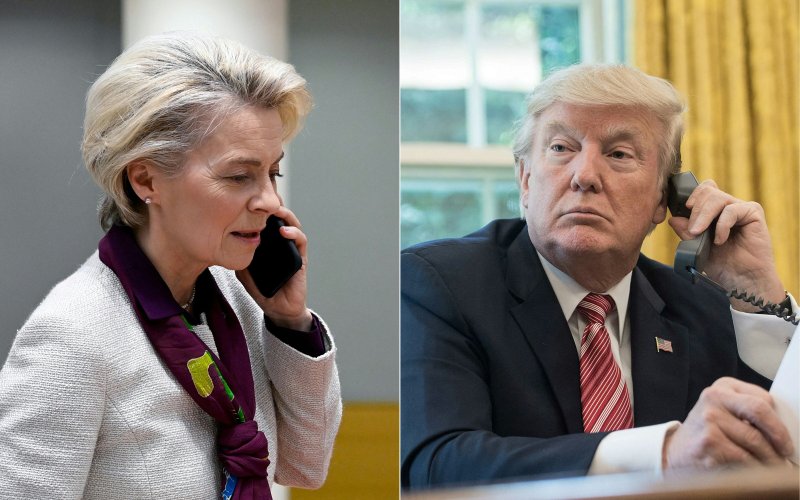
[Financial News] Donald Trump, President of the United States, announced that starting from the 1st of next month, tariffs on imports from the European Union (EU) and Mexico will be raised to 30%, increasing pressure for last-minute negotiations.
According to foreign media such as the Wall Street Journal (WSJ) on the 12th (local time), President Trump mentioned the tariff increase on EU and Mexican imports in a letter released via social media platform Truth Social, stating that if demands related to trade with Europe and drug trafficking control with Mexico are met, the tariffs could be lowered.
The mentioned 30% tariff replaces the existing 10% universal tariff and is lower than the previously threatened maximum of 50% against the EU.
The tariff on Mexican products will be raised from the initially announced 25% to 30%.
President Trump emphasized that the trade deficit is a threat to our economy and national security regarding this tariff increase.
He also pressured that if the EU completely opens its market to U.S. goods without tariffs, the U.S. could consider reducing tariffs on EU imports.
In the letter to Mexico, he acknowledged that Mexico has been cooperating well with border closures but pointed out that it is still insufficient and that drug trafficking organizations are not being stopped.
The EU and Mexico are major trading partners of the United States. According to the U.S. Trade Representative (USTR), last year's mutual trade between the U.S. and the EU was $975.9 billion (approximately 1,344 trillion won), and the U.S.-Mexico trade volume was $840 billion (approximately 1,157 trillion won).
Ursula von der Leyen, President of the European Commission, stated that she is ready to negotiate with the United States by the 1st of next month but also said, "At the same time, we will mobilize countermeasures (retaliatory tariffs) if necessary to protect the EU's interests."
The EU has already approved a plan to impose tariffs on $21 billion (approximately 34 trillion won) worth of U.S. products and is prepared to expand it to $95 billion (approximately 153 trillion won) if necessary.
Europe has pointed out that the difficulties in negotiations with the U.S. are due to structural differences between the two economies rather than trade barriers and that the U.S. is ignoring the surplus it records in the services sector.
President von der Leyen emphasized, "There is no place in the world economy as open and fair in trade practices as the EU."
Meanwhile, German car manufacturers are most nervous about the U.S.'s announcement of a 30% tariff.
Yahoo Finance reported that both Mercedes-Benz and Porsche rely on the U.S. market for about 25% of their sales and are concerned about the decline.
In April, President Trump announced a 2% tariff on all imported cars.
Unlike Mercedes-Benz, which operates a large factory in Alabama, USA, Porsche produces all its vehicles in Germany and other EU countries, which means it will have no choice but to pass on the burden of price increases due to tariffs to consumers, said Oliver Blume, CEO. The background to this tariff increase lies in the U.S. trade deficit.
jjyoon@fnnews.com Jaejun Yoon, Reporter