LCC International Passenger Numbers Surpass Major Airlines for 3 Consecutive Years
- Input
- 2025-07-13 07:50:57
- Updated
- 2025-07-13 07:50:57
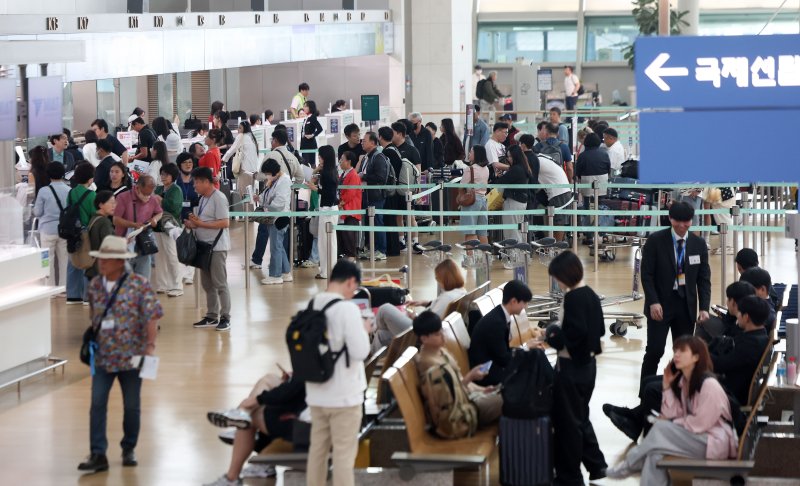

[Financial News] In the first half of this year, the number of international passengers on domestic low-cost carriers (LCC) surpassed that of major airlines (FSC) such as Korean Air and Asiana Airlines, as well as foreign airlines. This marks the third consecutive year of dominance since 2023.
Due to the impact of accidents at the end of last year and the beginning of this year, Jeju Air and Air Busan saw a decrease in passengers. However, other LCCs like Eastar Jet and Jin Air saw an increase in passengers.
According to aviation statistics from the Ministry of Land, Infrastructure and Transport on the 13th, the total number of international passengers at domestic airports (combined departures and arrivals) from January to June this year was 45,829,686. Among them, the number of international passengers on eight domestic LCCs was 15,781,630 (34.4%).
This is about 120,000 more than the 15,656,395 international passengers of major airlines, which include Korean Air (9,474,488) and Asiana Airlines (6,181,907), accounting for 34.2%. It also exceeds foreign airlines (14,391,661, 31.4%) by nearly 1.4 million.
The number of LCC international passengers in the first half of the year has shown dominance for three consecutive years since 2023, when they first surpassed major airlines. LCCs have significantly increased passenger numbers by focusing on short- and medium-haul routes with high tourism demand, such as Japan and Southeast Asia, following the endemic transition after 2023.
However, the gap in market share between LCCs and major airlines narrowed from 2.6%p (35.7% and 33.1%) in the first half of last year to 0.2%p in the first half of this year. While the number of major airline passengers increased by nearly 1.5 million in a year, the number of LCC passengers increased by only 520,000 due to the impact of accidents involving Jeju Air and Air Busan.
Jeju Air had 3.59 million passengers in the first half of this year, a decrease of 730,000 (16.9%) compared to 4.32 million in the first half of last year. Jeju Air reduced flights to enhance operational safety after the accident, resulting in a more than 10% decrease in the number of seats supplied in the first half of the year.
Jeju Air maintained its position as the number one domestic LCC in terms of passengers, ahead of Jin Air (3.47 million) and T'way Air (3.38 million).
Air Busan's passengers from January to June this year were approximately 2.05 million, a decrease of 130,000 (5.9%) compared to 2.18 million in the first half of last year. This is attributed to the reduction in operations in January and February, when demand for flights was high, due to a fire on a passenger plane in January.
Air Seoul also had 880,000 passengers in the first half of the year, a decrease of 4.7% (43,000) compared to the same period last year. This is believed to be due to issues with maintenance and operation of some aircraft, leading to the suspension of flights from Incheon to Tokyo, Da Nang, Fukuoka, Bohol, and other routes from late May to early this month.
LCCs that introduced new aircraft or launched new routes and increased flights saw an increase in international passengers. Eastar Jet, which showed the largest increase, saw its passengers increase from 740,000 to 1.35 million, an increase of 81.2% in one year. After bringing in four new aircraft since the second half of last year and launching multiple routes such as Incheon-Tokushima, Almaty, and Busan-Chiang Mai, the number of passengers increased significantly.
Jin Air increased by 340,000 (11%), Aero K by 570,000 (58.8%), and T'way Air by 180,000 (5.8%).
ggg@fnnews.com Kang Gugu Reporter