Delayed Organizational Restructuring Plan... Concerns About Hindering New Government's Task Achievement
- Input
- 2025-07-13 13:59:21
- Updated
- 2025-07-13 13:59:21
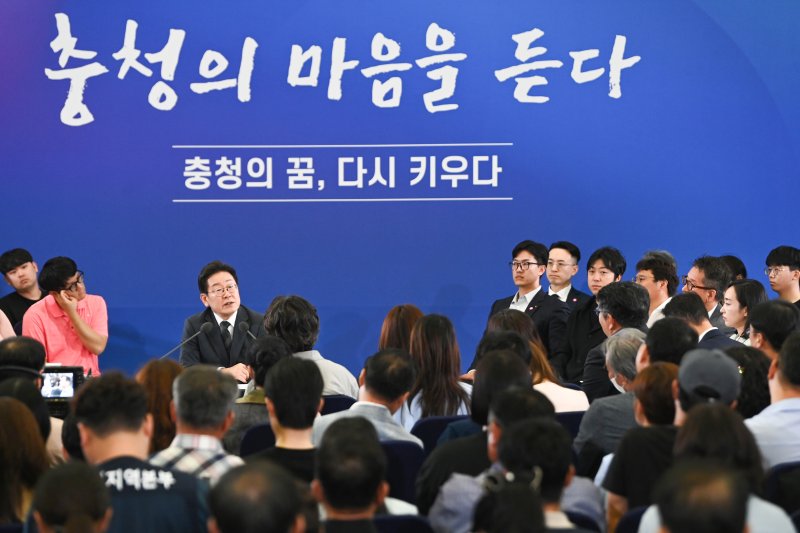
[Financial News] As the new government enters the final coordination stage for government organizational restructuring, concerns are growing within the financial sector regarding the direction of the financial authorities' organizational restructuring. With financial issues such as household debt, debt adjustment, stablecoin regulation, and the eradication of unfair trade piling up, it is pointed out that the dismantling of organizations and separation of functions may hinder a swift and systematic response to realize President Lee Jae-myung's national policy. There are also significant differences of opinion within the National Planning Committee, drawing attention to the final direction.
According to the financial sector on the 13th, the National Planning Committee is finalizing the government organizational restructuring plan, including the Financial Services Commission.
Cho Seung-rae, spokesperson for the National Planning Committee, stated in a regular briefing on the 11th, "We are having specific consultations among the divisions, ministries, presidential office, prime minister's office, and related agencies," and "We are now almost at the stage of finalizing it."
The new government's organizational restructuring aims to separate the budget organization from the Ministry of Strategy and Finance and divide it into the Planning and Budget Office and the Ministry of Economy and Finance.
The National Planning Committee has been promoting a plan to transfer the 'Financial Industry Policy' handled by the Financial Services Commission to the Ministry of Strategy and Finance, and to establish a 'Financial Supervisory Commission' so that the Financial Services Commission focuses solely on financial supervision functions. This essentially means the Financial Services Commission will be dismantled.
Additionally, there is a plan under review to separate the Consumer Protection Department within the Financial Supervisory Service and establish a 'Financial Consumer Protection Agency' (FCPA).
Regarding this restructuring direction, both inside and outside the financial sector, there is a consensus that it may not be beneficial for achieving the new government's national tasks of economic growth and crisis response.
A financial sector official said, "To achieve the new government's core national goal of a '3% potential growth rate', the role of finance is very important given the limitations of government finances," and "The current organizational restructuring being discussed may conflict with efficiently achieving this goal." Another financial sector official expressed concern, "Issues like debt adjustment could become ambiguous as to which department is in charge under the current direction of organizational restructuring."
There are also concerns that rapid crisis response may become difficult as financial risks such as household debt are increasing. The 2003 credit card crisis, when the actual delinquency rate of card companies reached 28.3% and the number of credit delinquents surged to 4 million, is a representative case.
According to the report 'The Role of Public Institutions Related to Financial Stability and Financial Systems' by Professor Kim Hong-beom of Gyeongsang National University's Department of Economics, published by the Financial Economics Research Institute under the Bank of Korea in January 2004, despite detecting household insolvency risks in early 2001, the government, particularly the Ministry of Finance and Economy, neglected the card issue due to its domestic demand stimulus policy, exacerbating the insolvency.
The report pointed out, "The biggest problem of the Ministry of Finance and Economy is that it has not maintained an appropriate distance from the Financial Supervisory Commission or the Bank of Korea and has deeply intervened in their daily policy operations." It specifically criticized that despite various side effects such as card company insolvency, rapid increase in household debt, proliferation of credit delinquents, rising delinquency rates, and real estate overheating, the Ministry of Finance and Economy's excessive push for domestic demand stimulus effectively restricted the perspectives and actions of supervisory authorities and the Bank of Korea.
Separating the Consumer Protection Department within the Financial Supervisory Service to establish a Financial Consumer Protection Agency is also raising concerns that it may not only make rapid response to consumer damage difficult but also lead to overlapping responsibilities and avoidance of accountability.
The labor union of the Financial Supervisory Service issued a statement on the 11th, arguing, "If the Consumer Protection Department is separated, when consumer damage occurs due to incomplete sales of large financial products or financial accidents, supervisory resources will be dispersed and accountability will become ambiguous, making rapid damage relief difficult." They further argued that instead of separating the Consumer Protection Department, its authority should be significantly increased by granting it inspection rights and expanding its supervisory scope to strengthen consumer protection functions.
sjmary@fnnews.com Seo Hye-jin Reporter